Why Am I So Tired After Golf?
Written by Paula, RCMM Operations & Content Lead
Originally published: 11 May 2026
Last updated: 28 August 2026
Golf has a funny reputation.
You walk for a bit. Stop. Hit a ball. Walk again. Have a chat. Repeat.
It does not necessarily feel like a hard workout while you are doing it, which can make it surprising when you get home after 18 holes and suddenly realise how tired you are.
But a round of golf can add up to several hours on your feet, thousands of steps, repeated swings and a fair amount of concentration.
Feeling tired afterwards is not particularly mysterious. Your body has simply done more work than the stop-start nature of golf sometimes makes obvious.

Summary
An 18-hole round of golf can involve several hours of physical activity.
Research suggests that walking a course can add up to roughly 11,000–16,000 steps across around 4–8 miles, although the actual amount depends on the course, the golfer and whether you walk or use transport.
The swings are only one part of the workload. Time on your feet, hills and terrain, carrying or pushing equipment, repeated practice and full swings, weather and several hours of concentration can all contribute to how tired you feel afterwards.
Being tired after golf does not automatically mean you are unfit or that anything is wrong.
The amount of golf you are currently used to matters too.
Educational Note
This article is for general education and does not provide medical advice or a diagnosis.
Tiredness after several hours of activity is one thing. Fatigue that feels unusual or disproportionate, keeps happening without an obvious reason, or comes with symptoms such as fainting, chest pain, unusual breathlessness or feeling generally unwell should not simply be put down to golf.
Golf Adds Up More Than You Might Think
One of the easiest things to underestimate about golf is simply how long you are doing it for.
A recent review of golf research describes an 18-hole round as commonly lasting around four to six hours.
You are obviously not exercising hard for every minute of that time. There are periods of standing, waiting and talking between shots.
But you are still repeatedly:
walking
standing
bending to pick things up
taking practice swings
swinging the club
moving over hills and uneven ground
pushing or carrying equipment
getting in and out of bunkers or rough
concentrating on what you are doing
None of those things individually sounds enormous.
Put them together for several hours and they become a meaningful amount of activity.
If golf repeatedly leaves an area feeling more worked than you expect, our Sports Injury and Sports Recovery page explains how RCMM approaches concerns that show up during or after the activities people enjoy.
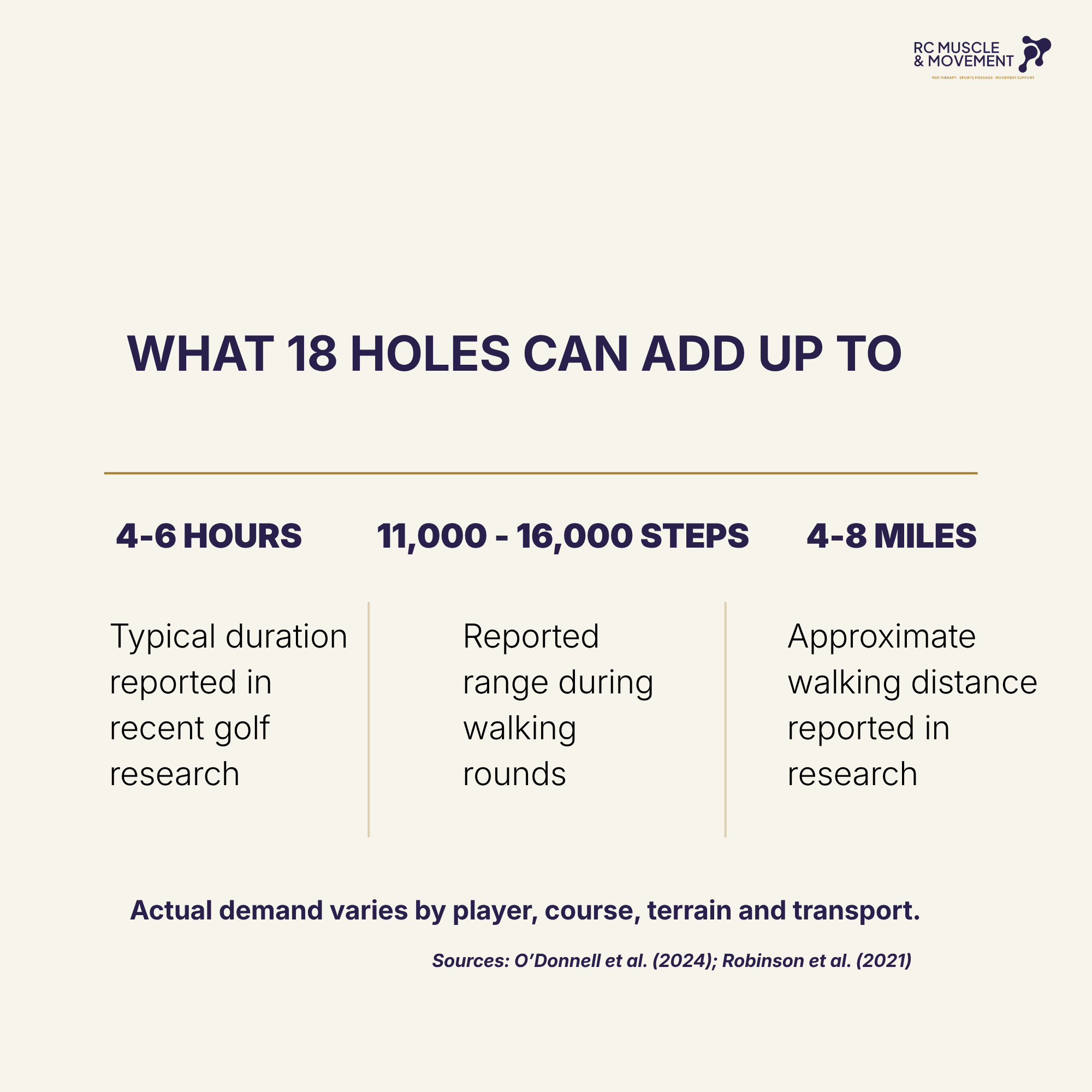
What Can 18 Holes Actually Add Up To?
Studies vary because golf courses, players and methods of getting around are different.
But the overall picture is useful.
These figures come from published golf research rather than one single study (What 18 holes can add up to graphic), so they shouldn’t be read as a fixed description of every round. Course length, terrain, whether someone walks or uses transport, pace of play and the individual golfer can all change the physical demand.
What the research does show consistently is that an 18-hole round can involve several hours of activity and a substantial amount of walking — far more physical work than the golf swing alone might suggest.
These are not targets you need to hit, and they are not predictions of exactly what your smartwatch should show.
They simply put the physical demand of a round into perspective.
Someone walking 18 holes is doing considerably more than taking 70, 80 or 100 golf swings.
Most of the round is happening between the shots.
Walking Is a Bigger Part of Golf Than the Swing
The golf swing gets most of the attention because it is the recognisable sporting action.
But research looking at the energy demands of golf suggests that walking between shots is a major contributor to the overall physical workload.
Think about what that means over 18 holes.
The course itself may be several miles long, but you rarely walk it in a perfectly straight line.
There is walking between tees and greens, finding balls, moving around greens, heading towards the next hole and occasionally discovering that your drive has taken a slightly more adventurous route than planned.
Add hills, soft ground or carrying a bag and the effort can change again.
That is also why two rounds of golf can feel completely different even if your score is similar.
A flat nine holes on a cool day is not physically identical to walking 18 holes over a hilly course in warm weather.
The Swings Still Count
Walking might make up much of the overall activity, but the swing is not free.
A golf swing asks the legs, hips, trunk, shoulders and arms to coordinate quickly.
You then repeat it.
And the number on your scorecard does not tell you the whole story.
There may also have been:
practice swings
warm-up swings
shots on the range beforehand
provisional balls
repeated putting practice
a few attempts you would rather were not included in the official record
Again, none of this means golf is secretly the same as an intense gym session.
It just means the muscular work should not be ignored because it happens in short bursts.
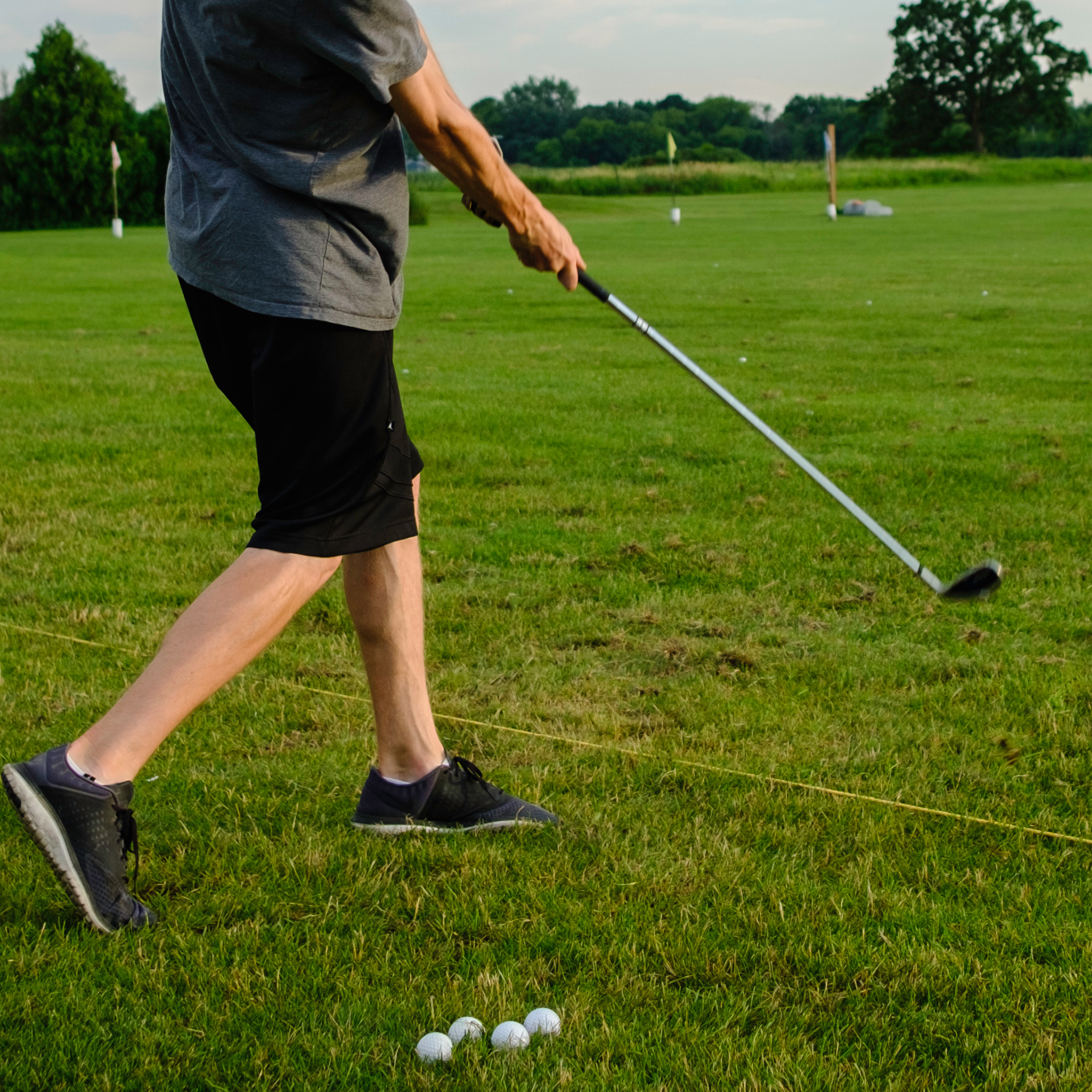
Golf Swings Makes Lot of Muscles Work Together
You might not realise the load and effort your body has been put through until the next day
Why Can Golf Feel Harder After Time Away?
This is where the answer becomes less about golf itself and more about what your body is currently used to doing.
Someone who walks and plays several times every week may find an ordinary round fairly comfortable.
The same round can feel very different if you:
have not played for a few months
suddenly move from nine holes to 18
play several rounds close together
spend more time at the driving range than usual
choose a much hillier course
carry your clubs when you usually use a trolley
have had a generally tiring week before you even reach the first tee
Your current capacity is influenced by what you have been doing recently.
That is why doing more than usual can sometimes leave you surprisingly tired or sore even when the activity itself is completely normal.
We've explored that idea more generally in Why Am I Sore After Trying a New Sport or Fitness Class?.
Golf Can Be Mentally Tiring Too
There is also another part of the round that your step counter cannot see.
Golf involves concentration.
You are repeatedly making decisions about distance, club choice, wind, terrain, shot selection and where you want the ball to go.
Then you have to execute the shot.
Then do it again.
Research into mental fatigue in golf is still developing, so it would be too strong to claim that concentration explains why every golfer feels exhausted after a round.
But studies do suggest that prolonged golf tasks can contribute to mental fatigue.
That probably matches something many golfers already recognise:
Sometimes your head feels as done as your legs by the 18th.
Do Food and Hydration Matter?
Potentially — particularly because golf can last several hours.
A 2024 review of golf nutrition research found evidence suggesting that hydration and energy availability can influence fatigue and aspects of golf performance.
But there is an important limitation.
Golf-specific nutrition research is still relatively small, and much of it has been carried out in small groups of male or competitive golfers.
So there is no need to turn an ordinary Saturday round into an elite sports-nutrition protocol.
For most recreational golfers, the basics are fairly unglamorous:
arrive having eaten normally
take something to drink
consider bringing food if you are going to be out for several hours
pay more attention to fluids when the weather is warm
notice what leaves you feeling good rather than blindly copying somebody else's routine
You do not need a supplement stack to survive the back nine.
Does Feeling Tired After Golf Mean I Need to Get Fitter?
Not necessarily.
Tiredness is a normal consequence of doing something physically demanding enough for long enough.
Fitness influences how demanding a round feels, but so do:
how much golf you normally play
how far you walked
the terrain
the weather
whether you carried equipment
what else you have done that week
how well rested you were beforehand
Feeling tired after 18 holes is therefore not a particularly useful fitness test on its own.
A better question can be:
Is the amount of tiredness roughly what I would expect from what I did?
If you have just walked several miles over a hilly course for four or five hours, being ready to put your feet up afterwards is hardly surprising.

What Can Make a Round Feel More Manageable?
There does not need to be a complicated golf-specific routine.
Build your golf back up
If you have been away from the course, going straight into repeated 18-hole rounds gives your body a fairly large jump in workload.
Nine holes, the range or a less demanding round can be a useful way to ease back into it.
Remember the walking
If you know a course is long or hilly, the walking is part of what you are preparing for.
Regular everyday walking can therefore be relevant to golf even though it does not look like golf practice.
Eat and drink like you are going to be out for a while
Because you are.
There is no universal golf diet required, but several hours outside without anything to eat or drink may feel very different from arriving reasonably fed and having something available during the round.
Look at the whole week
Sometimes golf is not the only thing contributing.
Work, gym sessions, poor sleep, another sport or simply a busier-than-usual week can all sit alongside the round.
Bodies do not reset their workload counter when you step onto the first tee.
What If It Is Always the Same Area That Feels Worked After Golf?
General tiredness after a round is different from the same physical concern appearing every time you play.
Perhaps your back repeatedly becomes uncomfortable later in the round.
Maybe one shoulder starts bothering you.
Perhaps your calf or hip always seems to tighten after several holes.
That still does not automatically tell us why it is happening.
Rather than assuming one muscle is weak, tight or “out of place”, it can be more useful to look at what changed, when the problem appears, how you are currently moving and what other physical demands have been building up.
Our Gym, Training & Recreational Activity Support page is the main place to explore how RCMM approaches recurring concerns around golf, gym training and recreational sport.
If you already know you want an appointment, Sports Massage is RCMM's more treatment-focused option when something specific is affecting movement or activity.
Frequently Asked Questions
Is golf actually exercise?
Yes.
Research generally classifies golf as moderate-intensity physical activity, particularly when the course is walked.
How demanding it feels will still vary with the person, course, terrain, weather and how they move around it.
How far do you walk playing 18 holes?
There is no universal distance.
Published research has reported approximately 4–8 miles and around 11,000–16,000 steps during walking rounds.
The real figure can be higher or lower depending on the course and the route you actually take around it.
Why do my legs feel tired after golf?
Walking several miles and spending hours on your feet can be enough to leave your legs feeling worked, especially if that amount of walking is more than you normally do.
Hills, terrain and carrying or pushing equipment can change the demand too.
Why am I more tired after golf than the gym?
They are different types of physical demand.
A gym session may be harder for short periods but last an hour.
A round of golf is usually lower intensity but can continue for several hours.
One does not need to be “harder” than the other for both to leave you tired in different ways.
Why am I exhausted after golf when I use a buggy?
Walking is not the only demand.
You are still spending several hours outside, standing, repeatedly swinging and concentrating.
However, research comparing walking with golf-cart use does show substantially lower step counts and physical activity when players ride rather than walk.
If the tiredness feels far greater than the activity seems to explain, it is worth considering factors beyond golf rather than assuming the sport must be responsible.
The Simple Answer
Golf does not have to leave you gasping for breath to be physically demanding.
An 18-hole round can mean several hours of activity, thousands of steps, repeated swings and sustained concentration.
That can be plenty of work.
So if you finish a round, sit down and suddenly realise you are shattered, there may not be anything particularly mysterious going on.
Golf adds up.
And how much it adds up depends not only on the course, but on what your body was prepared for that day.
Professionally Reviewed by Ross Canning, Sports Therapist
Ross reviewed this article for accuracy, professional scope and practical relevance. RCMM’s educational content does not replace medical diagnosis or individual healthcare advice.
Related Articles and Support

Source Base Used
Sorbie GG, Beaumont AJ, Williams AK, Lavallee D. (2022). Golf and Physical Health: A Systematic Review. Sports Medicine.
O'Donnell A, Murray A, Nguyen A, et al. (2024). Nutrition and Golf Performance: A Systematic Scoping Review. Sports Medicine.
Robinson PG, Murray A, Close G, et al. (2021). Public health considerations regarding golf during the COVID-19 pandemic: a narrative review. BMJ Open Sport & Exercise Medicine.
Pan X, et al. (2025). Mental fatigue in golf: A systematic review.
The evidence base was used to establish the physical demands of golf, typical walking/step ranges, duration, energy demand and what can reasonably be said about fatigue, hydration and concentration.