Sciatica-Type Symptoms Are Not Always a Disc Problem
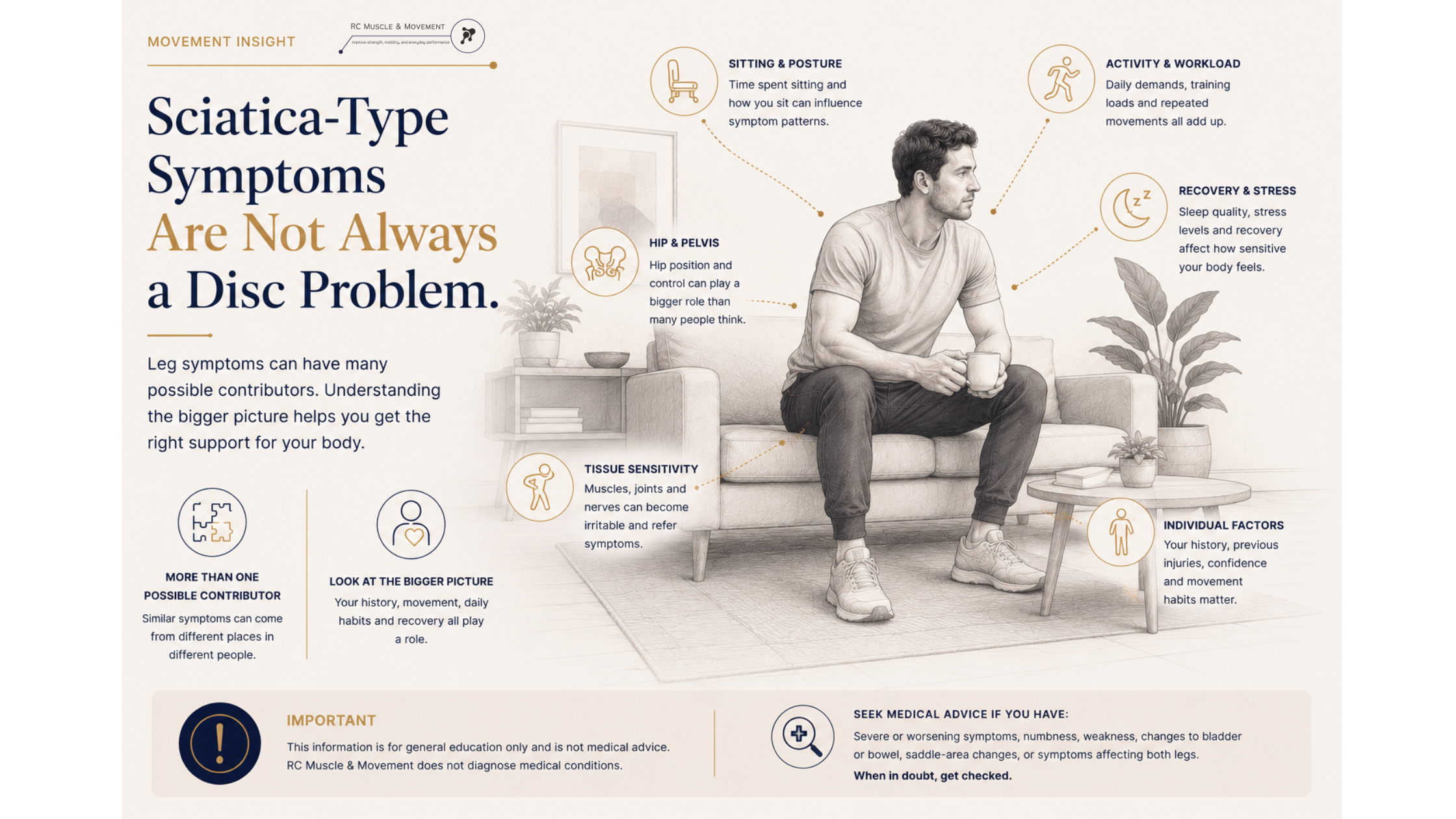
Sciatica-type symptoms do not always mean a disc problem. Symptoms that travel into the buttock, back of the thigh, calf or foot can be influenced by the lower back, hip, pelvis, deep gluteal area, sitting position, movement habits and nervous system sensitivity. A medical assessment is important if symptoms are severe, worsening, affecting both legs, or linked with changes in bladder, bowel or saddle sensation.
Educational Note
This article is for general education only.
It is not medical advice and it is not a diagnosis.
RC Muscle & Movement does not diagnose sciatica, nerve conditions, disc injuries or spinal conditions. We provide movement-focused assessment, hands-on soft-tissue support and practical guidance within our sports therapy scope.
If symptoms are severe, new, worsening, unexplained, affecting both legs, or linked with changes in bladder, bowel, saddle sensation, numbness or progressive weakness, seek appropriate medical advice urgently.
Why This Topic Needs Care
Leg symptoms can feel worrying.
When discomfort travels from the lower back or buttock into the hamstring, calf or foot, many people immediately think:
“Is this sciatica?”
And very often, the next thought is:
“Is it a disc?”
That worry is understandable.
The word sciatica is used a lot, but it is often used loosely. Some people use it to describe any discomfort that travels down the back of the leg. Others use it after being given a medical diagnosis. Others use it because they have heard the term before and it seems to match what they are feeling.
For that reason, this article uses the phrase sciatica-type symptoms.
That means symptoms that may feel like they follow a sciatic line, without assuming the cause.
This distinction matters.
Not every leg symptom is sciatica.
Not every sciatic-type symptom is caused by a disc.
And not every disc change seen on a scan explains how someone feels.
The aim here is not to diagnose the cause of leg symptoms.
The aim is to explain why the picture can be wider than “disc equals symptoms” and why a movement-first view can be helpful when symptoms are not urgent or medically concerning.
When To Get Medical Help First
Before talking about movement, sitting, hips or soft tissue, it is important to be clear about safety.
Seek urgent medical advice if symptoms include:
symptoms affecting both legs
severe or worsening weakness
numbness around the genitals, anus or saddle area
changes in bladder or bowel control
difficulty starting or controlling urination
loss of sensation when passing urine or bowel movements
symptoms after a serious accident
symptoms that are rapidly worsening
feeling generally unwell alongside back or leg symptoms
These are not situations for a sports massage appointment or a general movement review.
They need appropriate medical assessment.
You should also seek medical advice if symptoms are new, severe, spreading, not improving, or stopping you from doing normal daily activities.
Why “Sciatica” Is Not Always A Simple Label
Sciatica is commonly described as symptoms that travel along the path of the sciatic nerve.
That path can include:
lower back
buttock
back of the thigh
calf
foot
But symptoms in this region can come from different contributors.
Some may relate to the lower back.
Some may relate to nerve root irritation.
Some may relate to sensitivity around the deep gluteal area.
Some may relate to the hip, pelvis or surrounding soft tissues.
Some may be influenced by sitting, driving, repeated loading or movement habits.
This does not mean symptoms are imagined.
It means the body is more complex than a single label.
A travelling symptom tells us where something is being felt.
It does not automatically tell us why it is being felt.
That is why sciatica-type symptoms should be approached carefully, especially when someone has not had a medical diagnosis.
Disc Changes Can Be Part Of The Picture — But Not Always The Whole Picture
Disc problems can contribute to sciatica.
That is true.
A disc can irritate or compress a nerve root, and that can create symptoms down the leg.
But this is where the conversation often becomes too simple.
Many people hear “disc” and assume:
something is badly damaged
movement is dangerous
bending must be avoided
the symptom will not improve without a scan
the scan will explain everything
The evidence does not support that simple a story.
Imaging studies show that disc changes are common in people who do not have symptoms. Disc degeneration, bulges and protrusions can be found in people who are not experiencing back or leg symptoms at all.
That does not mean scans are useless.
It means scan findings need to be interpreted carefully and in context.
A scan may show structural information.
It does not always explain symptom intensity, confidence, movement tolerance or why symptoms vary day to day.
For most people, this is useful to understand because it reduces the fear that every leg symptom must mean serious disc damage.
If you are looking for a broader, movement-first overview of this symptom pattern, our Sciatica-Type Symptoms pageexplains how these symptoms may show up in everyday life.
Why Symptoms Can Feel Like They Travel
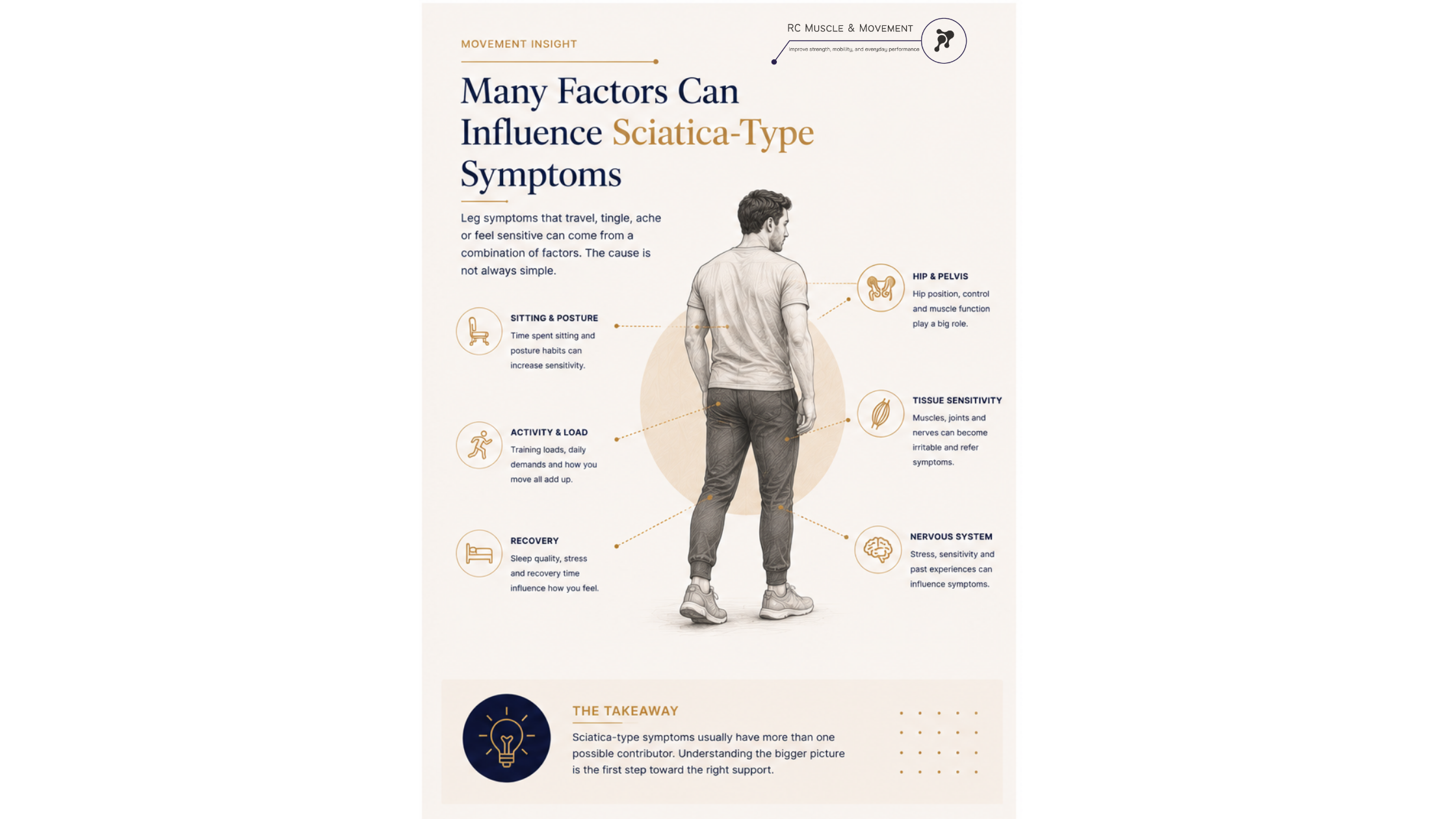
Sciatica-type symptoms often feel as though they move along a line.
That might include:
buttock into hamstring
buttock into calf
back into leg
hip into thigh
pins and needles or tingling sensations
a heavy or sensitive feeling through the leg
Travelling symptoms can happen when nerve tissue or surrounding tissues become more sensitive.
Sensitivity is not the same as damage.
It means the system is responding more strongly than usual.
That sensitivity can be influenced by:
prolonged sitting
long drives
repeated bending
sudden changes in activity
hip position
reduced movement variety
stress and fatigue
training load
how the lower back, pelvis and hips are sharing work
This is one reason symptoms may change depending on what you have been doing.
The same person may feel worse after sitting, better after walking, then more aware of symptoms again later in the day.
That fluctuation does not automatically mean something is getting worse.
It may reflect how sensitive the area is to certain positions or loads.
Sitting Can Be A Common Trigger
Many people notice sciatica-type symptoms more when sitting.
This can happen during:
desk work
driving
sitting on a low sofa
sitting with the hip deeply bent
long meals
long periods without changing position
Sitting is not bad.
But sitting changes how the body shares load.
It changes hip angle, pelvic position, lower back position and how much movement variety the body gets.
Some people feel symptoms more in slumped sitting.
Others feel symptoms more in upright sitting.
Some feel worse in the car but fine at a desk.
Some feel better once they stand and walk.
This tells us something useful:
The position matters less than the pattern.
A position may be tolerable for ten minutes but not for two hours.
A chair may be fine on one day and irritating after a busy week.
A long drive may make symptoms feel more obvious because the body has had less chance to move and redistribute load.
The aim is not perfect posture.
The aim is more movement options.
The Hip And Deep Gluteal Area Can Matter Too
The sciatic nerve travels through the pelvis and deep gluteal region before continuing down the back of the leg.
That means symptoms felt in a sciatic-type line are not automatically explained by the lower back alone.
The deep gluteal area, hip position and surrounding tissues can all influence how comfortable this region feels.
This is one reason some people notice symptoms with:
deep sitting
crossing legs
sitting on one side
driving
heavy lower-body training
long walking
standing still
hip-dominant movements
sitting in low chairs
This does not mean the glutes are “trapping the nerve”.
That would be a diagnosis.
It simply means the hip and deep gluteal region are part of the route symptoms may follow, and they may be worth considering in a movement-focused assessment.
For RCMM, this is where the bigger picture matters.
If someone only looks at the disc, they may miss how the hip, pelvis, trunk and leg are sharing work.
If someone only looks at the glute, they may miss the role of the lower back.
The useful answer is rarely one isolated structure.
Why Symptoms Change From Day To Day
Sciatica-type symptoms often fluctuate.
That can feel confusing.
You might notice symptoms are worse:
after sitting longer than usual
after a long drive
after a poor night’s sleep
during a stressful week
after increasing training
after standing still for a long time
after doing more lifting, gardening or DIY
when you have moved less than usual
You might also notice symptoms ease:
once you walk
when you change position
after gentle movement
when workload reduces
when sleep improves
when you vary your sitting position
when you build up tolerance gradually
This does not mean symptoms are random.
It often means the system is responding to the overall demand placed on it.
That demand includes physical load, movement variety, recovery, stress and confidence.
For many people, understanding that is helpful.
It moves the question away from:
“What one thing is broken?”
and toward:
“What is this area being asked to tolerate?”
That is a more useful starting point for everyday movement support.
Why Scans Are Not Always The First Step
Many people assume they need a scan to understand sciatica-type symptoms.
Sometimes imaging is appropriate.
That decision belongs with medical professionals.
But major guidance does not recommend routine imaging for low back pain with or without sciatica in non-specialist settings unless there is a reason to suspect something more serious or the result would change management.
This matters because scans can show changes that are not responsible for symptoms.
They can also increase worry if findings are not explained properly.
For someone without urgent signs, the first useful step is often a careful conversation and assessment of:
symptoms
medical history
how symptoms behave
what makes them better or worse
strength and movement confidence
daily habits
sitting and standing tolerance
work and training demands
whether medical referral is more appropriate
At RCMM, this sits within the role of the Movement & Function Assessment.
It is not a diagnosis.
It is a movement-focused review to help understand patterns, decide whether RCMM is appropriate, and guide next steps.
If symptoms feel unclear, recurring or linked to movement, sitting or workload, a Movement & Function Assessment can help build a clearer picture of what may be contributing and whether RCMM is the right support.
What A Movement-First View Looks At
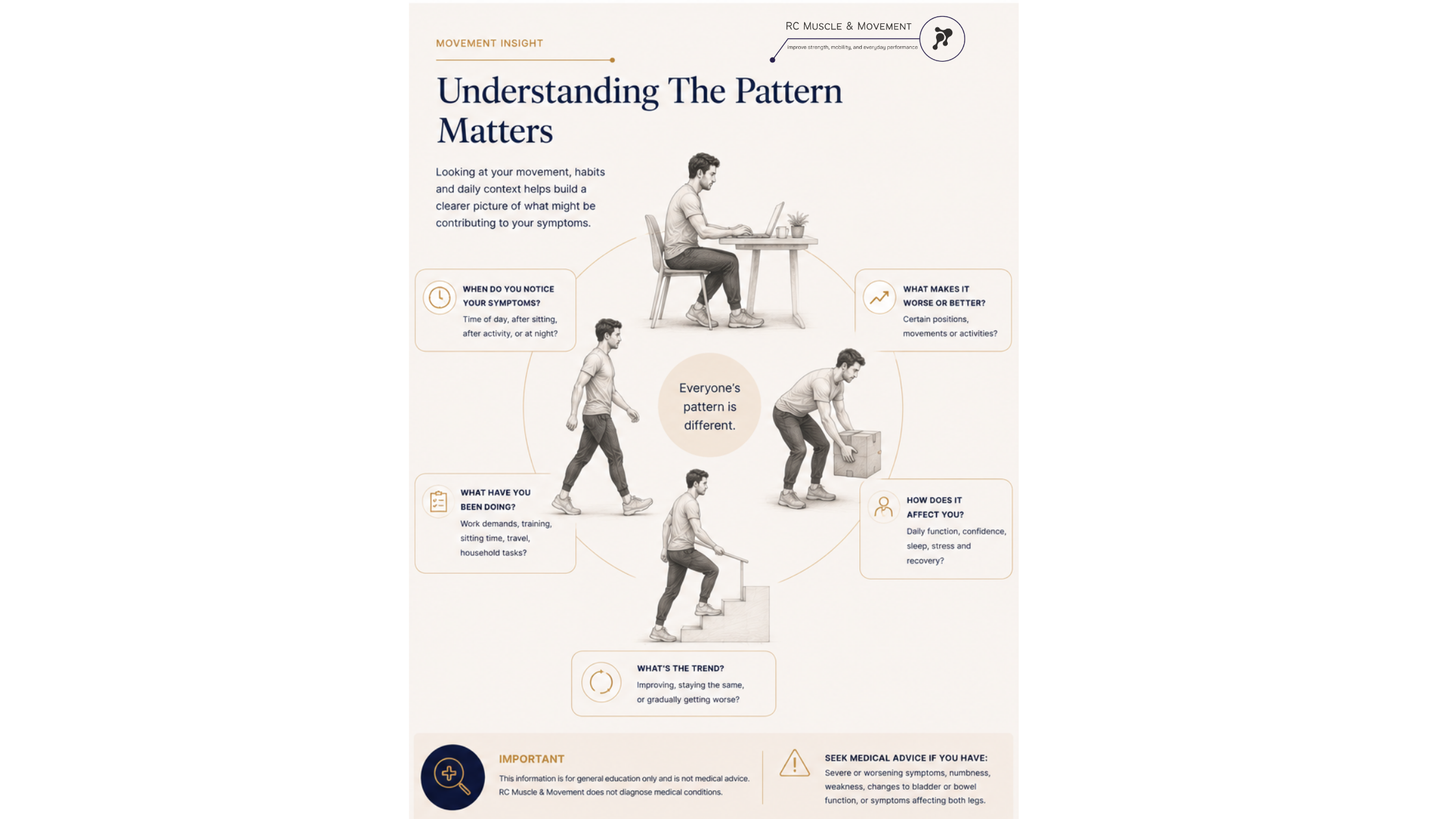
A movement-first view does not ignore symptoms.
It does not dismiss the possibility of a disc issue.
It does not claim everything is muscular.
It simply looks at the wider picture.
That may include:
how symptoms started
whether symptoms are changing
what positions affect them
whether walking helps
how sitting affects them
how the hip and lower back move
whether one side is doing more work
how confident someone feels bending, reaching or loading
what work, training or daily life currently asks of the body
whether symptoms need medical review before hands-on or movement support
This is especially important with sciatic-type symptoms because the same symptom area can be influenced by different contributors.
One person may need medical assessment.
Another may need more movement variety and reassurance.
Another may benefit from hands-on support around areas that feel overworked.
Another may need gradual strength and tolerance work.
Another may need a combination.
The starting point is clarity.
Where Sports Massage May Fit
Sports Massage may be useful when there is a clear area of muscular tension, guarding or overload around the lower back, hips, glutes or legs.
It may help an area feel more comfortable and easier to move.
But with sciatica-type symptoms, hands-on work should be used carefully.
It should not be framed as “treating the nerve” or “fixing sciatica”.
That would be outside RCMM’s scope.
A more appropriate way to understand it is this:
Sports Massage may support the surrounding soft tissues when they feel tight, protective or overworked.
It can sit alongside movement advice, workload awareness and a clear plan.
It is usually not the best first choice if the symptoms are new, severe, spreading, medically unclear or linked with neurological changes.
In those situations, assessment and appropriate signposting matter more than massage.
What May Help In Everyday Life
This is general guidance, not treatment advice.
For many non-urgent sciatica-type patterns, people often find it useful to reduce long periods in one position and explore tolerable movement.
Options may include:
changing sitting position more often
standing briefly before symptoms build
walking little and often
adjusting seat height
avoiding long periods in low, deep chairs
varying hip position during the day
using gentle movement that feels tolerable
gradually rebuilding confidence with everyday tasks
avoiding long periods of complete rest where possible
seeking medical advice if symptoms are worsening or concerning
The key word is tolerable.
You do not need to force through sharp, spreading or worsening symptoms.
You also do not need to avoid all movement out of fear.
The aim is to find the level of movement that feels manageable and build from there.
Common Misconceptions About Sciatica-Type Symptoms
“If it goes down the leg, it must be a disc.”
Not always. Disc-related sciatica is one possibility, but symptoms that travel into the buttock or leg can have several possible contributors.
“A scan will explain exactly why I feel this.”
Sometimes imaging is useful, but scans can show changes that are also common in people without symptoms. Scan findings need to be interpreted alongside symptoms and clinical assessment.
“If I move, I might make it worse.”
Some symptoms need medical review, especially if they are severe or worsening. But for many non-urgent back and leg symptom patterns, staying gently active and avoiding long periods of rest is commonly recommended.
“Massage can fix sciatica.”
That is too simplistic. Massage may help surrounding soft tissues feel more comfortable, but RCMM does not diagnose or treat nerve conditions. With sciatic-type symptoms, the wider movement picture matters.
“It is all coming from the glutes.”
Not necessarily. The gluteal region may be part of the picture for some people, but the lower back, pelvis, hip, workload, sitting tolerance and sensitivity can also matter.
Key Takeaways
Sciatica-type symptoms are not always as simple as “disc problem”.
A disc can be involved, but the wider picture may include:
lower back sensitivity
hip position
deep gluteal region sensitivity
sitting tolerance
movement habits
workload
recovery
strength and confidence
how the body shares effort
Travelling symptoms should be taken seriously, but they do not always mean serious damage.
The important thing is knowing when to seek medical help and when movement-focused support may be appropriate.
If symptoms are severe, worsening, affecting both legs, or linked with numbness, weakness, bladder, bowel or saddle-area changes, seek urgent medical advice.
If symptoms are non-urgent but recurring, confusing or linked to sitting, movement or daily workload, a movement-focused assessment may help make the pattern clearer.
How RCMM Can Help Within Scope
At RC Muscle & Movement in East Kilbride, we work with people who are dealing with tightness, stiffness, restricted movement and recurring movement-related symptoms.
For sciatica-type symptoms, our role is not to diagnose the nerve, disc or spine.
Our role is to help you understand the movement pattern, explore what may be contributing, and decide what support is appropriate.
That may include:
a clear conversation about what you are experiencing
movement-focused assessment
practical guidance
hands-on soft-tissue support where appropriate
signposting if symptoms need medical assessment
The goal is not to label the problem.
The goal is to help you move forward with more clarity.
If you are unsure what is contributing to recurring sciatic-type symptoms, the Movement & Function Assessment is usually the clearest starting point. If you already know the area that feels tight or overworked, Sports Massage may be useful as part of wider movement support.
FAQs
Does sciatica always mean a disc problem?
No. Disc-related sciatica is one possible explanation, but sciatica-type symptoms can also be influenced by the hip, pelvis, deep gluteal region, sitting position, movement habits and sensitivity along the symptom pathway.
Can disc changes show up in people without symptoms?
Yes. Research has shown that disc changes are common in people without pain or symptoms. This is why scan findings need to be interpreted carefully and in context.
Why does sitting make sciatic-type symptoms feel worse?
Sitting changes hip angle, pelvic position and lower back position. Long periods without movement can also reduce movement variety and increase sensitivity for some people.
Why does walking sometimes help?
Walking changes position, redistributes load and gives the body more movement variety. Many people find gentle movement feels better than staying still for long periods.
Can Sports Massage help sciatica-type symptoms?
Sports Massage may help surrounding soft tissues feel more comfortable where there is tightness, guarding or overload. It does not diagnose or treat sciatica or nerve conditions.
Should I book Sports Massage or Movement & Function Assessment?
If symptoms are unclear, recurring, spreading or linked with movement patterns, the Movement & Function Assessment is usually the clearer starting point. If you already know the area that feels tight or overworked, Sports Massage may be appropriate.
When should I seek medical help?
Seek urgent medical advice if symptoms affect both legs, include worsening weakness or numbness, involve changes in bladder or bowel control, or include numbness around the genitals, anus or saddle area. You should also seek medical advice if symptoms are severe, worsening or stopping normal daily activity.
Is RCMM diagnosing sciatica?
No. RCMM does not diagnose sciatica, nerve conditions, disc injuries or spinal conditions. We provide movement-focused assessment, hands-on soft-tissue support and practical guidance within sports therapy scope.
Source Base Used
NICE. Low back pain and sciatica in over 16s: assessment and management. NG59.
NHS. Sciatica.
NHS. Back pain.
Jensen RK, Kongsted A, Kjaer P, Koes B. Diagnosis and treatment of sciatica. BMJ. 2019.
Koes BW, van Tulder MW, Peul WC. Diagnosis and treatment of sciatica. BMJ. 2007.
Brinjikji W et al. Systematic literature review of imaging features of spinal degeneration in asymptomatic populations. AJNR. 2015.
Siddiq MAB et al. Extra-spinal sciatica and sciatica mimics: a scoping review. Korean Journal of Pain. 2020.
Martin HD et al. Deep gluteal syndrome. Journal of Hip Preservation Surgery. 2015.
Hernando MF et al. Deep gluteal syndrome: anatomy, imaging, and management of sciatic nerve entrapments in the subgluteal space. Skeletal Radiology. 2015.