Why Back Pain Feels Worse After Sitting
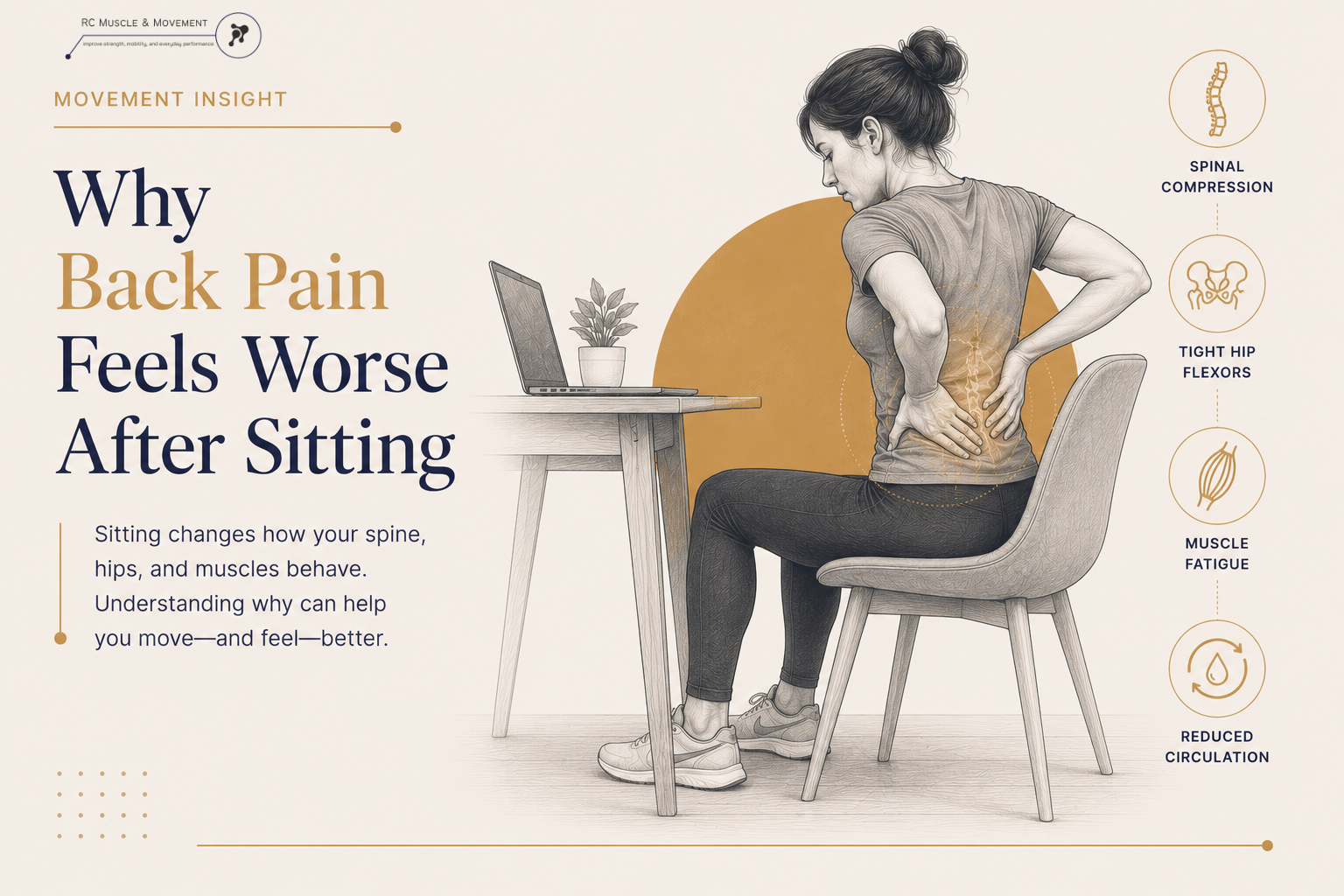
Back pain can feel worse after sitting because your body has spent a long time in one position with limited movement variety. Sitting can change how load is shared through your hips, pelvis and lower back. This does not automatically mean damage. For many people, stiffness after sitting improves once movement returns.
Why Your Back Can Feel Worse After Sitting
Back pain after sitting is common.
It might happen after:
a long day at a desk
driving
sitting on the sofa
working from a laptop
long meetings
gaming
travelling
sitting more than usual during a busy week
Sometimes your back feels fine while you are sitting.
Then you stand up and notice stiffness, tightness or discomfort straight away.
That can feel worrying, especially if nothing obvious happened.
But back discomfort after sitting does not automatically mean something is damaged.
A more useful way to look at it is this:
Your body has spent a long time doing one thing.
When you sit for a while, movement options reduce. Certain areas stay in similar positions. Your hips, pelvis and lower back share load differently. When you stand up again, your body needs time to move out of that position.
That first change of position can feel stiff.
For many people, movement helps it ease.
Sitting Is Not Automatically Bad
Sitting itself is not the problem.
The body is designed to tolerate different positions.
Sitting, standing, walking, bending and lifting all place different demands on the body.
The issue is usually not one position on its own.
It is often:
how long you stay there
how often you change position
how much movement variety you get
how well your body is coping that day
how much stress, workload or fatigue is already present
NHS guidance for back pain generally encourages people to stay active, continue normal daily activities where possible, and avoid long periods of bed rest. (nhs.uk)
That fits what many people notice in real life:
Staying completely still often makes things feel worse.
Moving regularly often helps things feel more manageable.
Load Is Not The Same As Harm
Sitting can change how load is placed through the lower back.
Some research comparing sitting and standing has looked at spinal loading and intradiscal pressure. The evidence is not as simple as “sitting damages discs”. Research reviews suggest sitting can change spinal loading, but raised load alone does not automatically mean harm or disc damage. (PubMed)
This is important.
Your back is not fragile.
Your spine experiences load every day.
It experiences load when you:
walk
lift
carry
climb stairs
sit
stand
twist
get out of a chair
Load is normal.
The more useful question is:
Has your body had enough movement variety to tolerate that load comfortably?
If sitting regularly leaves your lower back feeling tight or uncomfortable, our Back Pain page explains how recurring back stiffness can build through work, sitting, lifting and everyday life.
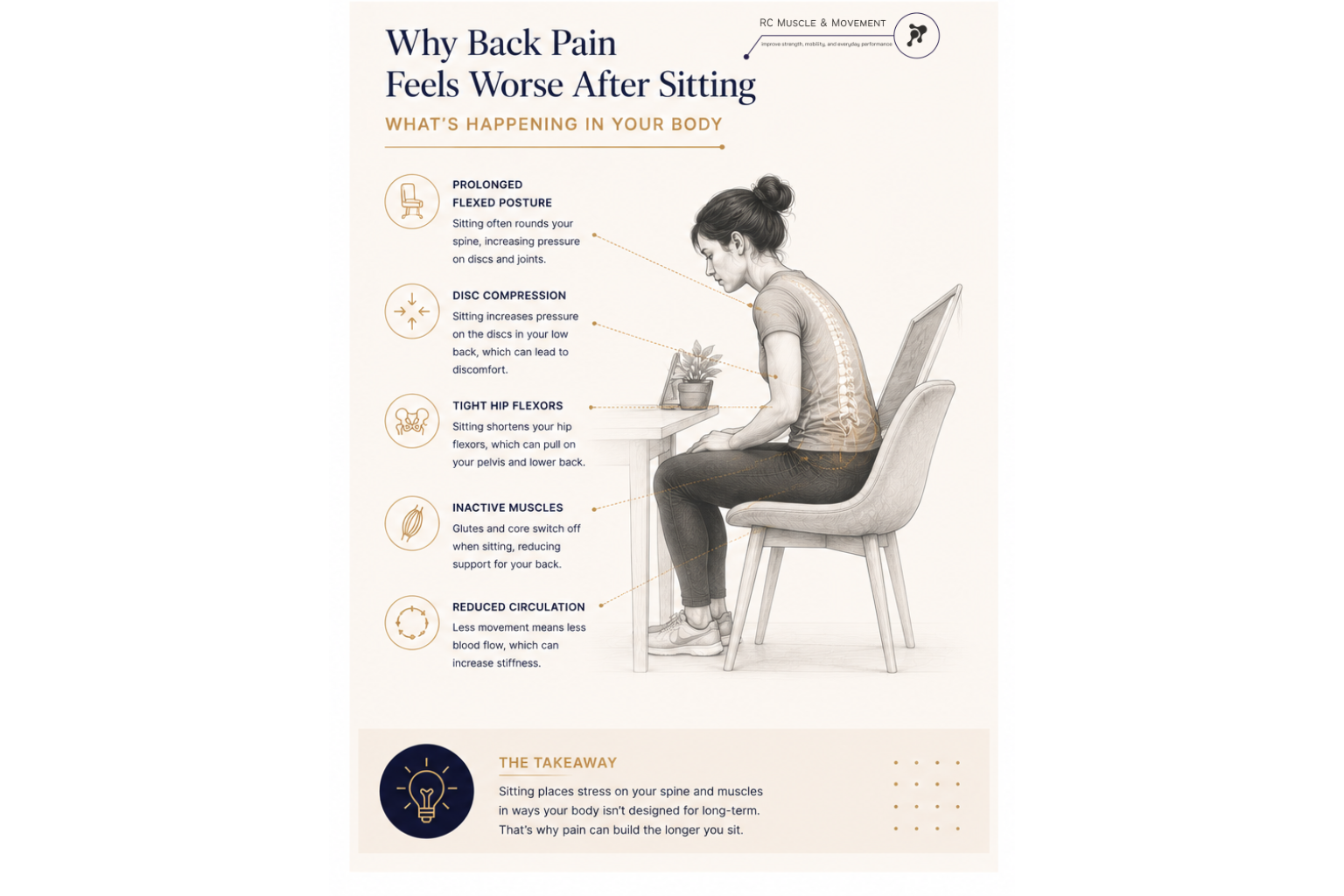
illustration showing what may be happening in your body while seated and why it can cause pain
Why Posture Is Only Part Of The Picture
A lot of people worry that they are sitting “wrong”.
They may think:
I slouch too much.
My chair is causing this.
I need to sit upright all day.
My posture must be the problem.
Posture can influence comfort, but it is rarely the whole story.
The bigger issue is usually staying in one position for too long.
NHS Inform advises that posture does not need to be perfect, but moving often and avoiding staying in the same position for too long can help people return to normal activity. (NHS inform)
That is a much more useful message than:
Sit perfectly.
A better aim is:
Change position regularly.
Even a “good” posture can become uncomfortable if you hold it long enough.
Why The First Few Steps Feel Stiff
The first few steps after sitting can feel worse than the sitting itself.
People often describe:
stiffness standing up
tightness across the lower back
heaviness through the hips
feeling slow to straighten
discomfort that eases after moving
needing a few steps before things loosen
This makes sense.
After sitting for a while, your body has adapted to that position.
Your hips have been flexed.
Your pelvis has been relatively still.
Your lower back has had fewer movement options.
When you stand up, everything has to change quickly.
For many people, the first few movements feel stiff because the body is shifting from a sustained position back into movement.
If symptoms ease once you start walking, that often suggests movement is helping your body redistribute load and regain options.
Why Sitting Affects People Differently
Two people can sit for the same length of time and feel completely different afterwards.
That does not mean one person is broken and the other is not.
It means their bodies may be responding differently.
Things that can influence sitting-related back discomfort include:
chair height
hip position
how long you sit without moving
how often you change position
stress levels
sleep
general activity
strength and movement confidence
previous sensitivity around the back
A 2019 study of office workers found that people with chronic low back pain tended to show more static sitting behaviour, while the wider relationship between sitting and low back pain remains complex. (ScienceDirect)
A later scoping review also found that sitting behaviour, fewer breaks and more static sitting were associated with low back pain in office workers. (Sage Journals)
The practical takeaway is simple:
Your back usually likes options.
Movement Variety Matters More Than Perfect Position
Your body generally responds well to variety.
That does not mean constantly stretching.
It means changing the demand often enough that one area is not doing the same job for hours.
Helpful options might include:
leaning back for a while
sitting upright for a while
standing briefly
walking for a minute
changing seat position
using the backrest
gently rotating through the upper body
adjusting hip position
breaking up long sitting periods
This does not need to be complicated.
You are not trying to create a perfect desk routine.
You are simply giving your body more movement options.
MSK Dorset guidance also advises people in static jobs to avoid prolonged static postures and take regular movement breaks. (Musculoskeletal Matters)
Why Sofas And Car Seats Can Feel Worse
Some seats feel worse than others.
People often notice this with:
deep sofas
low chairs
car seats
soft chairs
bucket-style seats
working from the sofa
sitting with a laptop on the knee
These positions can place the hips and pelvis in a way that gives the lower back fewer options.
That does not mean the chair is dangerous.
It simply means some positions make it harder to move, shift and share load comfortably.
If your back feels worse after certain seats, it may be worth adjusting:
seat height
back support
how often you stand
how long you stay there
whether your feet are supported
how easy it is to move while sitting
Again, the goal is not perfection.
The goal is less time stuck in one position.
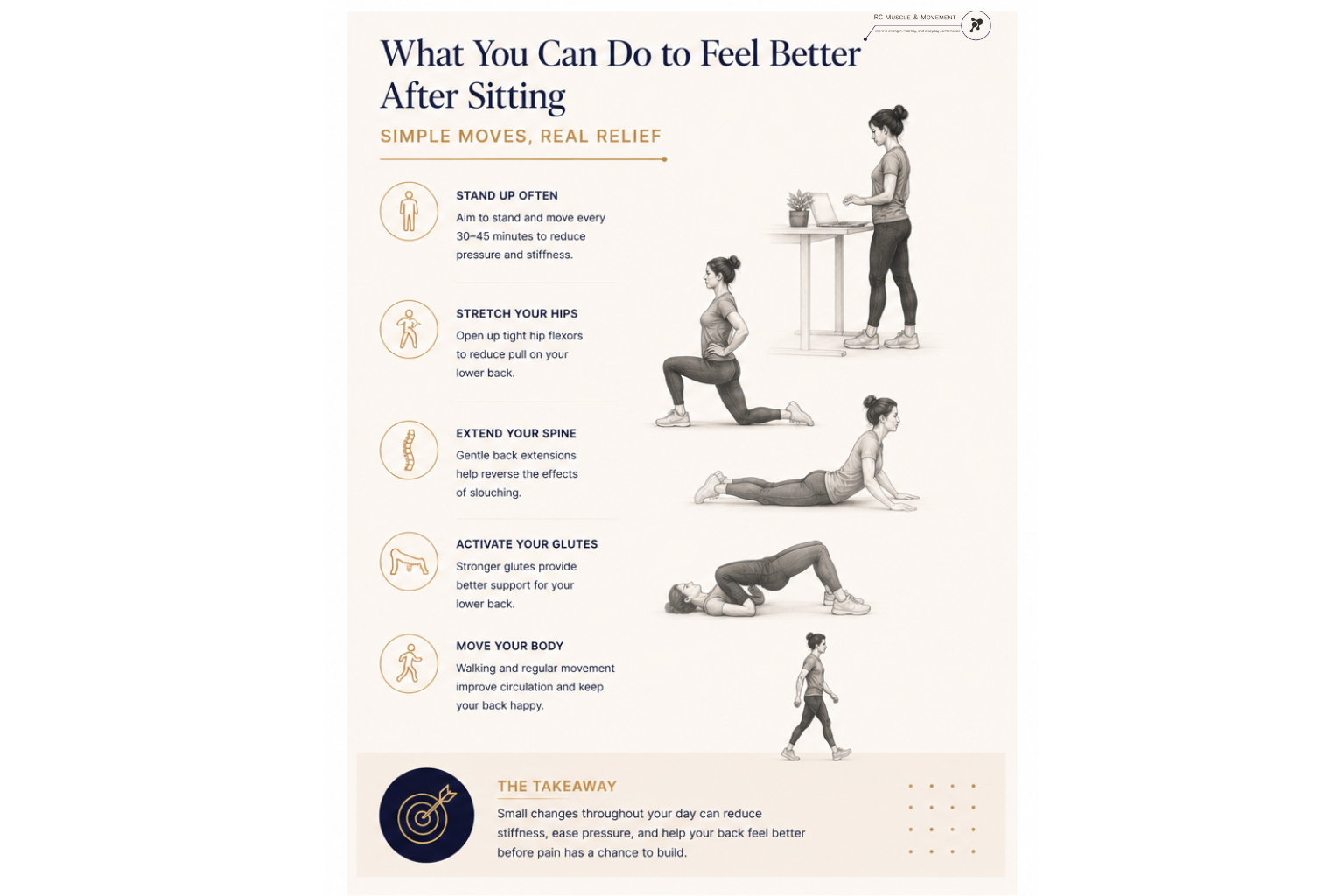
couple of movements and stretches to relieve back-pain , please always consult advice before trying anything
Strength And Capacity Matter Too
Back comfort is not only about sitting position.
It is also about what your body can tolerate.
This is where strength-informed thinking matters.
Not gym culture.
Not performance pressure.
Just everyday physical capability.
Your back, hips and legs all help with normal daily tasks:
standing up from a chair
carrying shopping
walking
climbing stairs
lifting at work
bending
getting in and out of the car
If your body has more capacity for everyday demand, it often copes better with positions and tasks that previously felt harder.
That might involve simple movements such as:
sit-to-stands
step-ups
carrying light loads
gentle hinging movements
walking regularly
changing position more often
MSK Dorset includes regular strength exercise within its back pain guidance, especially around work and lifting demands. (Musculoskeletal Matters)
The point is not to train hard.
The point is to help your body feel more capable.
If back discomfort after sitting keeps returning and you are unsure what is contributing, a Movement & Function Assessment can help build a clearer picture of how your body is moving and what support may fit best.
What Can Help Day To Day?
The most useful changes are often simple.
You might try:
standing up briefly every so often
walking for a minute after long sitting
using the backrest instead of hovering upright
changing hip position
avoiding working from the sofa for long periods
breaking up long drives where possible
moving before stiffness builds too much
gently rotating or side-bending
building general strength gradually
You do not need to do all of these.
Pick one or two that feel realistic.
RCMM’s approach is not about giving people long routines they will never do.
It is about finding simple changes that fit real life.
When Sitting Discomfort Is Usually Less Concerning
Back stiffness after sitting is often less concerning when:
it eases once you move
it comes and goes
it relates to long sitting periods
it changes with workload or stress
it improves with regular movement
it feels like stiffness rather than severe pain
That does not mean ignore it.
It means you do not need to panic every time your back feels stiff after sitting.
Your body may simply be responding to sustained position, reduced movement and overall demand.
When To Get Support
It may be worth getting support if:
back discomfort keeps returning
sitting affects your work or daily life
movement feels harder than it should
you feel less confident bending, lifting or standing up
symptoms are not improving with simple changes
you are unsure what is contributing
you keep relying on short-term relief but the issue returns
Support can help you understand what may be contributing and what type of next step makes sense.
That might include hands-on work, movement-focused assessment, practical guidance or a combination of these.
Key Takeaways
Back pain after sitting does not automatically mean damage.
Sitting can influence how your back feels because:
movement variety reduces
load stays in similar areas for longer
the hips and pelvis stay in one position
your body may become more sensitive during busy or stressful periods
general strength and capacity can affect tolerance
Perfect posture is not the goal.
More movement options are usually more useful.
Movement First, Not Perfect Posture
At RCMM, we look at back discomfort through a movement-first lens.
That means asking:
what has your body been doing most?
where does stiffness build?
what changes when you move?
what does your day ask from your body?
what would help you feel more comfortable and capable?
You do not need to sit perfectly.
You need enough movement, confidence and capacity to move through normal life without feeling stuck, stiff or unsure.
If the issue feels localised and muscular, Sports Massage may help. If it feels recurring or unclear, the Movement & Function Assessment is usually the clearest starting point.
FAQs
Why does my back hurt after sitting?
Your back can feel worse after sitting because your body has stayed in one position for a while. Movement options reduce, load is shared differently, and stiffness can build.
Is sitting bad for my back?
Not automatically. Sitting is a normal position. Problems are more likely when sitting is prolonged, static and not balanced with enough movement.
Is poor posture causing my back pain?
Posture can influence comfort, but it is rarely the full explanation. Staying in one position for too long is often more relevant than finding one perfect posture.
Why does walking help my back after sitting?
Walking changes position, restores movement variety and helps your body redistribute load after being still for a while.
Should I sit upright all day?
No. Holding any position rigidly for long periods can become uncomfortable. It is usually better to change position regularly.
What should I book if back pain keeps returning after sitting?
If back discomfort keeps returning and you are unsure what is contributing, the Movement & Function Assessment is usually the best starting point.
Source Base Used
NHS. Back pain — guidance on staying active, avoiding long periods of bed rest, and using movement/exercise where appropriate. (nhs.uk)
NHS Inform. Back problems — guidance on keeping active, avoiding holding the body still, changing position regularly, and moving often rather than aiming for perfect posture. (NHS inform)
MSK Dorset NHS. Low back pain — guidance on avoiding prolonged static postures, taking movement breaks, and building strength for work and lifting demands. (Musculoskeletal Matters)
Bontrup et al. Low back pain and its relationship with sitting behaviour among sedentary office workers — study exploring sitting behaviour in office workers, including more static sitting behaviour in those with chronic low back pain. (ScienceDirect)
Alaca et al. Low back pain and sitting time, posture and behavior in office workers: A scoping review — review finding associations between low back pain and sitting time, fewer breaks, posture and more static sitting behaviour, with sitting behaviour showing strong relevance. (Sage Journals)
Dzakpasu et al. Musculoskeletal pain and sedentary behaviour in occupational and non-occupational settings: a systematic review with meta-analysis — source used for wider context around sedentary behaviour, sitting and musculoskeletal discomfort. (link.springer.com)