Why Your Knee Can Feel Worse on Stairs Than Walking
Knee pain on stairs is common.
You might feel it going upstairs.
You might notice it more going downstairs.
Or walking on the flat may feel fine, but stairs feel uncomfortable, heavy, sharp, stiff, or harder than they should.
That can be frustrating because it feels inconsistent.
But stairs are not the same as flat walking.
They ask more from your knees, hips, ankles, feet and leg muscles. That does not mean stairs are damaging your knee. It usually means stairs are a higher-demand task, and your body may be more sensitive to that demand on certain days.
This blog explains why stairs can feel harder, what may be contributing, and when it may be worth getting support.
Why stairs can feel harder than walking
Walking on the flat is usually a lower-demand movement.
Stairs are different.
When you go up or down stairs, your knee bends more. Your thigh muscles work harder. Your hips and ankles have to help control the movement. Your body also has to manage balance, step height, timing and repeated loading.
Research on patellofemoral pain shows that stairs are often one of the most uncomfortable everyday activities for people with pain around the front of the knee. Stair climbing places greater demand on the knee than level walking because of increased knee movement and quadriceps demand.
In plain English:
stairs ask more from the knee than walking does.
That is why your knee can feel fine on flat ground but uncomfortable on steps.
The knee does not work on its own
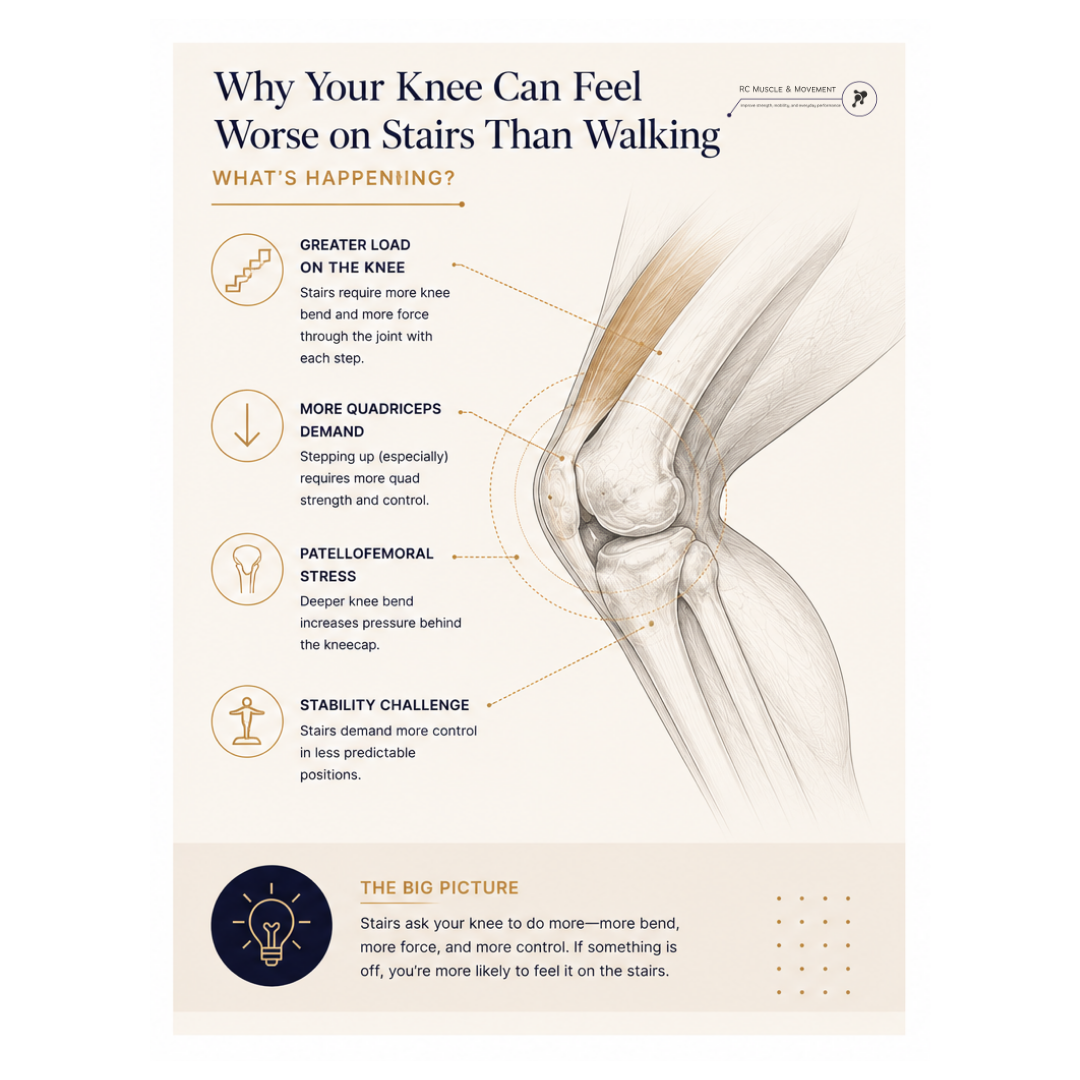
Reasons why knee may feel worse on stairs compared to walking
It is easy to think of knee pain as only a knee problem.
But stairs involve more than the knee.
Your body uses:
hips
knees
ankles
feet
glutes
thigh muscles
calves
trunk control
balance
When one area is tired, stiff, underused, or doing less than it could, another area may start doing more work.
That can make the knee feel more loaded during stairs.
This is why RCMM does not only ask:
“Where does it hurt?”
We also ask:
“What is the movement asking your body to do?”
That question gives a clearer picture.
If knee discomfort is becoming more regular during stairs, walking or everyday movement, it may help to understand the wider patterns behind knee pain.
Why going downstairs can feel worse
A lot of people find going downstairs harder than going upstairs.
This makes sense.
Going downstairs usually asks the leg to control your bodyweight as you lower down. The knee bends, the thigh muscles help slow the movement, and the kneecap area can feel more loaded.
That does not automatically mean damage.
It often means the task is asking more control from the knee and surrounding muscles.
You may notice it more when:
steps are steep
you are tired
you are carrying bags
you move slowly and cautiously
your knee already feels sensitive
you have done more walking than usual
you have been sitting for a long time beforehand
Small changes in the day can make stairs feel very different.
Why knee pain on stairs can vary day to day
Knee pain on stairs is not always the same.
One day, stairs may feel manageable.
Another day, the same stairs may feel much harder.
That does not always mean the knee has got worse.
Your body may simply be responding to a different level of demand.
Things that can affect how stairs feel include:
sitting longer than usual
walking more than usual
using more stairs than normal
carrying bags or equipment
training after a quieter week
standing for long periods
poor sleep
stress
footwear
step height
hip, ankle or foot stiffness
None of these automatically mean something serious is happening.
They are everyday factors that can influence how your knee responds to load.
NHS Inform explains that knee problems can flare up and that keeping the body moving is usually an important part of recovery, while also building activity gradually around symptoms.
Pain on stairs does not always mean more damage
This is important.
Pain does not always match the amount of load going through the joint.
One study found that people with patellofemoral pain did not show higher kneecap joint stress during stair ascent or descent compared with people without pain. Instead, they appeared to use different movement strategies, such as slower cadence and reduced knee extensor moment, to manage the task.
That sounds technical, but the useful point is simple:
two people can use the same stairs and have very different experiences.
One person may feel fine.
Another may feel pain, pressure, or uncertainty.
That difference is not always explained by structure alone.
It can also involve strength, confidence, sensitivity, fatigue, recent activity and how the body is sharing work.
Why strength matters for stairs
Stairs need strength.
Not gym-performance strength.
Everyday strength.
Your body needs enough strength and control to:
push up through the leg
lower down with control
manage balance
keep the hips and knees steady
deal with repeated steps
carry bags while moving
cope with tiredness
The thigh muscles are important, but they are not the whole story.
The hips, glutes, calves, ankles and feet all help too.
NICE guidance for osteoarthritis places tailored therapeutic exercise, including local muscle strengthening and general aerobic fitness, as a core part of non-surgical support. It also explains that exercise may cause some initial discomfort but can support function and quality of life over time.
For RCMM, the key point is:
strength supports movement confidence.
That does not mean forcing through pain or jumping into heavy training.
It means building enough capacity so everyday tasks feel more manageable.
Why avoiding stairs can sometimes make things harder
If stairs feel uncomfortable, it is natural to avoid them.
Sometimes that is sensible short term, especially if symptoms are strong or the knee feels irritated.
But avoiding stairs completely for a long time can reduce confidence and tolerance.
The body often needs gradual exposure to the things we want it to manage.
That might mean:
using the handrail
taking fewer stairs at once
slowing down when needed
using lifts where appropriate but not avoiding all steps
building strength gradually
practising controlled step work when suitable
noticing how much stair use your day already contains
The goal is not to force the knee.
The goal is to find a level of movement your body can tolerate, then build from there.
NHS Inform advises using stairs in a way that reduces strain when needed, including using a handrail, and then gradually using the leg more as symptoms allow.
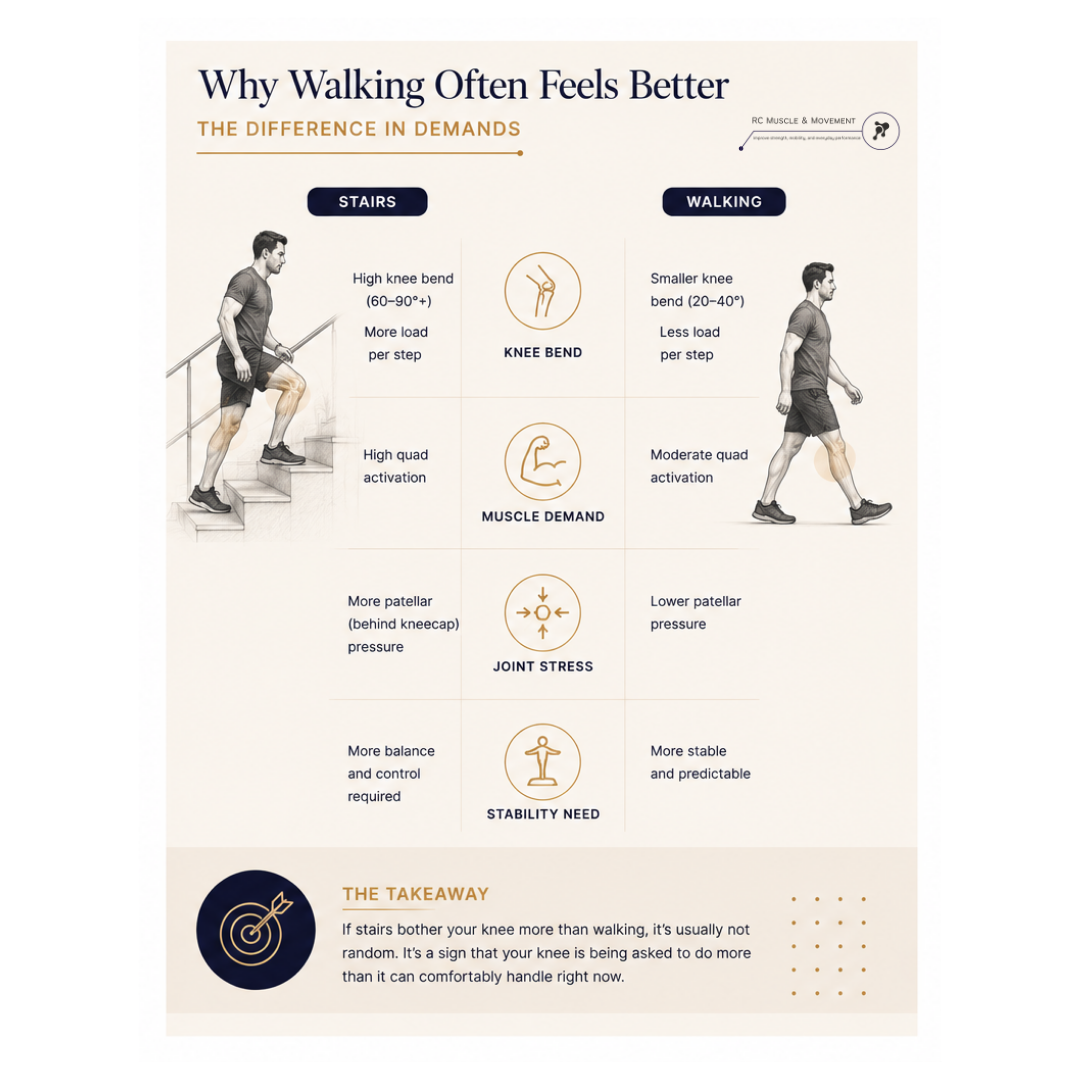
side by side of walking and stairs impact on knees
Practical ways to make stairs feel more manageable
These are not rules.
They are options to explore.
Different people respond differently.
1. Use the handrail
Using the handrail is not a failure.
It can reduce demand, improve balance, and help you move with more confidence.
2. Take smaller steps where possible
Large steps usually ask more from the knee.
Smaller, more controlled steps can feel easier for some people.
3. Avoid rushing when symptoms are sensitive
If the knee already feels irritated, rushing stairs may increase discomfort.
A steadier rhythm may help.
4. Notice what happens before the stairs
Sometimes stairs feel worse after:
long sitting
long driving
a heavy workday
a long walk
a training session
carrying bags
That information matters.
It tells you what your knee may be responding to.
5. Build leg strength gradually
Useful movement options may include:
sit-to-stands
small step-ups
supported step-downs
calf raises
short walking blocks
simple hip and glute strengthening
These should be adapted to the person.
The right starting point depends on what your knee currently tolerates.
6. Share the work through the whole leg
If the hip, ankle or foot is stiff or not contributing well, the knee may feel like it is taking more of the work.
That is where looking at the full movement picture can help.
If stairs keep feeling harder than they should, a Movement & Function Assessment can help look at how your hips, knees, ankles and everyday movement are sharing the work.
Where sports massage may fit
Sports massage may help when the muscles around the knee, thigh, hip or calf feel tight, heavy, or overworked.
It can be useful when there is a specific area that feels restricted or loaded.
But if knee pain on stairs keeps returning, it is worth looking beyond the tight area.
The useful questions are:
what is the knee being asked to do?
are the hips helping enough?
are the ankles or feet affecting the movement?
is strength or control part of the issue?
has daily workload changed?
are certain areas doing more work than they should?
Hands-on work can be helpful.
But for recurring stair discomfort, the bigger picture usually matters too.
When to get medical advice
Most everyday knee discomfort is not urgent.
But there are times where it is better to get medical advice.
NHS guidance advises getting help if the knee is very painful, you cannot move it or put weight on it, it is badly swollen or has changed shape, it locks or gives way, or there are signs of infection such as heat, redness, fever or chills.
NHS Inform also advises seeking help after significant trauma, if the knee is misshapen, if you cannot put weight through the leg, if there is immediate swelling after a twisting injury, or if the knee locks, gives way, becomes hot, swollen or tender.
If something feels unusual, severe, or not right for you, get it checked.
How RC Muscle & Movement can help
At RC Muscle & Movement in East Kilbride, we work with people who feel tight, stiff, restricted, or like certain areas are doing more work than they should.
If stairs are uncomfortable, we do not just look at the knee in isolation.
We look at how your hips, knees, ankles, feet and everyday movement are working together.
That might involve hands-on work.
It might involve looking more closely at how you move.
It might involve simple guidance to help you build more confidence with everyday tasks like stairs, walking and getting up from sitting.
The goal is straightforward:
to help you understand what may be contributing and improve how you move and feel in everyday life.
FAQs
Why does my knee hurt on stairs but not walking?
Stairs usually ask more from the knee than flat walking. The knee bends more, the thigh muscles work harder, and the hips and ankles help control the movement.
Is knee pain on stairs always a sign of damage?
No. Knee pain on stairs does not automatically mean damage. It can relate to load, strength, sensitivity, confidence, fatigue, recent activity and how your body is sharing work.
Why is going downstairs worse than going upstairs?
Going downstairs often asks more control from the knee and thigh muscles as you lower your bodyweight. That can make symptoms feel more noticeable.
Should I avoid stairs if they hurt?
Not always. Short-term modification can help if the knee is irritated, but avoiding stairs completely for a long time may reduce confidence and tolerance. Gradual exposure is often more useful.
Can sports massage help knee pain on stairs?
Sports massage may help if muscles around the thigh, hip, calf or knee feel tight or overworked. If stair discomfort keeps returning, it may also help to look at movement, strength and daily workload.
What should I book if stairs keep bothering my knee?
If the issue keeps returning or you are unsure what is contributing, a Movement & Function Assessment is usually the best starting point. If you mainly want area-specific soft tissue work, Sports Massage may be more suitable.
Source Base Used
This updated version is evidence-aware rather than research-heavy. It draws on NHS knee pain guidance, NHS Inform knee problem guidance, NICE recommendations around exercise and support for knee osteoarthritis, and biomechanical research showing that stairs place greater demand on the knee than level walking.