Why Does My Neck Feel Tight by the End of the Day?
Written by Paula, RCMM Operations & Content Lead
Originally published: 18 May 2026
Last updated: 11th September 2026
Your neck was fine over breakfast. By dinner, you are rubbing the back of it, turning your head to see if it still feels stiff and wondering what you have done.
You have not necessarily done anything unusual. That is often the puzzling part.
But a task does not have to feel strenuous to become uncomfortable after a while. Holding a position takes muscular effort too. Add a long spell of concentrated work, a rushed afternoon or a poor night's sleep, and there are several reasons the same neck might feel different later in the day.
Understanding those differences gives you more to work with than simply waiting until evening and hoping a stretch sorts it out.
Summary
Neck tightness can become more noticeable as time spent on tasks increases and muscles feel tired or uncomfortable. Stress can affect muscle activity, while sleep loss can affect how strongly pain is felt. Together, these offer possible explanations for feeling reasonably comfortable earlier and sore later.
The useful response is to consider both the demands of the day and how you are coping with them. Changing the length or setup of a task, finding comfortable movement and building physical capacity where appropriate all have a different job to do.
Educational Note
This article provides general education, not medical advice, a diagnosis or an individual rehabilitation programme. RCMM offers Sports Therapy assessment, hands-on treatment and movement or strength guidance within professional scope.
Seek individual advice for persistent or concerning symptoms. Medical-help guidance appears below.
Your Neck Is Still Working When You Are Sitting Still
We tend to recognise muscular effort when we can see movement. Carry a heavy bag and it is obvious that your arm is doing something. Sitting at a table looks like much less work.
Yet muscles also produce force to hold a position. Around your neck, they help support and control your head while you read, look at a screen or concentrate on something in front of you. Your upper body is doing a job even when you have barely moved from the chair.
Think of holding a mug out in front of you. It might feel easy initially, then more tiring if you keep it there. The mug has not become heavier. You have been holding it for longer.
Your neck is more complicated than that example, but the useful principle carries across: how long you do something is part of its physical demand.
That helps explain why a day of apparently light activity can still leave you feeling physically worked. Reading paperwork, driving and preparing dinner involve different tasks, but each may include stretches of holding your head and arms in fairly similar positions.
The same applies to more active jobs. Painting a ceiling or spending an afternoon leaning over a flower bed can ask more of your neck than the occasional few minutes you normally spend there.
Sustained uncomfortable positions and doing more activity than usual are recognised contributors to neck discomfort in NHS guidance. NHS physiotherapy guidance.
Why Does It Build Through the Day?
A position can be comfortable at first and become less comfortable with time. As a task continues, you may notice muscular tiredness, aching or an increasing urge to move.
Consider an afternoon spent decorating. The first section of wall is straightforward. Later, you are still reaching and looking upwards, but your neck and shoulders are starting to feel the effort. If you spread the job across shorter sessions, the experience may be different.
Now consider a quieter day: paperwork, a long drive, then another hour answering messages. There may be no single demanding moment to point to. What stands out is the amount of time spent doing similar things without much change.
These are examples of how an evening pattern could develop. They are not a claim that everybody's symptoms follow the same process.
There is an important distinction between feeling tired or tight and knowing that a muscle has reached its physical limit. You cannot measure muscle fatigue, weakness or tissue damage just from that sensation. Neck pain does not reliably tell us how quickly those muscles will tire when tested. Research on neck muscle endurance.
So the useful explanation is broader than “your neck muscles have run out of strength”. Time on the task may matter, alongside how comfortable the position is and how sensitive the area feels that day.
You can use that information without having to identify one faulty muscle.
A Pressured Day Can Ask More of You Than You Realise
Two days at the same desk can feel very different.
On one, you have time to work at your own pace. On another, you are rushing, checking every detail and trying to finish before somebody needs you elsewhere.
Research helps explain why that difference can be physical. A review of studies found that simulated workplace pressures, including faster work and greater precision demands, increased activity in neck and shoulder muscles during computer tasks. The evidence came mainly from laboratory settings, so it does not tell us exactly what happens during everyone's working day. It does show that the physical demand is not determined by posture alone. Eijckelhof and colleagues.
You may also find that you postpone breaks when you are busy or stay absorbed in a task for longer. If that describes your day, changing the chair addresses only one part of it.
A manageable workload and a chance to pause can belong in the conversation about neck discomfort just as much as how your screen is positioned.
Why Can the Same Routine Feel Worse After Poor Sleep?
The amount of work your body does and how strongly discomfort is felt are connected, but they are not the same thing.
Pain involves the nervous system as well as the tissues in the area that hurts. Sleep loss can change that system's sensitivity. In experimental research, reducing sleep has increased pain sensitivity or pain intensity in healthy adults, although the findings vary with the type of sleep loss and the pain being measured. Evidence in people with chronic pain is less certain. Chang and colleagues.
In ordinary language, something can feel more uncomfortable without the task having become harder.
That offers one possible reason the same afternoon routine is manageable on one day and bothersome on another. A poor night does not diagnose the cause of your neck pain, but it can be relevant to how the day feels.
It also changes what “recovery” means here. Recovery includes sleep and opportunities to settle between demands, as well as anything you do directly to the sore area. A neck stretch cannot do all of those jobs.
Do You Need to Sit Straighter?
If changing your position makes you more comfortable, use that. Adjusting the height of reading material or bringing something within easier reach can make a task less awkward.
The difficulty comes when sitting straighter becomes another position you feel obliged to hold all day.
A useful setup should let you do the task comfortably, with support where you want it and room to change position. HSE guidance covers both workstation assessment and breaks or changes of activity.
Try asking whether a position is comfortable enough for the job, and whether you have been there longer than suits you. That gives you something you can adjust without checking your posture every few minutes.
What Can You Change Before Evening Arrives?
Start with the part of the day that seems to bring the discomfort on. There are several ways to make a task more manageable, and they change different things.
| What you notice | What to try | What that changes |
|---|---|---|
| Reading becomes uncomfortable after a long spell | Support the book or paperwork at a more comfortable height, then change activity between sections | The position and uninterrupted time spent there |
| A household job involves repeated reaching | Bring the work closer where possible, or split the job into smaller amounts | How far you reach or how much you repeat |
| You spend the whole afternoon on one task | Alternate it with a different job rather than saving everything else until the end | The pattern of effort through the afternoon |
| You finish at the computer and immediately pick up your phone | Put a comfortable walk or another activity between the two | The transition between similar periods of sitting and looking at a screen |
These are small experiments, not promises. Research has not established that a particular break schedule reliably prevents neck pain. A recent Cochrane review found the evidence about additional workplace breaks very uncertain. Cochrane review.
You can still judge whether a change makes your own day easier. Try one that fits your routine and look beyond whether you feel briefly better: can you finish the task more comfortably? Does the discomfort appear later, feel less intrusive or settle more readily afterwards?
If nothing changes, that is useful too. It is a reason to reconsider the approach rather than keep adding more reminders to move.
Where Does Physical Capacity Fit?
Breaking a job into smaller amounts changes the demand. Building capacity means developing what your body can handle.
Both can be useful. If an afternoon of decorating is much more than you are used to, doing less at once may help you manage the job now. If your work regularly involves physical tasks, suitable exercise may help build the strength and endurance those tasks require over time.
For people with persistent neck pain, exercise also has some evidence behind it. A review of office workers found that strengthening exercises could reduce pain and disability, although the certainty of the evidence was low. Jones and colleagues.
That gives exercise a possible role beyond simply stretching whenever something feels tight. It does not mean everyone needs the same neck exercises, or that pain proves you are weak.
The useful question is what you need to be able to do, how it currently feels and whether building up towards it would be appropriate.
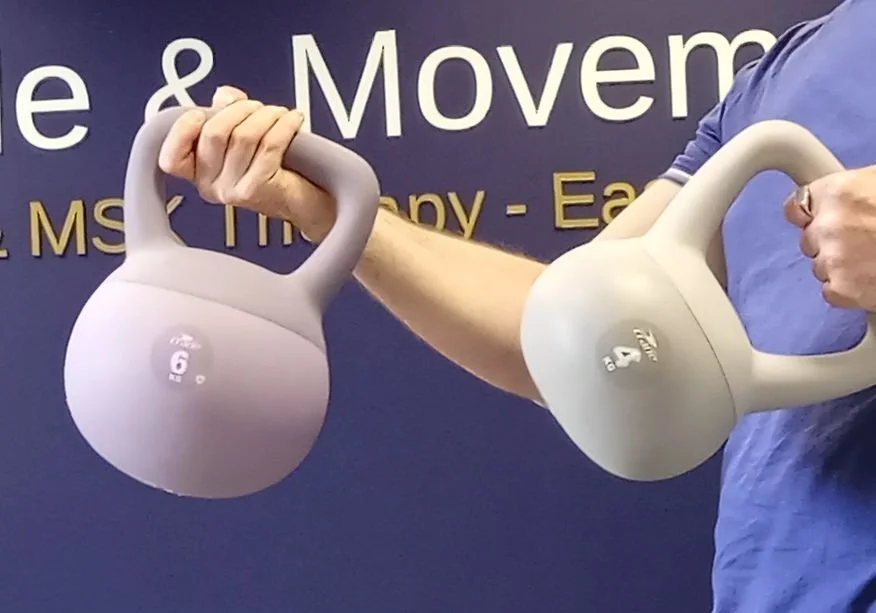
Build Capacity To Develop What Body Can Handle
strength training is one way to build physical capacity
What About Relief When You Get Home?
There is nothing wrong with wanting the area to feel better.
Comfortable movement, a gentle stretch or a wrapped heat pack may help settle an aching neck. Keep it gentle enough that you are not forcing your way through increasing pain. NHS guidance encourages keeping the neck moving unless a doctor has advised otherwise. NHS advice.
Relief and changing the day's demands can work alongside each other. If warmth helps you unwind in the evening, it does not need to solve the whole problem to be worthwhile. You can enjoy that relief while also looking at the long afternoon task that keeps becoming uncomfortable.
What matters is whether the overall pattern is becoming easier to live with, rather than whether you can temporarily make the sensation disappear.
When Is It Worth Getting Help?
If discomfort keeps taking over your evenings, disturbs your sleep or is making ordinary activities difficult, it is worth having the problem looked at.
At RC Muscle & Movement in East Kilbride, a Movement & Function Assessment gives Ross time to discuss how symptoms change and assess relevant movement. You receive a plan based on what is appropriate, including advice on another healthcare route where needed.
You can find more about the help available on our Neck & Shoulder Pain Support page.
When Neck Pain Needs Medical Advice
Contact a GP if neck pain or stiffness has not settled after a few weeks, you are worried about it, or you have other symptoms such as pins and needles or a cold arm. Avoid driving if restricted movement makes it unsafe. NHS guidance.
Seek urgent medical assessment for neck pain starting suddenly after trauma, progressive weakness or loss of coordination in your limbs, worsening balance, or new bladder or bowel changes. NHS physiotherapy guidance.
Frequently Asked Questions
Does feeling better in the morning mean nothing is wrong?
Improvement is useful information, but morning comfort does not rule out a problem that needs attention. Consider the overall pattern: whether it is improving, how much it affects you and whether any of the symptoms above are present.
Should I keep stretching until the tightness goes?
You do not need to chase complete looseness. If a gentle stretch feels helpful, it can be one way to find comfort. If you keep needing to stretch during the same task, it is also worth changing how that task is organised. Increasing pain or new symptoms are reasons to stop and seek advice.
What if I already take breaks and still feel sore?
Breaks change only part of the day. They do not establish what is causing the discomfort, and they will not help everybody. Persistent symptoms deserve a broader assessment that considers the history, relevant movement, health and activity rather than simply prescribing more breaks.
A More Useful Way to Look at Your Evening
Your neck feeling tight at dinner does not necessarily mean you did one thing wrong at lunchtime.
The duration of a task, the effort involved and how you are feeling that day can all be relevant. Start with something you can reasonably change, give it a chance and notice whether it helps you do what you need to do.
You should come away with more options for getting through the day, not another rule about how to hold your body.
Related RCMM Guides
Why Does Neck Tension Keep Coming Back? — for the cycle of relief and returning symptoms across days or weeks.
Why Do My Shoulders Feel Tight After Desk Work? — for the specific demands of working at a computer.
Why Feeling Tight Does Not Always Mean Something Is Short — for a closer look at the sensation of tightness.
Professionally reviewed by Ross Canning, Sports Therapist
Ross Canning checked this article for clinical accuracy, professional scope and relevance to the people RCMM helps.
Reviewed: [7th September 2026]
Source Base
NHS — Neck pain: self-care and medical advice.
Dynamic Health NHS — Neck pain: task context and urgent assessment guidance.
HSE — Work routine and breaks: workplace guidance on changes of activity.
Edmondston et al., 2011: small primary study illustrating why neck pain should not automatically be equated with faster muscular fatigue.
Eijckelhof et al., 2013: systematic review and meta-analysis of workplace stressors and muscle activity; findings mainly from laboratory research.
Chang et al., 2022: systematic review and meta-analysis of experimental sleep loss and pain perception.
Jones et al., 2024: systematic review and meta-analysis of exercise for chronic neck pain in office workers; low-certainty evidence.
Luger et al., Cochrane 2025: very uncertain evidence about additional workplace breaks for preventing musculoskeletal symptoms.