Why Can Bending and Lifting Feel Uncertain After Back Pain?
Written by Paula, RCMM Operations & Content Lead
Originally published: 15 May 2026
Last updated: 4 September 2026
Summary
Back pain can make bending and lifting feel less certain, particularly if one of those movements was painful before.
Research suggests people with low back pain often lift differently from people without it. They may move more slowly, use less spinal movement or appear more guarded. That tells us behaviour can change around pain, but it does not prove those movement patterns caused the pain.
There is also limited evidence for the idea that simply keeping the lower back out of flexion — avoiding rounding — prevents low back pain.
Rather than chasing one perfect lifting technique, it can be more useful to look at the whole task: what you are lifting, how heavy it is, where it starts, how often you need to do it and what your body is currently used to.
A gradual return might involve changing one of those demands first, then building from there.
Educational Note
This article provides general education. It is not medical advice, a diagnosis or an individual rehabilitation programme.
RC Muscle & Movement does not provide medical diagnosis. We offer Sports Therapy assessment, hands-on soft-tissue work and practical movement or strength guidance within professional scope.
New, severe or rapidly worsening back pain, significant trauma, marked or progressive weakness or numbness, changes in bladder or bowel function, or altered sensation around the genitals or buttocks need appropriate medical assessment.
Why Can an Ordinary Bend Suddenly Feel Like a Big Decision?
Pain is memorable.
If you reached down for something and your back suddenly hurt, it would be unusual to forget about it completely the next time you reached towards the floor.
You may become more deliberate. You might keep your back straighter, bend your knees more, move more slowly or hold onto something for support.
None of those choices is automatically a problem.
They may simply be the way you make the movement feel manageable at that point.
Research comparing people with and without low back pain has found something interesting here. People with back pain often lift more slowly and stiffly and may use more knee bend and less spinal movement. Researchers cannot tell from those studies whether the movement difference contributed to the pain or appeared because the person already had pain.
That distinction matters.
Seeing somebody move carefully does not allow us to say:
“There is the faulty movement causing their back pain.”
Sometimes it simply tells us that the person is being careful.
Is There a Correct Way to Lift?
This is where back-pain advice can become more confusing than helpful.
Many of us have been taught some version of:
Keep your back straight. Bend your knees. Lift with your legs.
There are situations where changing technique is completely sensible. A very heavy awkward object at work is different from picking a sock off the floor.
But research does not support the idea that one particular lifting style guarantees protection from back pain.
A systematic review looking specifically at lumbar flexion — how much the lower back bends during lifting — found low-quality evidence that greater flexion was not a risk factor for developing or continuing low back pain.
Older workplace research also found that teaching “correct” lifting technique on its own did not prevent back pain or associated disability.
That does not mean:
Technique never matters.
It means:
Technique is not the whole story.
A useful way to lift a heavy awkward box may look very different from the way you pick up your shoes.
And if your work requires repeated heavy manual handling, workplace safety procedures and lifting equipment still matter. Evidence about one universal spinal posture should not be used as an excuse to ignore sensible occupational safety.
Think About the Task, Not Just Your Back
Suppose you want to lift a washing basket from the floor.
There isn't only one demand involved.
The basket has a weight.
It has a size.
You need to reach a certain distance.
You may be carrying it two metres or taking it upstairs.
You may need to do that once or several times.
Perhaps you are doing it first thing in the morning. Perhaps it is at the end of a long workday.
Change one of those things and you have changed the task.
That gives us more options than simply asking:
“Am I bending correctly?”
For example:
| If this feels difficult | You could change |
|---|---|
| Picking something up from the floor | Start from a higher surface |
| A heavy washing basket | Put less in it initially |
| Carrying several shopping bags | Take fewer at a time |
| A long carry | Start with a shorter distance |
| Returning to a gym lift | Reduce the load, range or repetitions |
| Repeated lifting at work | Look at the overall volume, task setup and available assistance |
These are examples rather than instructions for a particular back problem.
The useful principle is that a task can be made easier or harder in more than one way.
Your Back Is Allowed to Bend
The spine moves.
Bending is one of the things it does.
That does not mean every person with back pain should immediately bend as far as possible under the heaviest load they can find.
It does mean we should be careful about turning spinal flexion itself into something people believe they must avoid for life.
The lifting research does not give us good evidence that greater lumbar flexion during lifting, by itself, predicts low back pain.
At the same time, pain can change how much someone moves their back. A later review of spinal movement research also found that people with low back pain tend, on average, to show reduced lumbar movement in some tasks.
Those findings sit together quite comfortably.
A person whose back hurts may move differently.
That does not automatically mean the difference is the cause.
What If You Have Become Used to Avoiding the Movement?
Sometimes the back has settled but the old rule stays behind.
You still never bend to the floor.
You still ask somebody else to lift the box.
You still avoid the exercise that bothered you six months ago.
There may be good reasons for that in an individual case, particularly after injury or when medical advice has placed a genuine restriction on an activity.
But if the task is appropriate to return to, avoiding it indefinitely also means you get very little opportunity to find out what you can now manage.
This is where the broader idea of movement confidence becomes relevant.
RCMM uses that phrase to describe how able and willing somebody feels to do a particular movement or task. It is not a diagnosis and it is not a way of saying the pain is “all in your head”.
We have a separate guide explaining what movement confidence is and how it can change across lots of different MSK situations.
For this article, the important bit is much narrower:
if bending or lifting has become uncertain, the task itself eventually needs a place in the conversation.
Returning to Bending Does Not Need to Be Dramatic
Imagine bending to pick a bag up from the floor still feels uncertain.
You do not have to choose between:
never doing it
and
testing yourself with the hardest possible version.
There is a lot of ground in between.
You might begin with a lighter object on a higher surface.
As that becomes more familiar, the surface can become lower.
Or the object can become heavier.
Perhaps neither of those needs changing yet and you simply repeat the same manageable version a few times over the week.
There is no prize for progressing as quickly as possible.
What matters is that the progression still connects with the thing you actually want to do.
NICE guidance for low back pain encourages people to continue normal activity where possible and recommends choosing exercise around the person's needs, preferences and capabilities.
The NHS gives similar advice: stay active and try to continue normal daily activities rather than spending long periods in bed.
That is much closer to gradually returning to life than following a rigid list of movements everybody with back pain should or should not do.
Where Does Strength Fit?
Strength is useful here without becoming another explanation for why your back hurts.
We do not need to conclude:
“Your back pain happened because you were weak.”
But everyday lifting still requires physical capacity.
A light shopping bag and a heavy suitcase do not ask the same thing from you.
Neither do lifting a small box once and moving boxes for an entire shift.
If you currently have enough capacity for a task, great.
If the task exceeds what you are used to, some appropriate strength work may help build more capacity for it.
Exercise has a reasonable evidence base in persistent non-specific low back pain. A major Cochrane review found that exercise probably reduces pain compared with no treatment, usual care or placebo, although improvements in functional limitation were smaller and the research does not identify one exercise programme everybody needs.
The practical point for RCMM is straightforward:
strength gives you more physical options.
That might mean being able to lift a heavier object, repeat the task more often or cope better with the demands of work, training or everyday life.
It does not mean everybody with back pain needs to deadlift.
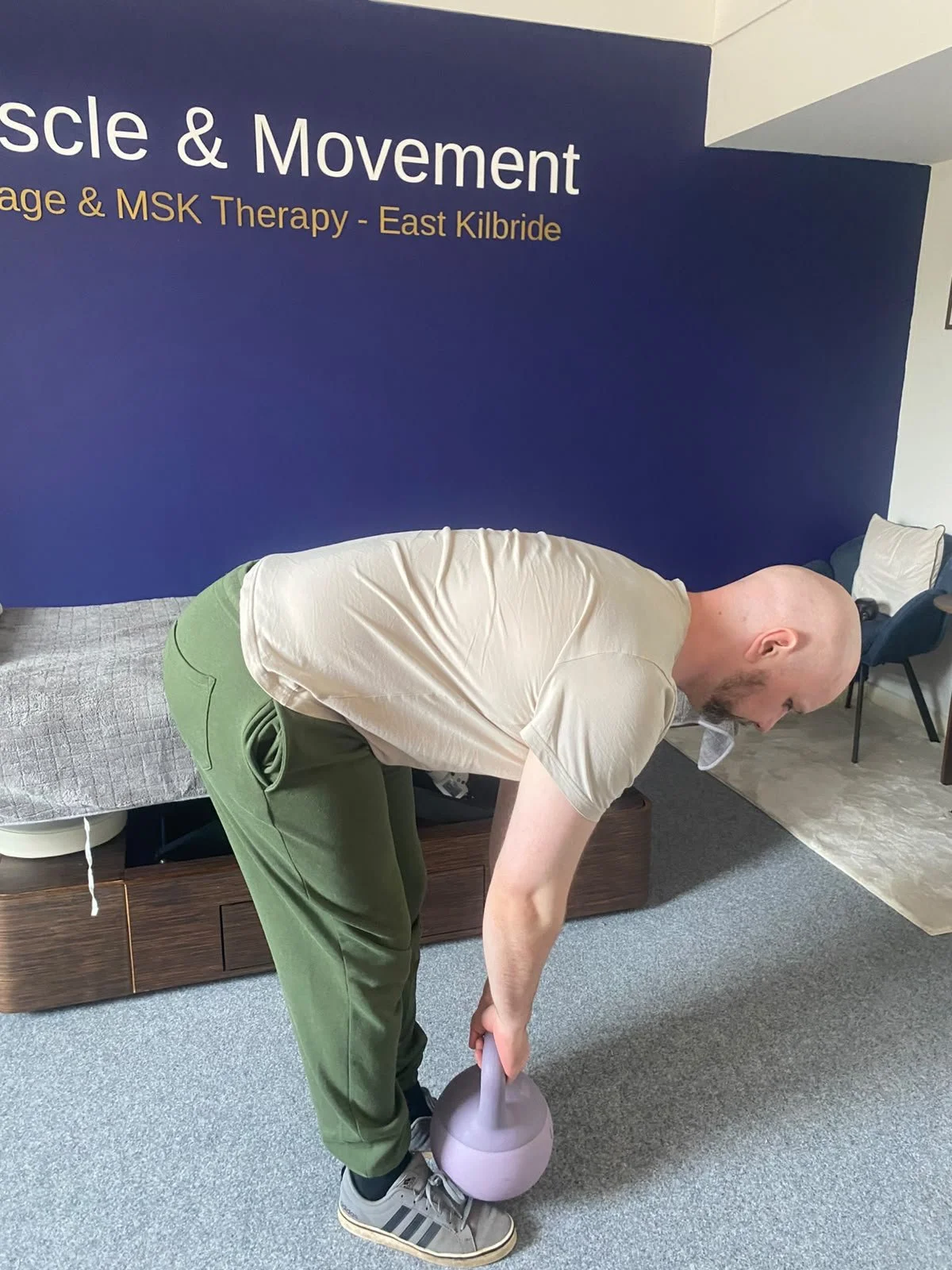
We See Strength As Capacity
the movements in the gym are movement patterns we carryout in everyday life
What About Returning to a Deadlift or Gym Exercise?
The same principles still apply.
If a deadlift bothered your back, the useful question is not necessarily:
“What is the one perfect deadlift technique I must use from now on?”
First establish whether returning to that lift is appropriate.
Then look at what has actually changed.
Perhaps the previous session involved much more weight than usual.
Perhaps training volume jumped.
Perhaps you are comfortable with a lighter deadlift but uncertain once the weight reaches a certain point.
Perhaps bending outside the gym is completely fine and it is only that exercise that feels uncertain.
Those are different problems.
A return might involve adjusting load, range, repetitions or exercise variation before gradually moving closer to the version you want to perform.
That is strength coaching territory when the issue is programming and physical capacity.
Where pain, injury or the reason for the change is unclear, assessment comes first.
Should Bending or Lifting Hurt While You Are Returning to It?
There is no useful universal rule such as:
“If it hurts at all, stop.”
or:
“Pain doesn't matter, push through.”
Both remove the context.
Some people can return through movements that feel comfortable.
Others with persistent back pain may still experience familiar symptoms while remaining active.
The amount, type and behaviour of those symptoms matter, as does the person's health history and what they are trying to do.
A blog cannot set an individual pain threshold.
If you are unsure whether the response you are getting is reasonable, that is a much better reason to seek individual advice than trying to apply somebody else's internet rule to your back.
When Is It Worth Looking at the Problem More Closely?
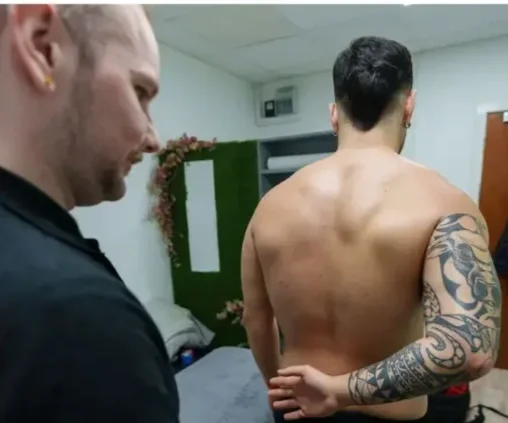
An assessment may be useful when bending or lifting keeps causing trouble, the issue repeatedly returns, you have stopped several normal activities or you are simply unsure what you are dealing with.
At RCMM, the Movement & Function Assessment gives Ross time to hear what has happened and look at the movement or task that is actually causing difficulty.
That may include relevant Sports Therapy assessment, movement or strength testing and a discussion of what the task demands.
Sometimes that leads to a fairly straightforward plan.
Sometimes the useful outcome is recognising that another healthcare professional or medical assessment is more appropriate.
The point is not to find faults in every movement.
It is to gather enough useful information to decide what makes sense next.
When Back Pain Needs Medical Attention
Most back pain is not caused by a serious medical problem, but there are situations where massage, exercise advice or a Sports Therapy appointment should not be the first stop.
According to current NHS guidance, seek urgent medical help for back pain that is severe and worsening quickly or when you feel significantly unwell.
Call 999 or attend A&E if back pain is accompanied by symptoms such as new numbness around the genitals or anus, changes in bladder or bowel control, or significant symptoms affecting both legs. Back pain following a serious accident also needs urgent assessment.
The NHS also advises contacting a GP when back pain is not improving, is stopping normal daily activities or is otherwise causing concern.
A More Useful Question Than “Am I Lifting Wrong?”
When a back has hurt, it is very easy for every bend to turn into a technique check.
Sometimes technique does need adapting.
But the research does not support reducing back pain to one forbidden spinal position or one correct way everybody must lift.
A better set of questions is:
What am I trying to do?
What part currently feels difficult?
Can I change the demand enough to make it manageable?
What would I need to build towards to do the full task again?
That leaves room for the way real life actually works.
Because eventually you still need to pick up the shopping, empty the washing machine, move something at work or reach down to the floor.
The aim is not to make every bend technically perfect.
It is to have enough options and capacity to deal with the movements your life actually asks of you.
Frequently Asked Questions
Is bending your back bad for you?
Bending is a normal movement of the spine.
Research looking at lifting has not shown good evidence that greater lumbar flexion on its own is a risk factor for developing or continuing low back pain.
That does not mean every load or task is appropriate for every person at every stage. The weight, repetition, speed, overall demand and individual situation still matter.
Should I always squat down instead of bending at the back?
Not necessarily.
A squat-style lift can be useful for some objects and situations, but biomechanical research has not established it as a universally safer way to lift or a reliable way to prevent low back pain.
Use a strategy that fits the task, the load and your current ability.
Why do I lift more stiffly since hurting my back?
People with low back pain often do lift more slowly and with less spinal movement.
That may reflect pain, caution or other changes around the task. The available studies are largely observational, so they cannot tell us that moving stiffly caused the pain.
Can strength training help me lift more confidently?
It can help build the physical capacity required for lifting.
Exercise is also supported within current low-back-pain guidance, but there is no single strength exercise everybody with back pain needs.
Strength work should match the person's goal and current ability.
What should I book at RCMM for back pain when lifting?
If the issue is recurring, unclear, linked to an injury or you want the movement assessed, start with a Movement & Function Assessment.
If you already understand the issue and mainly want targeted hands-on treatment around something affecting movement or activity, Sports Massage may be the better fit.
If your main goal is a firmer massage for general muscular comfort or maintenance rather than assessment, choose Deep Tissue Massage.
Related RCMM Guides
Back Pain Support in East Kilbride
Start here if your main question is whether RCMM may be relevant to your back concern.
What Is Movement Confidence — and How Can You Rebuild It?
The broader guide to confidence across everyday movement, activity and MSK concerns.
Why Back Pain Comes and Goes
For understanding why back symptoms may settle, return or fluctuate.
Why Does My Back Feel Tight?
For the specific sensation of recurring back tightness or stiffness.
Movement & Function Assessment in East Kilbride
RCMM's structured assessment appointment for injuries, recurring issues and movement concerns.
Professionally Reviewed by Ross Canning, Sports Therapist
Ross reviewed this article for professional scope, accuracy and practical relevance.
RCMM educational content is designed to help people understand movement and musculoskeletal topics more clearly. It does not replace medical diagnosis or individual healthcare advice.
Source base
NICE — Low back pain and sciatica in over 16s: assessment and management (NG59).
Strong UK guidance for remaining active, self-management, exercise and the limited/combined role of manual therapy.
NHS — Back pain, reviewed 5 March 2026.
For current UK public guidance on staying active and when back pain needs GP, urgent or emergency assessment.
Saraceni et al., 2020 — To Flex or Not to Flex? Is There a Relationship Between Lumbar Spine Flexion During Lifting and Low Back Pain?
Systematic review/meta-analysis.
Nolan et al., 2020 — Are there differences in lifting technique between those with and without low back pain?
Systematic review showing that people with low back pain often lift more slowly/stiffly and use different strategies, while emphasising that the cross-sectional evidence cannot establish causation.
Hayden et al., Cochrane 2021 — Exercise therapy for chronic low back pain.
Good high-level evidence for the exercise section,
Martimo et al., BMJ 2008 — Effect of training and lifting equipment for preventing back pain in lifting and handling.
Older, but still useful because it directly examined whether teaching lifting technique prevents back pain and found no evidence that technique training alone did so.