Why Does My Back Feel Tight?
Written by Paula, RCMM Operations & Content Lead
Originally published: 13 May 2026
Last updated: 28 August 2026
You stand up after working for a while and your back feels stiff.
You bend to put your shoes on and it feels tighter than usual.
Or there is no obvious pain at all — just that familiar sense that your back needs to loosen off.
It is tempting to assume that a tight-feeling back must mean the muscles are physically tight, shortened or somehow stuck.
The feeling is real.
But the explanation is not always that simple.
Summary
A back that feels tight or stiff is not necessarily mechanically stiff.
Research in people with chronic low back pain has found that how stiff someone's back feels does not necessarily match objective measures of spinal stiffness.
Tightness can become noticeable in different situations — after spending a long time in one position, doing more physical activity than usual, during or after a painful episode, or simply when an area feels less comfortable to move.
The sensation alone cannot tell you which muscle, joint or other structure is responsible.
For mild and familiar tightness, comfortable movement, changing position or time may be enough. If the same feeling repeatedly affects what you can do, the pattern around it becomes more useful than the word “tight” on its own.
Educational Note
This article provides general education. It is not medical advice, a diagnosis or personalised rehabilitation guidance.
RC Muscle & Movement provides Sports Therapy, massage and movement-focused assessment in East Kilbride.
Seek appropriate medical advice for severe or rapidly worsening symptoms, significant trauma, new or progressive weakness or numbness, bowel or bladder changes, fever or feeling generally unwell, or another concerning change.
First: What Do You Mean by “Tight”?
People use the word tight to describe quite a few different sensations.
Your back might feel:
stiff when you first move
tense across one side
heavy after a busy day
resistant when you bend
uncomfortable at the end of your available movement
as though it needs to stretch or move
Those descriptions are useful.
What they do not give us is a diagnosis.
You cannot feel the exact length of a muscle, measure the mechanical stiffness of your spine or identify one particular tissue simply from the sensation of tightness.
That distinction matters.
We explore the terminology itself in more detail in Muscle Tightness or Muscle Tension: What’s the Difference?.
This article has a narrower question:
What might a tight-feeling back actually be telling you?
Feeling Stiff and Being Stiff Are Not Necessarily the Same Thing
This is one of the more interesting pieces of research around back stiffness.
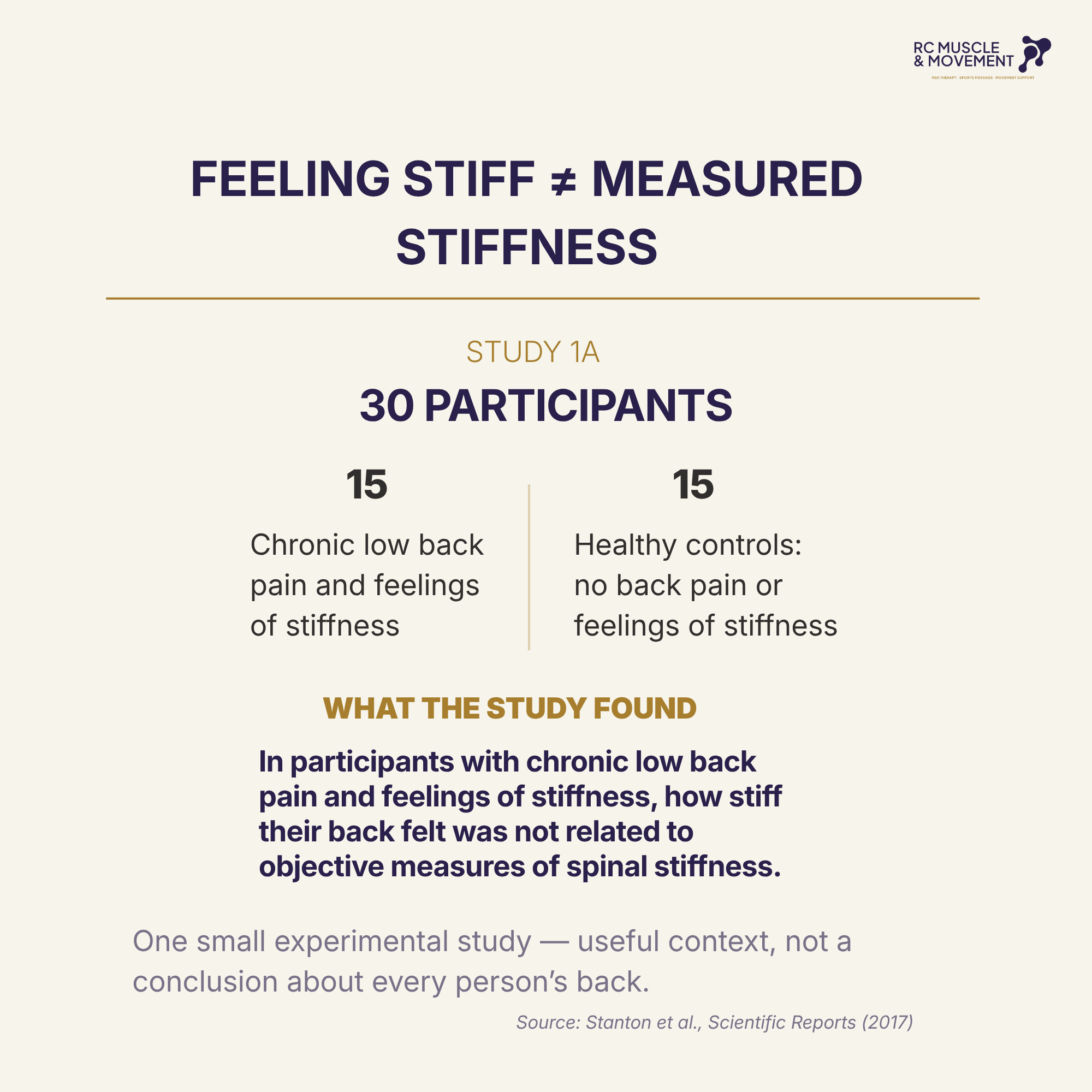
A 2017 study compared 15 people with chronic low back pain and feelings of stiffness with 15 people without back pain or stiffness.
Researchers measured how stiff participants said their backs felt and separately measured mechanical spinal stiffness using controlled pressure.
They found no significant relationship between perceived stiffness and the objective stiffness measurements in the group with chronic back pain.
That does not prove that every feeling of stiffness is purely perceptual.
It was a small study, involving a specific group of people with chronic back pain.
But it does challenge a very common assumption:
Feeling stiff does not automatically prove that your back is physically stiff.
The researchers suggested that stiffness may sometimes form part of a broader protective perception around the back.
That is an interesting possibility rather than a universal explanation.
A useful distinction
What you notice
What it tells you
“My back feels tight.”
Something about the area feels different or less comfortable.
“I cannot bend as far today.”
Your available or comfortable movement has changed.
Measured mechanical stiffness
A specific physical property measured under controlled conditions.
Back pain
A pain experience, which may occur with or without feelings of stiffness.
These things can overlap without being interchangeable.
So Why Might Your Back Feel Tight?
There is no single list of causes that can diagnose back tightness from a blog.
Context can still give you useful clues.
You have been in one position for a while
A back can feel stiff when you first move after spending a long time sitting, driving, standing or working in one position.
That does not make the position dangerous.
Sometimes the first few movements simply feel different after a period with less movement variety.
If sitting is the pattern you recognise most, Why Back Pain Feels Worse After Sitting looks specifically at that situation.
You have done more than you are used to
Gardening for three hours.
A longer walk.
A new gym session.
Moving furniture.
A weekend full of jobs around the house.
Your back is involved in a lot of ordinary physical tasks.
After doing more than usual, an area can feel tired, sore or stiff in much the same way that other parts of the body can feel worked after unfamiliar activity.
That does not automatically identify an injury.
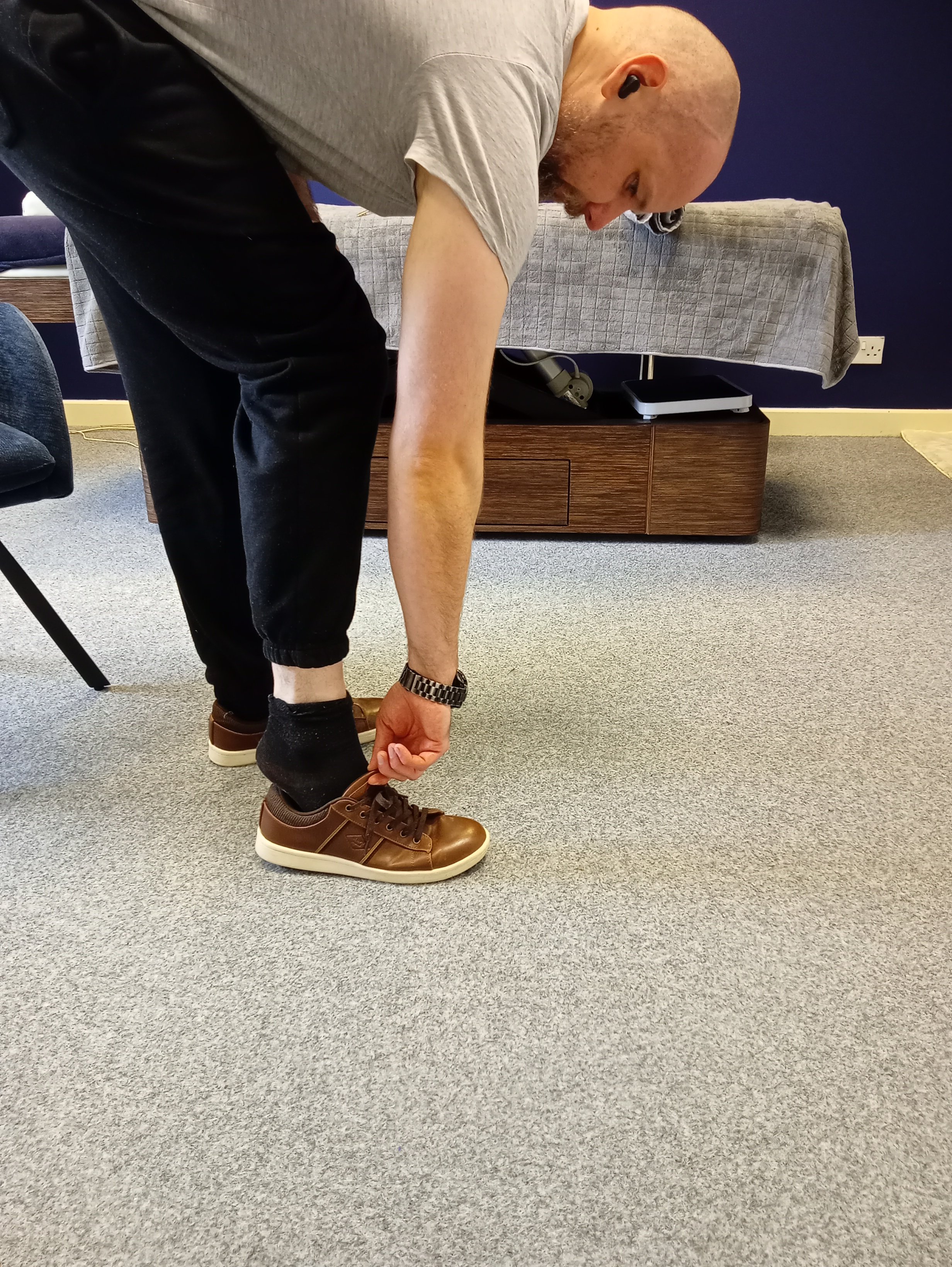
Your back does more than you notice.
Shoes, socks, bags, chairs — ordinary life asks your back to bend, reach and adjust all day.
Your back has recently been painful
Pain and stiffness often occur together.
An area that has recently been uncomfortable may also feel more guarded, restricted or simply less pleasant to move.
That still does not mean you can work backwards from the sensation and identify exactly what structure caused it.
Most low back pain is described as non-specific, meaning that one particular structural cause cannot confidently explain the symptoms.
That is one reason good back-pain care is usually broader than hunting for one “bad” muscle or joint.

Sometimes there is no obvious trigger
This is frustrating, but it is also common.
Not every bodily sensation comes with a neat before-and-after story.
You might notice that your back feels tighter one morning and struggle to identify anything dramatically different about the day before.
Rather than guessing, it can be more useful to watch what happens next:
Does it change once you start moving?
Does the feeling stay local?
Is it affecting what you can normally do?
Is this a familiar pattern or something genuinely new?
That information is often more useful than trying to name the cause immediately.
Why Can Moving Make a Tight Back Feel Better?
A lot of people recognise this pattern:
“It feels stiff when I first get up, but once I start walking around it loosens off.”
There are several possible reasons movement may change how an area feels.
Movement changes position and exposes the back to different ranges and loads. It also provides new sensory information and gives you an opportunity to discover that movements which initially felt reluctant may become more comfortable.
What we should not conclude is:
“Walking loosened the tight muscle, therefore a shortened muscle must have been the problem.”
Feeling better after moving tells you that movement changed the experience.
It does not identify the original cause.
Current NICE guidance for uncomplicated low back pain encourages people to continue normal activities where possible rather than routinely resting or avoiding movement.
That does not mean forcing painful movement.
It means that backs generally do not need to be protected from ordinary activity simply because they feel stiff.
What About Stretching?
Stretching can feel good.
Sometimes that is enough reason to do it.
A gentle stretch may temporarily change how an area feels or how comfortable a movement is.
Again, the response does not necessarily tell you why the tightness was there.
If your back feels better after stretching, that does not prove:
the muscle was shortened
something had moved out of place
you corrected your posture
the stretch permanently changed the tissue
It tells you that the stretch changed your experience at that point in time.
If it feels good and does not aggravate things, that may still be useful.
You do not need to invent a structural explanation to justify something that simply makes you feel more comfortable.
Why Does the Tightness Keep Coming Back?
This is where two different questions can easily get mixed together.
This article is about what a feeling of tightness can and cannot tell you.
If your bigger question is:
“Why is my back good for a few days and then bad again?”
that is about symptom fluctuation, and we have a separate guide on Why Back Pain Comes and Goes.
Keeping those questions separate matters.
A recurring sensation does not necessarily mean the same tissue is repeatedly becoming physically tight.
It tells you there is a pattern worth understanding.
A More Useful Way to Think About Back Tightness
Rather than immediately asking:
“Which muscle is tight?”
try gathering a little more information.
Where do you actually feel it?
Across the whole lower back?
One side?
Closer to the ribs?
Near the pelvis?
When does it appear?
First thing in the morning?
After sitting?
After training?
Towards the end of work?
After a physically busy weekend?
What happens when you move?
Does walking change it?
Does bending become easier after a few repetitions?
Does the sensation stay the same regardless of what you do?
Does it affect function?
There is a difference between:
“My back feels a bit stiff when I stand up.”
and:
“My back becomes so uncomfortable that I stop lifting, walking or doing normal activities.”
Is anything else happening?
Pain, leg symptoms, numbness, weakness, illness, trauma or a significant change in normal function all add information that the word tight cannot provide on its own.
You do not need medical terminology.
You need a useful description.
What Can You Try for an Everyday Tight-Feeling Back?
If the feeling is mild, familiar and there are no concerning changes, simple options may be enough.
Change position
If you have been sitting or standing for a long time, give yourself another position rather than searching for the one “perfect” posture.
Move comfortably
A short walk or a few comfortable movements can be a simple way of seeing how the sensation responds.
Keep doing normal things where you can
You do not necessarily need to stop bending, lifting or exercising simply because your back feels a little stiff.
Adjusting the amount or pace may make more sense than avoiding the activity altogether.
Notice patterns rather than chasing explanations
If the feeling disappears and rarely bothers you, it may not need much investigation.
If the same pattern repeatedly affects work, training or everyday movement, then there is more useful information to work with.
When Is It Worth Getting the Tightness Assessed?
A recurring tight feeling is not automatically a reason for treatment.
Assessment becomes more useful when the sensation:
keeps returning without a clear pattern
starts changing how you move
affects work, activity or normal daily tasks
occurs alongside pain or other symptoms
feels noticeably different from your usual experience
leaves you unsure what is sensible to do
Our Back Pain Support in East Kilbride page explains the wider way RCMM approaches recurring back discomfort.
When understanding the pattern is the priority, the Movement & Function Assessment gives Ross time to take a history, carry out relevant movement and physical assessment, and explain appropriate next steps.
Frequently Asked Questions
Why does my lower back feel tight even when I have not injured it?
A tight feeling does not require an obvious injury.
It may become noticeable after time in one position, more activity than usual, during or after an episode of discomfort, or without one obvious trigger.
The sensation itself cannot identify its cause.
Does a tight back mean my muscles are shortened?
Not necessarily.
Feeling tight is not a direct measurement of muscle length or mechanical stiffness.
Research in people with chronic back pain has shown that perceived back stiffness does not necessarily correspond with measured spinal stiffness.
Why does my back loosen up when I walk?
Movement changes position, loading and sensory information around the back.
If walking makes the area feel better, that is useful information — but it does not prove which structure caused the original feeling.
Should I stretch a tight lower back?
You can use comfortable stretching if it feels helpful.
You do not need to force range or stretch aggressively, and temporary relief does not necessarily mean shortened muscles caused the tightness.
Is back tightness the same as back pain?
No.
They can occur together, but tightness describes a sensation of tension, restriction or stiffness, while pain is a separate experience.
Should I worry if my back always feels stiff?
Persistent stiffness is worth paying attention to if it is worsening, changing, affecting normal activity or occurring alongside other symptoms.
The useful next step depends on the wider pattern rather than the word stiffness alone.
Key Takeaways
A back that feels stiff is not necessarily mechanically stiff.
Tightness is a sensation, not a diagnosis.
The feeling alone cannot identify one muscle, joint or other structure as the cause.
Time in one position, unfamiliar physical demand or a recent painful episode may provide useful context without proving a specific cause.
Movement or stretching can change the sensation without revealing why it started.
Mild, familiar tightness may need little more than comfortable movement and normal activity.
Recurring or function-changing symptoms are more useful to assess in context.
The question does not always need to be:
“What is tight?”
Sometimes the better question is:
“When does my back feel this way, what changes it, and is it actually stopping me doing anything?”
Professionally Reviewed by Ross Canning, Sports Therapist
Professionally Reviewed by Ross reviewed this article for accuracy, professional scope and practical relevance. RCMM’s educational content does not replace medical diagnosis or individual healthcare advice.
Related Articles and Support
Source Base Used
Stanton TR, Moseley GL, Wong AYL, Kawchuk GN. (2017). Feeling stiffness in the back: a protective perceptual inference in chronic back pain. Scientific Reports, 7, 9681.
A small experimental study examining perceived and objectively measured back stiffness. It supports the distinction between the sensation of stiffness and measured mechanical stiffness but should not be treated as a universal explanation for back tightness.
World Health Organization. (2023). Low back pain.
WHO reports that non-specific low back pain represents roughly 90% of low-back-pain presentations and emphasises rehabilitation, activity and return to meaningful function.
NICE. (2016; updated 2020). Low back pain and sciatica in over 16s: assessment and management (NG59).
NICE recommends information and self-management support, including encouragement to continue normal activities, and advises against routine imaging in non-specialist settings where serious pathology is not suspected.
Jones CMP, Underwood M, Basnet R, Trewern L, Lin CWC. (2025). Management of non-specific low back pain without drugs. BMJ.
Contemporary review of non-drug management supporting education, exercise and activity-based approaches for non-specific low back pain