Why Back Pain Comes and Goes
Written by Paula, RCMM Operations & Content Lead
Originally published: 11 May 2026
Last updated: 22 August 2026
Summary
Back pain does not always follow a tidy route from painful to better.
It may settle for days or weeks, return during an ordinary day, change in intensity or flare without one obvious trigger. Research describes back pain as commonly variable or recurring, although the pattern differs considerably between people.
Pain returning does not automatically mean you have damaged your back again. It does not prove that nothing physical matters either. The pattern alone cannot tell you the cause.
A more useful response is to notice whether anything has changed, adjust activity without abandoning movement altogether and seek appropriate medical advice when symptoms are new, worsening or accompanied by concerning changes.
Educational Note
This article provides general education. It is not medical advice or a diagnosis.
RC Muscle & Movement does not diagnose injuries or medical conditions. We provide movement-focused assessment, hands-on soft-tissue support and practical guidance within sports therapy scope.
New, significantly changed, worsening or unexplained symptoms should be discussed with an appropriate healthcare professional. Urgent warning signs are covered later in this article.
Why Back Pain That Returns Can Feel So Confusing
Your back settles.
You stop thinking about it.
Then it starts bothering you again.
Sometimes you can point to something different. Perhaps you did more lifting, spent longer driving or returned to the gym after time away.
Other times, nothing stands out.
It was a normal Tuesday. You put the shopping away, sat down for dinner and noticed your back was sore again.
That can leave you wondering:
“If it was getting better, why has it come back?”
It is an understandable question. We naturally want a clear event, a clear cause and a clear solution.
Back pain is not always that considerate.
If your main question is what support is available locally and which appointment may fit, visit our Back Pain Support in East Kilbride page.
This article has a narrower job: helping you understand why back pain can change and what you can sensibly do when it does.
Back Pain Does Not Always Follow a Straight Line
Some back-pain episodes improve and do not return.
Others settle, flare and settle again.
Some remain at a low level with occasional more difficult days. Others disappear for months before making an unwelcome return.
Research into recurrence reports different figures because studies use different definitions of recovery, recurrence and severity. The useful point is not one dramatic statistic. It is that improvement is not always a perfectly straight line.
A returning symptom therefore does not automatically put you back at the beginning.
It means something has changed in how your back feels. What it does not give you is a diagnosis.
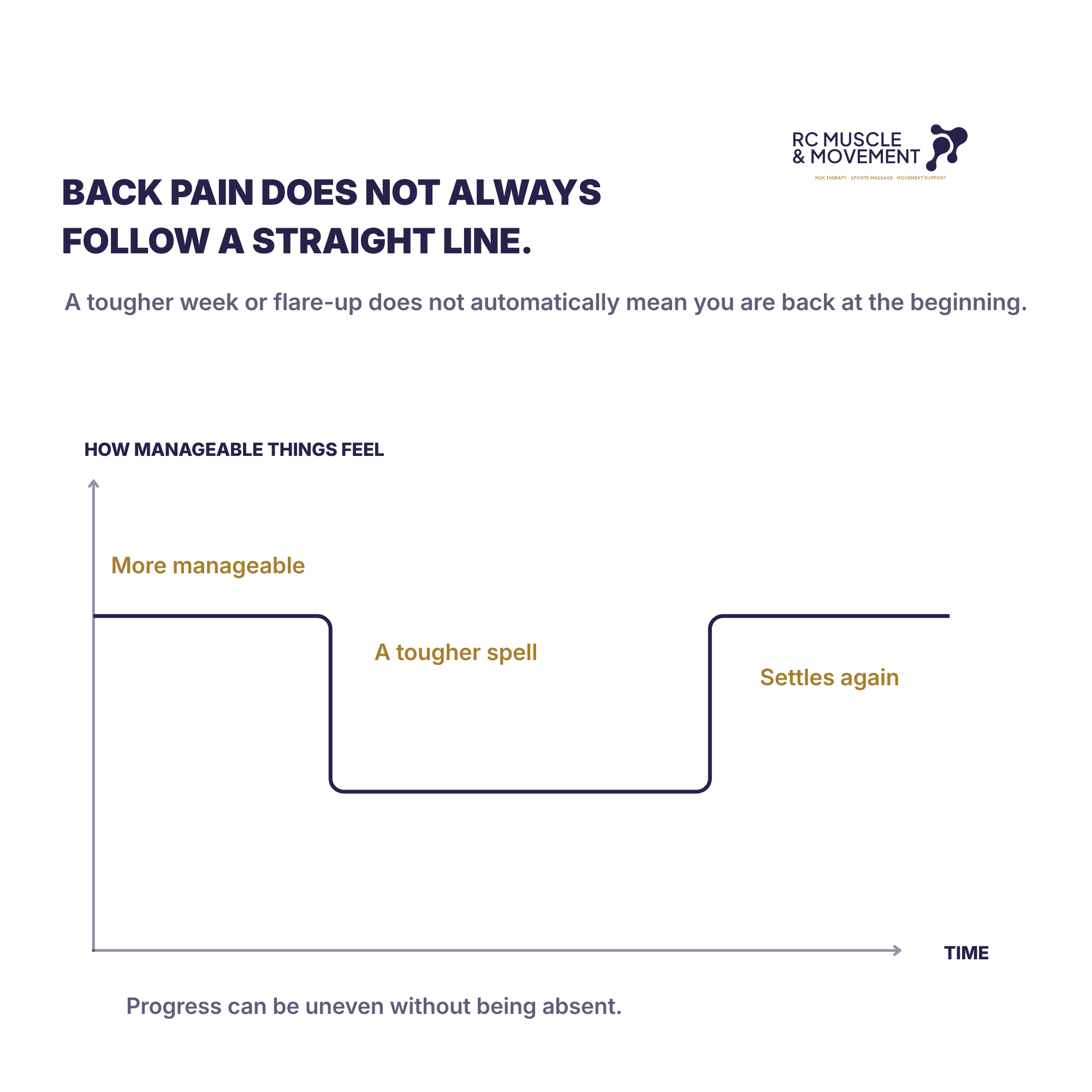
It’s not always linear
it can be hard to understand because back pain is not always in a straight line as diagram show
Pain Is Real, but It Is Not a Precise Damage Meter
Pain matters. It can affect sleep, work, exercise, family life and how confident you feel moving.
But pain is not a precise measurement of tissue damage.
The International Association for the Study of Pain explains that pain is a personal experience influenced by a mixture of biological, psychological and social factors.
In everyday language, that means pain can be shaped by more than one thing at a time:
what your body has recently been asked to do
previous experiences of pain
sleep and general recovery
stress and emotional strain
work and family demands
how safe or confident movement feels
health conditions or physical changes that require medical assessment
This does not mean pain is “in your head”.
It means your pain experience is real and your body does not operate separately from the rest of your life.
One way to picture it is as a volume control with several dials. Activity, recovery, stress, confidence and physical health may all influence the volume. Not every dial matters equally, and the combination can change from one day to the next.
That metaphor can help explain variation. It cannot tell you the medical cause.
A changing pain signal is useful information. It is not a diagnosis.
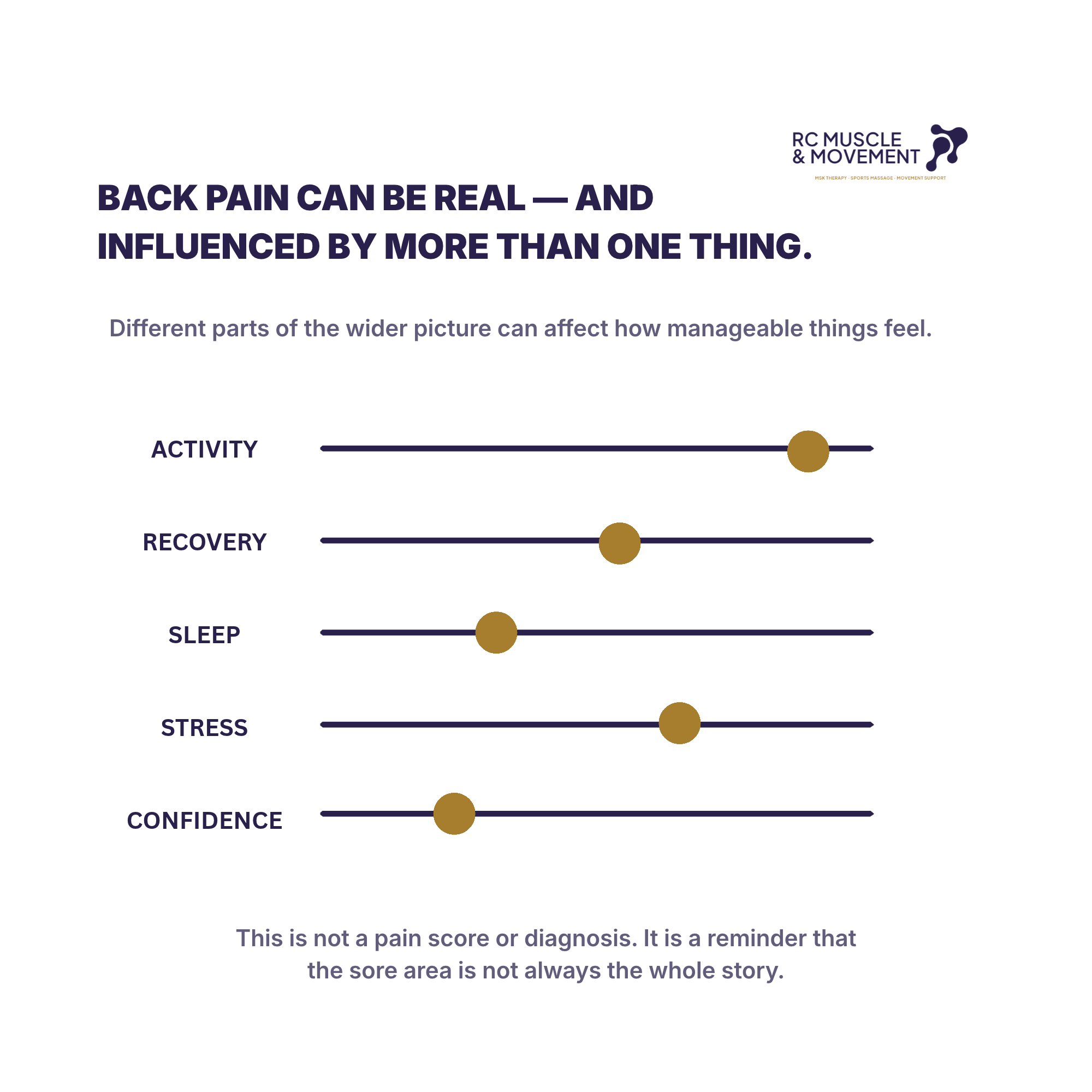
What Can Turn the Volume Up or Down?
A Change in What Your Back Has Been Asked to Do
The change does not need to involve a dramatic lift or obvious injury.
It might be:
gardening for longer than usual
returning to exercise after a break
carrying more at work
an unfamiliar journey
moving house
doing less for a few weeks and then suddenly doing much more
spending the weekend on a task your body is not used to
None of these activities is automatically bad.
They are simply changes in demand. A body that was comfortable with one level of activity may need time to adapt to another.
That does not prove the activity caused the pain. It gives you one possible part of the pattern to consider.
Spending Longer in One Position
Long periods at a desk, in the car or on the sofa may influence how your back feels.
The important point is not that sitting is dangerous or that you must hold perfect posture. It is that staying in one position gives your body fewer opportunities to move in other ways.
We cover that subject properly in Why Back Pain Feels Worse After Sitting, so there is no need to turn this article into another lecture about chairs.
Recovery May Not Match the Week You Have Had
A demanding week can feel more physically manageable when you are sleeping well and getting some recovery.
The same week may feel very different when sleep has been poor, work is stressful and you have barely had time to move.
Sleep, stress and other psychological factors may influence back-pain flare-ups, but the research is not strong enough to treat any one of them as a universal explanation. They are possible influences, not something to blame yourself for.
Stress affecting pain does not make the pain imaginary. Poor sleep affecting how you cope does not mean sleep is the whole cause.
Previous Episodes Can Change How Movement Feels
If bending hurt badly before, you may naturally become more cautious the next time your back feels sore.
That response makes sense. Nobody enjoys repeating something they believe may hurt.
The difficulty is that worry can make normal movement feel more threatening, especially when you do not understand why symptoms have returned.
Our article on Back Pain and Movement Confidence explores that side of the picture in more detail.
Sometimes There Is No Tidy Answer
You can do everything “right” and still have a sore day.
You can sleep well, move regularly and avoid any obvious unusual activity, yet symptoms still change.
That does not mean you failed to spot the secret cause.
Pain research cannot always explain why a particular flare happened on a particular day. Looking for patterns can be helpful. Interrogating every movement you made is not.
What Do We Mean by a Flare-Up?
“Flare-up” is often used casually, but researchers have worked with people who experience back pain to give it a clearer meaning.
Broadly, it describes a noticeable worsening that lasts from hours to weeks and is difficult enough to affect normal activity or how someone feels emotionally.
That is useful because it recognises that a flare-up is about more than a number on a pain scale.
It might mean:
walking becomes harder
sleep is disturbed
work needs adjusting
bending feels more guarded
you feel worried or frustrated
everyday plans become more difficult
A flare-up describes a change in your experience.
It does not tell us which structure is involved, prove that fresh damage has occurred or confirm that everything is harmless.
What to Do When Back Pain Flares
First, Ask Whether Anything Is Genuinely Different
Before assuming this is the same old problem, pause and check.
Is the discomfort in the usual place?
Does it behave in the familiar way?
Are there new leg symptoms, numbness, weakness, illness or changes to bladder or bowel control?
Has there been a significant accident or fall?
A familiar pattern may be managed differently from symptoms that are new or clearly changing. If something feels meaningfully different, medical advice is more useful than guessing.
Adjust Activity Without Abandoning It
When your back is sore, it is reasonable to make the day more manageable.
That might mean:
taking a shorter walk
reducing the weight you are carrying
breaking one task into smaller parts
changing position more often
slowing the pace
temporarily reducing an activity that sharply aggravates symptoms
Adjusting is not the same as doing nothing.
NICE guidance encourages people with low back pain to continue normal activities where possible. NHS Inform also advises against prolonged bed rest.
You do not need to force your way through severe pain to prove a point.
The aim is to find a manageable amount of movement rather than choosing between “carry on exactly as normal” and “stop everything”.
Choose Movement That Feels Manageable
There is no single magic exercise for every back-pain flare.
For one person, a short walk feels useful. Someone else may prefer changing position regularly or gently moving through a comfortable range.
Start with what feels possible.
If a movement makes symptoms significantly worse, produces new symptoms or leaves you clearly worse afterwards, stop and seek appropriate advice.
Look Back Across the Last Few Days
People often search for the exact movement that hurt.
Sometimes the more useful clues sit across the previous few days:
Has activity increased or dropped?
Have you done something unfamiliar?
Have you spent longer sitting or driving?
Has work been physically or mentally demanding?
Has sleep changed?
Is this the same pattern as before?
These questions may help you notice a pattern.
They are not a test you can fail, and they do not prove causation.
Build Back Up Gradually
As symptoms become more manageable, begin returning towards your usual activity.
That may mean adding a little more walking, carrying, bending, training or general movement over time.
You are looking for a level your body can currently manage, then building from there.
There is no prize for rushing. There is also no need to wait for every sensation to disappear before doing anything.

Keep a Short Note, Not a Full-Time Pain Diary
If symptoms keep returning, a brief note can sometimes reveal more than trying to remember everything afterwards.
For a week or two, record:
when symptoms were more noticeable
what your day had involved
what made movement easier or harder
whether the pattern was familiar or different
how much it affected normal activity
Keep it short.
The aim is not to monitor every twinge or spend the day thinking about your back. It is to gather enough useful information to make the pattern less vague.
If tracking makes you more anxious or focused on pain, leave it.
When to Get Medical Advice
Most back pain is not caused by a serious medical condition, but no article or non-diagnostic appointment can rule one out.
Speak to a GP or appropriate healthcare professional if:
pain is not improving after several weeks
it is stopping you from managing everyday activities
symptoms are worsening
you feel unwell, feverish or shivery
pain is consistently worse at night
you have lost weight without trying
the pattern has changed and you are concerned
you are finding the pain difficult to cope with
In Scotland, phone NHS 24 on 111 if back pain follows significant recent trauma or you develop new:
numbness or altered sensation around the genitals, inner thighs, buttocks or back passage
difficulty starting, stopping or controlling urination
loss of bladder or bowel control
increasing weakness, numbness or altered sensation affecting both legs
These symptoms are uncommon, but they require urgent medical assessment. Follow the current guidance on the NHS Inform back-problems page rather than relying on an online article alone.
How RCMM Can Help
If recurring back pain is becoming difficult to make sense of, the useful first step is not another confident guess.
It is building a clearer picture.
A Movement & Function Assessment gives you space to discuss:
when symptoms appear
what has changed
how movement currently feels
which activities are becoming difficult
what has or has not helped
which next step may be appropriate
RCMM does not diagnose the medical cause of back pain.
Where appropriate, support may include movement observation, practical guidance or hands-on soft-tissue work. If symptoms appear outside RCMM’s scope, medical or another form of professional support should be the next step.
Hands-on treatment may help some people feel more comfortable, but it should not be sold as a permanent fix for recurring back pain. NICE recommends manual therapy, including massage, only as part of a broader package that includes exercise.
The goal is to help you make a better-informed decision about what comes next.
Key Takeaways
Back pain often fluctuates rather than improving in a perfectly straight line.
Pain returning does not automatically mean fresh damage.
The pattern alone cannot diagnose the cause or confirm that symptoms are harmless.
Activity, recovery, sleep, stress, previous experience and wider health may all influence how pain feels.
During a familiar flare, adjust activity and keep moving where you reasonably can.
New, significantly changed or concerning symptoms need appropriate medical advice.
When recurring back pain feels unclear, assessment may help you build a more useful picture.
FAQs
Why does my back pain keep coming and going?
Back pain can have a variable or recurring course. Symptoms may change alongside activity, routine, recovery, sleep, stress or other factors, but there is not always one identifiable trigger. The pattern alone cannot tell you the cause.
Does pain returning mean I have damaged my back again?
Not automatically. Pain is not a precise damage meter, and symptoms can return without a new injury. However, returning pain does not prove that everything is harmless. New, worsening or changed symptoms should be assessed appropriately.
Why does my back hurt when nothing happened?
Not every episode begins with an obvious event. The influence may have built gradually, may involve several factors or may not be identifiable. A lack of an obvious trigger does not make the pain imaginary.
Can stress or poor sleep affect back pain?
They may influence how intense or manageable pain feels, particularly when combined with physical demand and reduced recovery. They should not be treated as the sole explanation for every episode.
Should I rest when my back pain flares?
A short period of rest may be understandable when symptoms are difficult, but prolonged bed rest is generally not advised. Modify activity and continue manageable movement where possible. Seek medical advice if you are unsure or symptoms are severe.
Do I need a scan because my back pain keeps returning?
Not necessarily. NICE does not recommend routine imaging for low back pain in non-specialist settings. A healthcare professional can decide whether imaging is appropriate based on your symptoms and whether the result is likely to change your care.
What should I book if recurring back pain feels unclear?
If symptoms are new, worsening or medically concerning, contact an appropriate healthcare professional.
If this is a familiar recurring pattern and you want to explore how movement and everyday demands may fit, the Movement & Function Assessment is usually RCMM’s clearest starting point.
Professionally Reviewed by Ross Canning, Sports Therapist
Ross reviewed this article for accuracy, professional scope and practical relevance. RCMM’s educational content does not replace medical diagnosis or individual healthcare advice.
Related Articles and Support
Back Pain Support in East Kilbride — local support, appointment information and booking guidance.
Why Back Pain Feels Worse After Sitting — sitting, posture and movement variety.
Everyday Back Tension: What’s Actually Going On — understanding recurring tightness and temporary relief.
Back Pain and Movement Confidence — how previous pain can affect trust in movement.
Source Base Used
NICE. Low back pain and sciatica in over 16s: assessment and management. NG59.
World Health Organization. Guideline for non-surgical management of chronic primary low back pain.
International Association for the Study of Pain. Pain terminology and definition.
A definition of “flare” in low back pain: consumer perspectives and expert consensus. 2019.
What do we know about flares in spinal and pelvic-girdle pain? A scoping review. 2026.