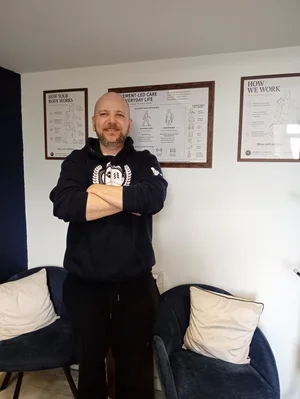
Why Feeling Tight Doesn’t Always Mean Something Is Short
Feeling tight does not always mean a muscle is physically short. Tightness can be influenced by movement habits, workload, recovery, strength, sensitivity, stress, sitting time and how your body is sharing effort. Stretching may help some people, but if tightness keeps returning, it may be more useful to look at the bigger movement picture.
Educational Note
This article is for general education only.
It is not medical advice and it is not a diagnosis.
RC Muscle & Movement does not provide injury diagnosis. We provide movement-focused assessment, hands-on soft-tissue support and practical guidance within our sports therapy scope.
If symptoms are severe, new, worsening, unexplained, or linked with other concerning changes, it is sensible to seek appropriate medical advice.
Why Tightness Is Often Misunderstood
Most people assume tightness means one thing:
“That muscle must be short.”
It sounds logical.
If your hamstrings feel tight, you stretch your hamstrings.
If your hips feel tight, you stretch your hips.
If your shoulders feel tight, you stretch your shoulders.
Sometimes that helps.
But many people notice the same thing keeps returning.
They stretch, feel better for a short while, then the tightness comes back.
That can be frustrating because it feels as though the body is not responding properly.
But tightness is not always as simple as muscle length.
A muscle can feel tight for several reasons.
It may feel tight because it is working hard.
It may feel tight because it is sensitive to certain positions.
It may feel tight because your day involves long periods of sitting, standing, driving or repeating the same task.
It may feel tight because another area is not contributing as well as it could.
It may feel tight because your body does not feel confident moving into a particular range.
So while stretching may be useful, it is not always the full answer.
Tightness Is A Feeling, Not Just A Measurement
This is an important distinction.
Tightness is something you feel.
Flexibility is something you can measure.
Those two things are related, but they are not identical.
Someone can have reasonable flexibility and still feel tight.
Someone else may have limited range of movement but not feel especially tight.
That is because the feeling of tightness is influenced by more than tissue length.
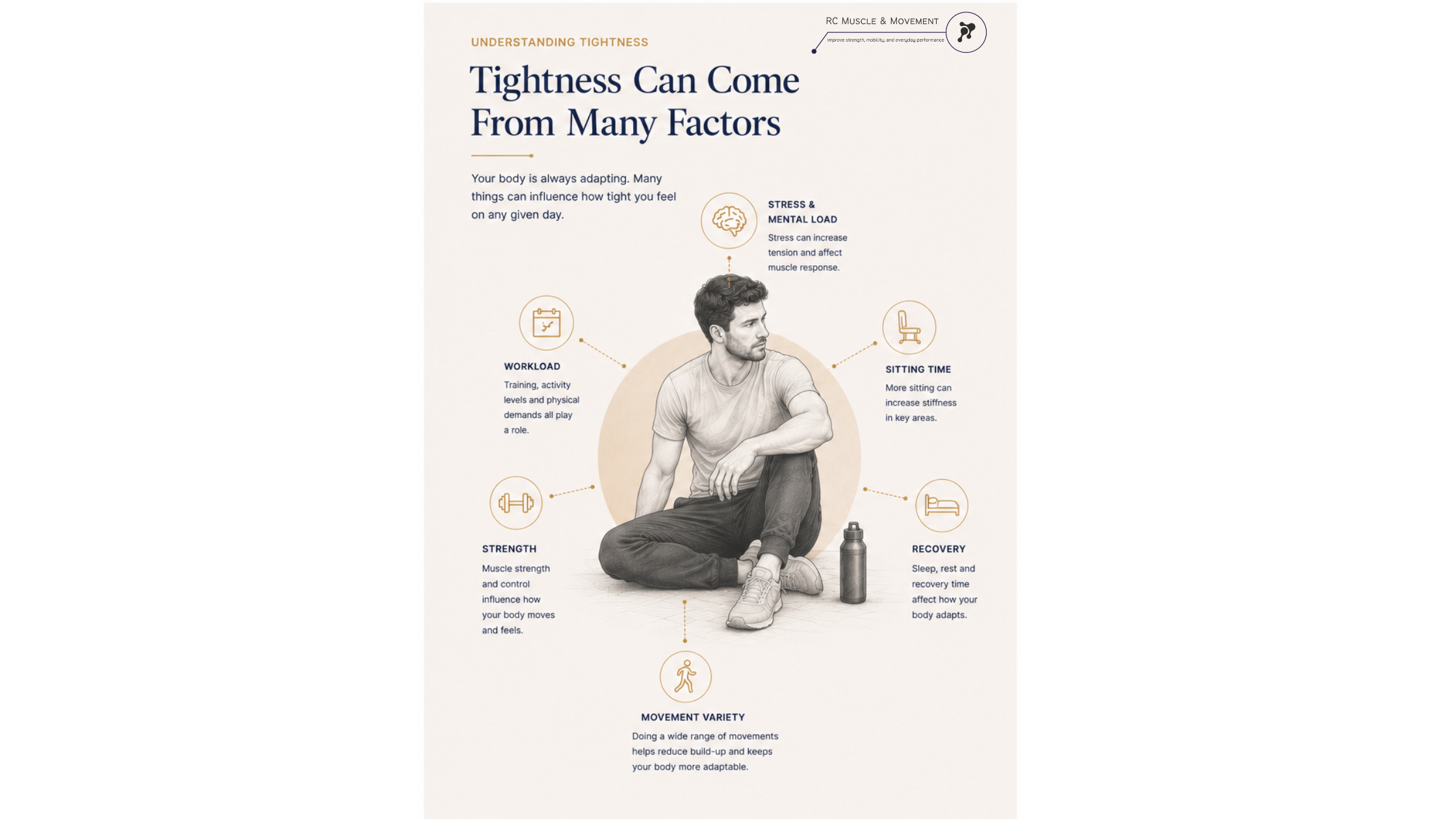
It can be affected by:
position
workload
movement habits
strength
confidence
recovery
stress
sleep
sensitivity
repetition
how recently you have moved
This is one reason why tightness can change from day to day.
A muscle has not necessarily become shorter overnight.
Your body may simply be responding differently to what life has recently asked from it.
If this sounds familiar around the back of the legs, our Hamstring Tightness pageexplains why hamstrings can feel tight, overworked or harder to trust during everyday movement.
Why Stretching Can Help — But Not Always For The Reason People Think
Stretching can be useful.
It can help people explore movement, reduce stiffness temporarily, and feel more comfortable moving into certain positions.
But the change is not always because the muscle has physically become longer in a simple mechanical way.
Research around stretching and flexibility suggests that changes in range of motion may involve stretch tolerance and sensation as well as tissue properties.
In plain English:
You may feel more comfortable moving further because your body becomes more used to that position.
That is still useful.
But it means stretching is not always “lengthening a short muscle” in the way people often imagine.
This matters because it changes how we think about recurring tightness.
If tightness keeps returning, the question may not be:
“How do I stretch this more?”
A better question may be:
“Why does this area keep feeling like it needs to protect, grip or work harder?”
Tightness Can Come From Overwork
A muscle may feel tight because it is doing too much.
This is very common.
For example:
hamstrings may feel tight if they are doing more work than the hips or glutes
shoulders may feel tight if the upper back and neck are carrying a lot of workload
calves may feel tight if the feet and ankles are not sharing movement well
the lower back may feel tight if it is taking on more work during sitting, bending or lifting
This does not mean the muscle is damaged.
It may simply be working harder than it needs to.
When an area is overworked, stretching it might feel good for a while.
But if the workload stays the same, the tight feeling may return.
That is why recurring tightness often needs more than a stretch.
It may need a better understanding of how the body is moving, loading and sharing effort.
Tightness Can Also Come From Underuse
This sounds like the opposite problem, but it can feel similar.
Sometimes an area feels tight because it has not been asked to move or work through enough variety.
This can happen after:
long periods of sitting
reduced activity
repetitive desk work
driving
changes in routine
avoiding certain movements
doing the same training patterns repeatedly
The body generally responds well to regular, varied movement.
When movement becomes limited or repetitive, some areas may begin to feel stiff, heavy or less comfortable.
This does not mean you need an aggressive mobility routine.
Often, the first step is simply reintroducing more movement options.
More positions.
More variety.
More confidence using the area.
Why Tightness Keeps Coming Back
Recurring tightness can be confusing because it often responds temporarily to massage, stretching or movement.
Then it returns.
This does not mean those things failed.
It may mean they helped one part of the picture.
For example:
Stretching may help you feel more comfortable in the short term.
Massage may reduce local tension and help the area feel easier to move.
Walking may help stiffness settle after sitting.
But if the bigger pattern is still there, the feeling can return.
That bigger pattern may include:
long periods in one position
one area doing more work than it needs to
reduced strength or capacity
repeated workload
poor recovery
stress-related tension
low movement variety
uncertainty around certain movements
This is why RCMM looks beyond the tight area itself.
Not because the tight area does not matter.
It does.
But it may not be the whole story.
When More Stretching Is Not The Best Next Step
More stretching is not always wrong.
But it is not always the most useful answer either.
You may need to look beyond stretching if:
the same area tightens again quickly
stretching gives only short-term relief
one side always feels tighter
tightness affects daily movement
the area feels tight during work or training
movement feels harder than it should
you feel unsure whether to stretch, strengthen or rest
In these situations, it can be more useful to ask:
What is this area being asked to do?
Is it doing too much?
Is it not doing enough?
Is another area avoiding work?
Does the body feel confident in this movement?
Has workload increased recently?
Has recovery changed?
That gives a clearer picture than simply assuming a muscle is short.
If tightness keeps returning and you are unsure what is contributing, a Movement & Function Assessmentcan help build a clearer picture of how your body is moving and what support may fit best.
Strength Can Change How Tightness Feels
This is where strength-informed thinking matters.
Not gym culture.
Not performance pressure.
Not telling everyone they need to lift heavy.
Just the simple idea that a body with more capacity often copes better with everyday physical demands.
If a muscle or area feels tight because it is overloaded, strengthening the wider system may help it cope better.
If an area feels tight because it lacks confidence in certain positions, gradual strength work may help movement feel more trustworthy.
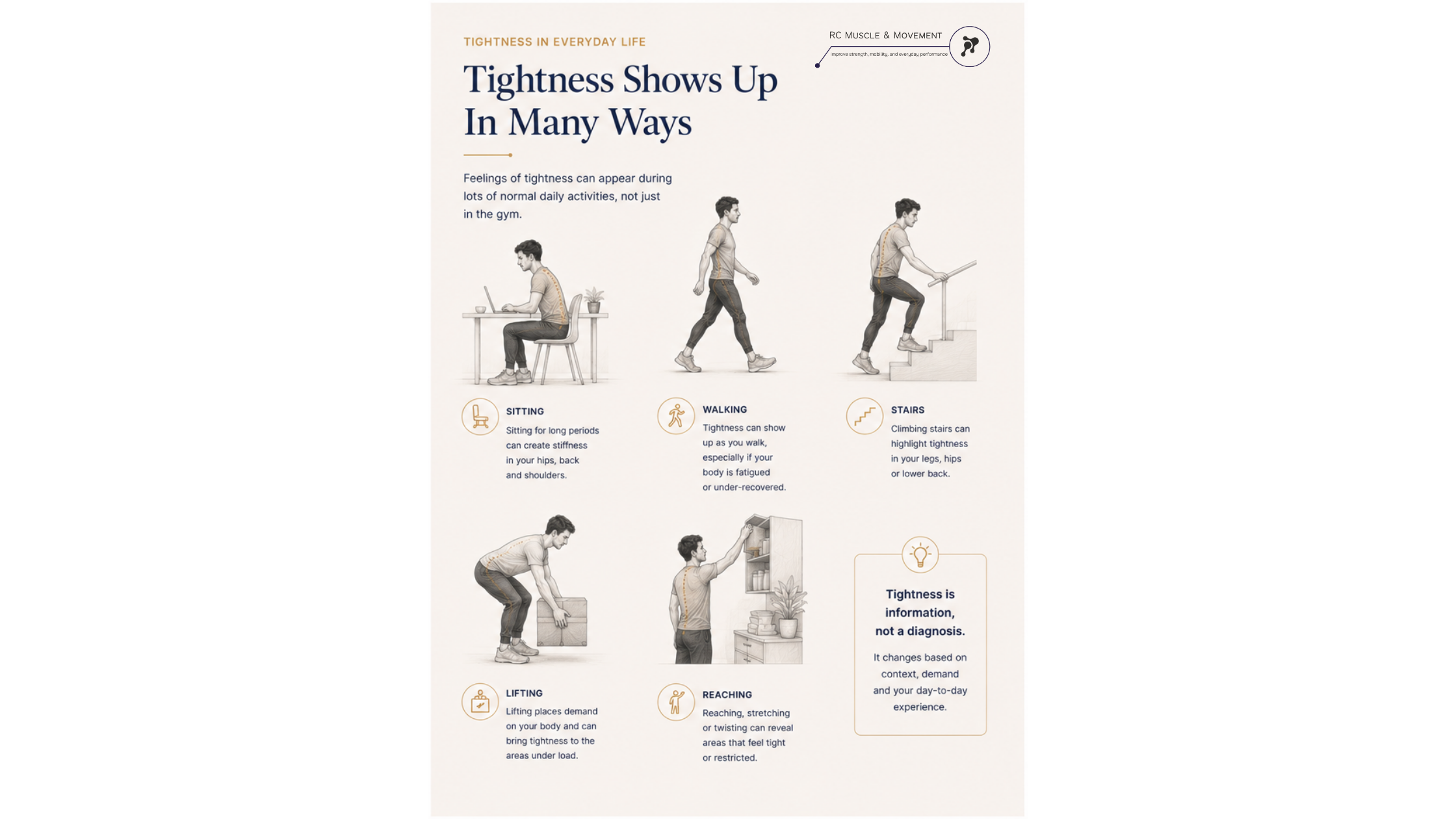
If tightness shows up during stairs, lifting, walking, sitting or training, it may be useful to look at how the body is tolerating those demands.
This might include simple movements such as:
sit-to-stands
step-ups
carries
gentle hinging movements
controlled reaching
walking
basic pushing or pulling movements
The aim is not to turn everything into exercise.
The aim is to help movement feel more capable and less overloaded.
That is very different from chasing flexibility for its own sake.
Tight Hamstrings Are A Good Example
Hamstrings are one of the most common areas people describe as tight.
Many people stretch them regularly.
Some feel temporary relief.
Others feel like nothing changes.
Hamstring tightness can relate to many things, including:
sitting time
hip position
back stiffness
training load
reduced strength
nervous system sensitivity
how the hips and lower back share work
confidence bending, reaching or hinging
That does not mean stretching hamstrings is pointless.
It means hamstring tightness may not be only a hamstring problem.
For some people, the hamstrings feel tight because they are being asked to provide control, stability or protection.
For others, they feel tight because the body has not had enough varied exposure to bending, reaching or loading positions.
This is why the same advice does not work for everyone.
Tightness Around The Neck And Shoulders Can Work The Same Way
Neck and shoulder tightness is another common example.
People often assume:
“I must need to stretch my neck.”
Sometimes gentle movement helps.
But recurring neck and shoulder tension may also be influenced by:
desk position
screen time
stress
breathing patterns
upper back movement
shoulder strength
workload
reduced movement variety
how often you change position
Again, the tight area matters.
But the reason it keeps feeling tight may involve more than the local muscle itself.
That is why support needs to be practical and individual.
What Can Help If You Always Feel Tight?
The answer does not need to be complicated.
Useful options may include:
changing position more often
walking regularly
using light strength work
adding movement variety
reducing long periods in one position
building confidence in movements that feel restricted
using hands-on work where helpful
reviewing workload and recovery
understanding what the tight area is being asked to do
You do not need to do everything at once.
In fact, that usually makes it harder to stick with.
Start with the simplest useful change.
If your hamstrings feel tight after sitting, stand and move more often.
If your shoulders tighten at your desk, vary your position and give your upper back more movement.
If your hips feel tight during walking or stairs, look at how your lower body is sharing work.
If the same tightness keeps returning, it may be worth getting a clearer movement-focused picture.
Where Sports Massage Fits
Sports Massage can be useful when a specific area feels tight, overworked or restricted.
Hands-on work may help reduce tension, improve comfort and make movement feel easier.
This can be especially helpful when the issue is localised and you know the area that needs attention.
But Sports Massage works best when it is part of a sensible wider picture.
That might include simple movement changes, better workload awareness, strength-informed guidance or a clearer understanding of why the same area keeps tightening.
The aim is not just temporary relief.
The aim is helping the area feel more comfortable and easier to use.
Key Takeaways
Feeling tight does not always mean something is short.
Tightness can be influenced by:
workload
movement variety
strength
recovery
stress
sitting time
confidence
sensitivity
how the body shares effort
Stretching may help, but if tightness keeps returning, it may not be the full answer.
Sometimes the more useful question is:
“Why does this area keep feeling like it has to work so hard?”
That question gives you more options.
Movement First, Not Stretching For Everything
At RC Muscle & Movement, we take a movement-first approach. (read our approach on msk led movement page)
That means we do not automatically assume every tight area needs more stretching.
We look at:
what you are feeling
when it shows up
what your day involves
how your body is moving
which areas may be doing more work
what may help things feel easier
Sometimes hands-on work is useful.
Sometimes movement review is useful.
Sometimes strength-informed guidance is useful.
Often, the best answer is a combination that fits real life.
If one specific area feels tight or overworked, Sports Massage may be useful. If the tightness keeps returning or feels harder to understand, the Movement & Function Assessment is usually the clearest starting point.
FAQs
Does feeling tight mean my muscles are short?
Not always. Tightness is a feeling and can be influenced by workload, sensitivity, movement habits, stress, recovery and strength, not just muscle length.
Why do I still feel tight even though I stretch?
Stretching may help temporarily, but if the same area keeps tightening, it may be worth looking at how your body is moving, loading and sharing effort throughout the day.
Is stretching bad?
No. Stretching can be useful for many people. The issue is assuming stretching is always the full answer for recurring tightness.
Why do my hamstrings always feel tight?
Hamstring tightness can be influenced by sitting time, hip movement, lower back stiffness, training load, strength, confidence and how your body shares work during bending or walking.
Can massage help tight muscles?
Yes, Sports Massage or Deep Tissue Massage may help reduce tension and improve comfort. If tightness keeps returning, movement-focused assessment may help identify the bigger picture.
Should I stretch or strengthen?
It depends on what is contributing. Some people benefit from stretching, some from strength work, some from more movement variety, and many from a combination.
When should I get support?
If tightness keeps returning, affects everyday movement, limits confidence or feels unclear, a movement-focused appointment may help you understand what may be contributing.
Source Base Used
Weppler CH, Magnusson SP. Increasing muscle extensibility: a matter of increasing length or modifying sensation? Physical Therapy. 2010.
Freitas SR et al. Can chronic stretching change the muscle-tendon mechanical properties? A review. Scandinavian Journal of Medicine & Science in Sports. 2018.
Konrad A et al. Chronic effects of stretching on range of motion with consideration of potential moderating variables: a systematic review with meta-analysis. Journal of Sport and Health Science. 2023.
Srinivasan D, Mathiassen SE. Motor variability in occupational health and performance. Clinical Biomechanics. 2012.
World Health Organization. WHO Guidelines on Physical Activity and Sedentary Behaviour. 2020.
NHS. Physical activity guidelines for adults aged 19 to 64.