How Hip Strength Can Influence Knee Comfort
Summary
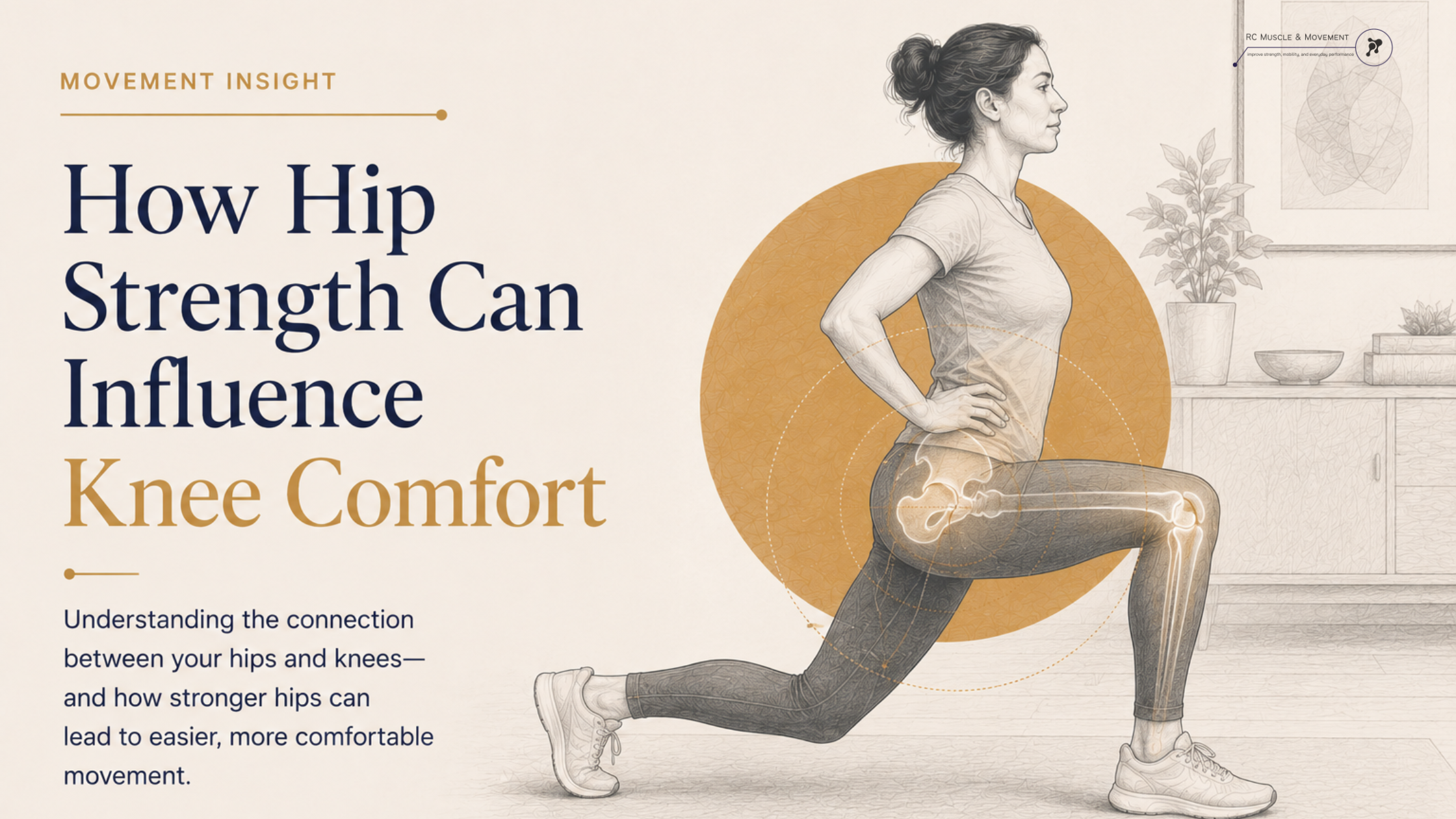
Hip strength can influence knee comfort because the hip, knee, ankle and foot work together during walking, stairs, standing up, lifting and everyday movement. If the hip is not contributing as well as it could, the knee may feel like it is doing more of the work. This does not automatically mean the knee is damaged or the hip is “weak”, but it can be useful to look at how the whole lower body is sharing effort.
Educational Note
This article is for general education only.
It is not medical advice and it is not a diagnosis.
RC Muscle & Movement does not diagnose knee injuries, hip conditions, joint disease or medical conditions. We provide movement-focused assessment, hands-on soft-tissue support and practical guidance within sports therapy and strength-coaching scope. Taking a movement led msk approach.
If knee pain is severe, new, worsening, linked with swelling, heat, redness, locking, repeated giving way, inability to bear weight, numbness, fever, recent trauma, or other concerning changes, it is sensible to seek appropriate medical advice.
Why People Ask About Hip Strength And Knee Pain
Knee discomfort is often treated as though it only belongs to the knee.
That makes sense at first.
The knee is where the person feels it.
But the knee does not work alone.
It sits between the hip above it and the ankle and foot below it.
Every time you walk, climb stairs, stand up from a chair, squat down, lift something, carry shopping or step onto a kerb, the hip and knee have to work together.
That is why some people notice patterns like:
knees feel worse on stairs
knees feel different on hills
one knee feels more loaded than the other
standing up from low chairs feels harder
knees feel worse when tired
knees feel more noticeable after sitting
squats feel different depending on hip position
knee discomfort changes when walking speed changes
This does not mean the hip is always the cause.
It does not mean the knee is unimportant.
It means knee comfort is often influenced by the wider movement picture.
A useful question is not only:
“Why does my knee hurt?”
It may also be:
“How are my hips, knees, ankles and feet sharing the work?”
The Knee Is Part Of A Bigger System
The knee is often described as a hinge joint.
That is broadly true.
But in real life, the knee does more than simply bend and straighten.
It helps manage direction, force, timing and control between the hip, ankle and foot.
During everyday movement:
the hip helps create and control movement
the knee helps guide and manage load
the ankle helps with balance and push-off
the foot adapts to the ground
the trunk influences where the body’s weight is going
If one part of that system contributes less, another area may feel like it has to do more.
This is why knee discomfort can sometimes be influenced by:
hip strength
glute control
ankle stiffness
foot position
walking speed
step height
fatigue
carrying weight
sitting habits
confidence in movement
The knee may be where you feel the issue.
But it may not be the only place worth considering.
If knee discomfort is the main issue you are noticing, our Knee Pain page explains how RCMM supports people dealing with knee discomfort during everyday movement.
What The Hip Does During Everyday Movement
The hip is a strong, mobile joint.
It helps with:
walking
standing up
climbing stairs
stepping down
lifting from the floor
carrying weight
changing direction
balance
squatting
getting in and out of the car
The muscles around the hip and pelvis help control how the thigh moves underneath the body.
That matters because the thigh connects directly to the knee.
If the hip is controlling movement well, the knee often has a clearer job.
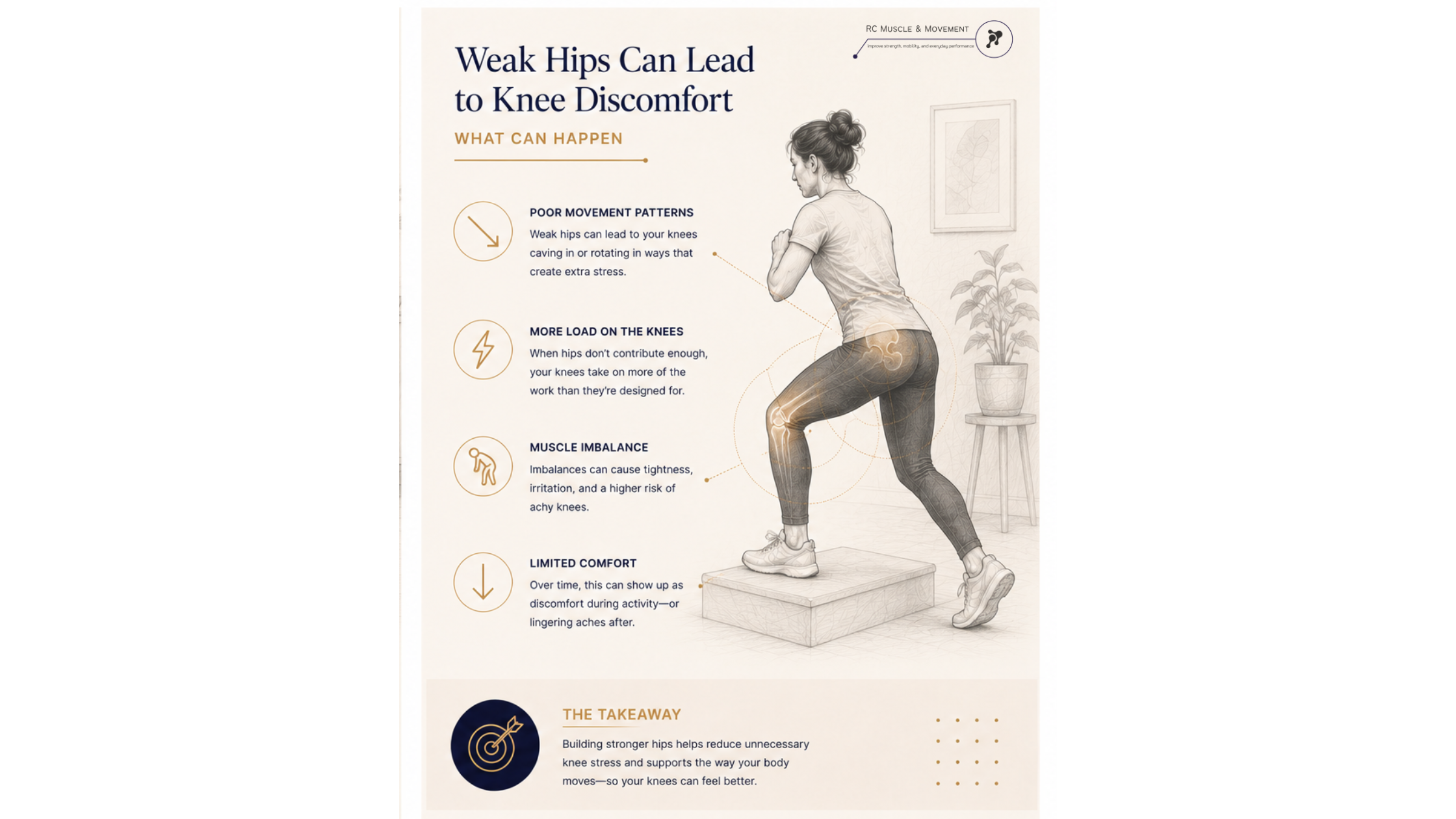
If the hip is tired, guarded, stiff, underused or less confident, the knee may feel like it is managing more of the task.
That does not automatically mean the hip is “weak”.
It may simply mean the hip is not contributing as well as it could in that specific movement, on that day, under that level of demand.
That distinction matters.
People are not either weak or strong.
The body responds to context.
Sleep, stress, training, work, sitting, recovery, footwear, walking speed and fatigue can all change how movement feels.
Hip Strength Is Really About Capacity
When people hear “hip strength”, they often think of gym exercises.
Heavy squats.
Resistance bands.
Glute workouts.
Performance training.
But for most everyday adults, hip strength is better understood as capacity.
Capacity means your hips can contribute to the things your life asks from them.
That might include:
getting up from a chair without pushing through your hands
climbing stairs without feeling like your knees take everything
walking uphill with more confidence
carrying shopping without one side feeling overloaded
standing from a low sofa
stepping down from a kerb
managing a long workday
returning to activity after doing less for a while
Strength does not need to be extreme to be useful.
It needs to be appropriate for your life.
For knee comfort, the useful question is often:
“Do my hips have enough capacity to help with the tasks I’m asking my knees to do?”
Why Stairs Often Reveal The Hip-Knee Relationship
Stairs are one of the most common places people notice knee discomfort.
This blog is not here to repeat a full stairs article, but stairs are a useful example of the hip and knee working together.
Compared with level walking, stairs usually ask for:
more knee bend
more hip contribution
more control from the thigh and glutes
more balance
more confidence
more effort from the whole leg
Going upstairs often needs the hip and thigh to help drive the body upward.
Going downstairs often needs the leg to control the body as it lowers.
If the hip is tired or not contributing confidently, the knee may feel more exposed during that task.
That does not automatically mean stairs are harmful.
It means stairs are more demanding than level walking.
They can reveal where the body is sharing effort well and where one area may be doing more than it would like.
Sit-To-Stand Is Another Useful Example
Standing up from a chair is a simple everyday movement.
But it tells you a lot.
When you stand from a chair, the hips and knees both have to contribute.
A higher chair may feel easy.
A low sofa may feel much harder.
That is because seat height changes how much effort is needed from the hips and knees.
If you always need your hands to push up, avoid low seats, or feel your knees working hard during sit-to-stand, it may be worth looking at how the hips and legs are sharing the task.
This does not mean there is something wrong.
It may simply show that the movement is asking for more strength, control or confidence than your body currently has available.
For many people, improving sit-to-stand comfort is not about perfect technique.
It is about rebuilding a useful everyday movement.
Why “Weak Hips” Is Often Too Simple
A lot of online content turns this into a simple message:
“Weak hips cause knee pain.”
That is too blunt.
The relationship is more useful than that.
Hip strength may influence knee comfort, especially in some knee pain presentations, but it is rarely the only factor.
Knee discomfort can also be influenced by:
activity changes
training volume
footwear
surface
sleep
stress
fatigue
walking speed
previous injuries
confidence
bodyweight
joint sensitivity
muscle strength around the knee
ankle and foot contribution
general physical capacity
So yes, hip strength can matter.
But it should not become another thing to blame.
RCMM’s approach is not:
“Your hips are weak.”
It is:
“Let’s look at how your body is sharing the work.”
That is more useful, more accurate and less frustrating.
Why Knees Can Feel Worse When You Are Tired
Many people say their knees feel worse later in the day or when they are tired.
That can make sense.
Fatigue can change movement.
When you are fresh, the body may use more options.
When you are tired, you may move with less variety.
You may:
lean more into one side
take shorter steps
avoid bending the knee
use stairs more cautiously
push less through the hip
let the knee do more of the holding
rely more on one leg
feel less confident lowering yourself down
None of this means you are moving “wrong”.
It simply means fatigue can change the way effort is shared.
When the hip contributes less, the knee may feel more noticeable.
When the whole leg is tired, the knee may feel less comfortable with tasks it handled earlier in the day.
This is why knee comfort is not only about structure.
It is also about capacity, timing and context.
What Research Allows Us To Say Carefully
There is research showing that hip and knee strengthening can be useful in some knee pain presentations, particularly patellofemoral pain.
There is also clinical guidance that supports therapeutic exercise and strengthening approaches for some knee-related conditions, where appropriate.
But it would be too strong to say:
“Hip strength fixes knee pain.”
That is not how we should explain it at RCMM
A more accurate statement is:
Hip strength may be one useful part of the picture for some people, especially when knee discomfort is linked to tasks such as stairs, squats, sit-to-stand, walking, running or changes in activity.
It is one factor.
Not the only factor.
The right approach depends on the person, the pattern and what else is going on.
If knee discomfort keeps returning or you are unsure what is contributing, a Movement & Function Assessment can help build a clearer picture of how your hips, knees, ankles and feet are working together.
What You May Notice In Everyday Life
Hip contribution can show up in ordinary movements.
You might notice your knee feels different when:
standing from a low sofa
walking uphill
going downstairs
carrying shopping
climbing into the car
getting up from the floor
squatting to pick something up
stepping onto a high kerb
walking faster than usual
walking after sitting for a long time
doing repeated stairs during a busy day
These are not special athletic tasks.
They are normal parts of life.
That is why hip strength and knee comfort matter for everyday adults, not just people who train.
The goal is not to move like an athlete.
The goal is to have enough capacity and confidence for the movements your life requires.
What May Help
This is general information, not a treatment plan.
Useful options may include:
gradually building lower-body strength
practising sit-to-stand from different chair heights
noticing whether stairs feel different when tired
strengthening the hips, thighs and calves over time
varying walking pace where comfortable
reducing sudden jumps in activity
improving confidence with everyday movements
using hands-on support where surrounding areas feel overworked
reviewing footwear, surfaces and workload
getting assessed if the pattern is recurring or unclear
For some people, small movement changes can make tasks feel easier.
For others, strength and capacity may need time to build.
For others, the first useful step is hands-on support to help an overworked area feel less restricted.
There is no single answer that fits everyone.
That is why understanding the pattern matters.
Where Sports Massage May Fit
Sports Massage may be useful when the muscles around the hip, thigh, calf or knee feel tight, overworked or protective.
For example, someone may feel their thigh, hip, glute or calf tightening when knee discomfort builds.
Hands-on support may help those areas feel more comfortable and easier to move.
But Sports Massage is not about “fixing” hip strength.
It is one support option.
It may be useful when:
one area feels tight or overworked
the legs feel heavy after work or training
the hip, thigh or calf feels protective
movement feels restricted around the knee
you want targeted hands-on support for a clear area
If the knee discomfort keeps returning, affects confidence or feels linked to several movements, assessment may be the clearer starting point.
When Assessment Is The Better Starting Point
A Movement & Function Assessment is usually the better starting point when:
knee discomfort keeps returning
stairs feel harder than they used to
one side feels less confident
you are unsure whether the hip, knee or foot is involved
Sports Massage helps temporarily but the pattern returns
you want to understand what may be contributing
movement feels less comfortable or less trustworthy
you are not sure whether to rest, strengthen, stretch or book massage
The assessment is not about diagnosing a knee condition.
It is about building a clearer picture of how your body is moving and what support may fit best.
That may involve:
movement observation
discussion about daily demands
simple strength or movement checks
hands-on support where useful
practical next steps
signposting elsewhere if something looks outside the most appropriate scope
The goal is clarity.
Not over-complication.
When To Seek Medical Advice
Most everyday knee discomfort is not an emergency.
But some symptoms should be checked medically.
Seek appropriate advice if you notice:
severe knee pain
significant swelling
heat or redness
the knee locking
the knee repeatedly giving way
inability to bear weight
the knee changing shape
fever or feeling unwell
numbness or unusual symptoms
symptoms after a fall, twist or direct injury
symptoms that are worsening or not improving
This is not to create fear.
It is about making sure the right support is used at the right time.
If something appears outside the most appropriate scope for an RCMM appointment, we will explain clearly and help guide you toward the most suitable next step.
Key Takeaways
Knee comfort is not always only about the knee.
The hip, knee, ankle and foot work together during everyday movement.
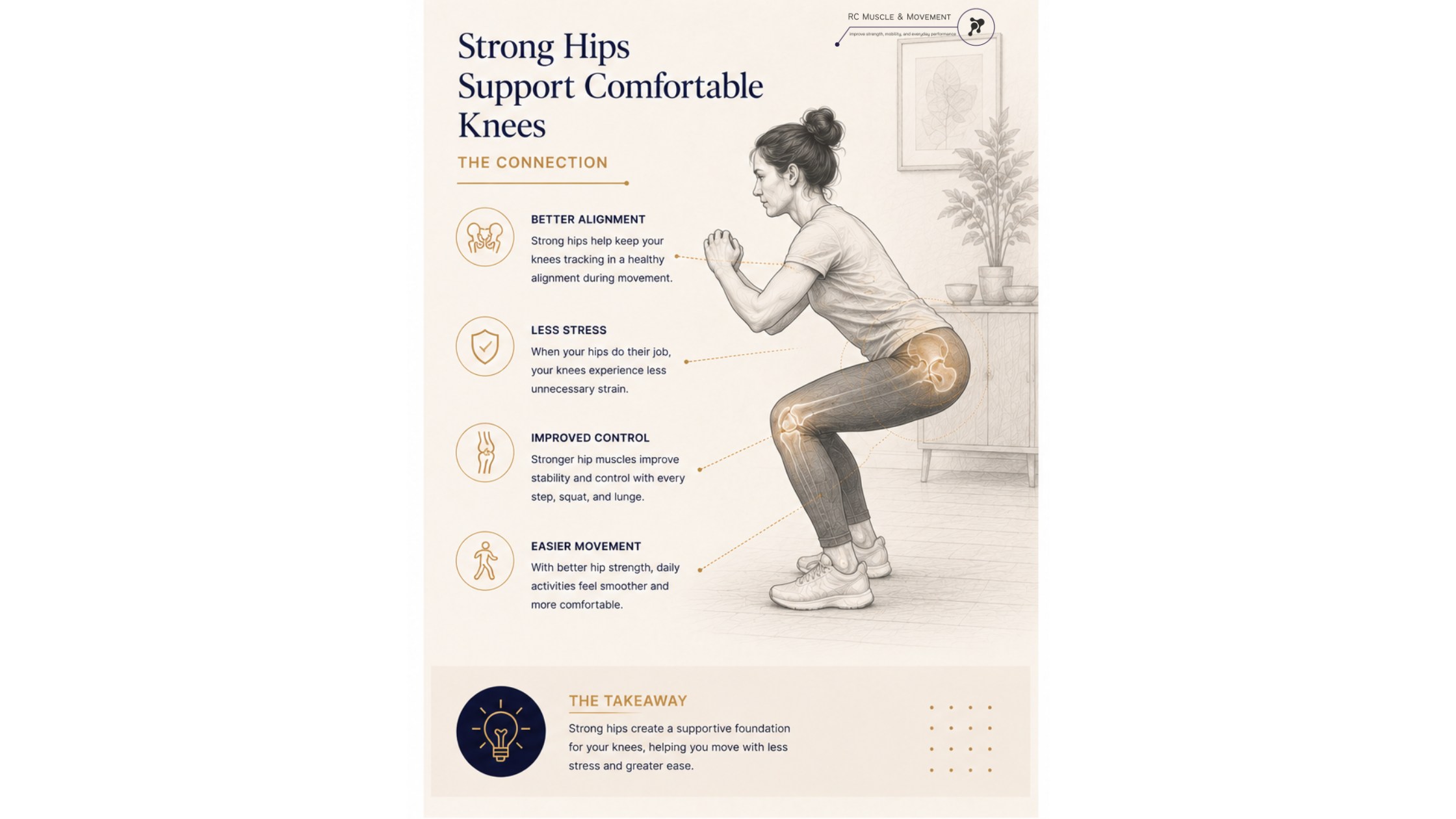
Hip strength can influence knee comfort because the hips help with:
standing up
stairs
walking
hills
lifting
balance
carrying
control of the leg
But this does not mean every knee issue is caused by weak hips.
It means the wider movement picture matters.
A better question is often:
“How is my body sharing the work?”
That gives more useful options than blaming one joint or one muscle.
How RCMM Can Help
RC Muscle & Movement is a movement-first sports massage and assessment clinic in East Kilbride.
We support people dealing with tightness, stiffness, restricted movement and areas that feel overworked during everyday life, work, training and routine.
For knee discomfort linked to hip strength, stairs, sit-to-stand or lower-body confidence, our role is to help you understand the pattern and decide what support may fit best.
That may involve:
Movement & Function Assessment
Sports Massage
hands-on soft-tissue support
practical movement guidance
strength-informed support where helpful
clear explanation in everyday language
The aim is to help movement feel clearer, more comfortable and easier to trust.
If knee discomfort keeps returning or you are unsure what is contributing, the Movement & Function Assessment is usually the clearest starting point. If one specific area feels tight or overworked, Sports Massage or deep tissue may also be useful.
related condition links:
Knee Pain
Hip Pain
Everyday Movement Support
FAQs
Can hip strength affect knee comfort?
Yes, hip strength can influence knee comfort because the hips help control and support lower-body movement. The knee, hip, ankle and foot work together during tasks such as walking, stairs, squats and standing up from a chair.
Does knee pain always mean something is wrong with the knee?
Not always. The knee may be where you feel discomfort, but the wider movement picture can matter too. Hip strength, ankle movement, foot position, fatigue, activity changes and daily workload can all influence how the knee feels.
Does this mean my hips are weak?
Not necessarily. “Weak hips” is often too simple. The hip may be tired, underused, less confident or not contributing well in a particular movement. That is different from saying something is wrong or permanently weak.
Why do my knees feel worse on stairs?
Stairs ask more from the hips, knees, ankles and feet than level walking. If the hip is not contributing as well as it could, the knee may feel like it is doing more of the work.
Can strengthening my hips help knee pain?
For some people, hip strengthening can be a useful part of improving knee comfort, especially where knee discomfort is linked to movement tasks such as stairs, squats or activity changes. It should be matched to the person and the wider pattern.
Should I only strengthen my hips if my knee hurts?
Usually no. The knee itself, the thigh, calf, foot, ankle and trunk may all matter. Hip strength can be one part of the picture, not the whole answer.
Can Sports Massage help if my knee feels overloaded?
Sports Massage may help if the muscles around the hip, thigh, calf or knee feel tight, overworked or protective. If the issue keeps returning or feels unclear, a Movement & Function Assessment may be more useful first.
What should I book if my knee discomfort keeps coming back?
If one specific area feels tight or overworked, Sports Massage may be suitable. If the issue is recurring, unclear or affecting confidence, the Movement & Function Assessment is usually the clearest starting point.
Source Base Used
NHS. Knee pain.
NHS Inform. Knee problems.
NICE. Osteoarthritis in over 16s: diagnosis and management. NG226.
Collins NJ et al. 2018 Consensus statement on exercise therapy and physical interventions to treat patellofemoral pain. British Journal of Sports Medicine. 2018.
Nascimento LR et al. Hip and Knee Strengthening Is More Effective Than Knee Strengthening Alone for Reducing Pain and Improving Activity in Individuals With Patellofemoral Pain. Journal of Orthopaedic & Sports Physical Therapy. 2018.
Willy RW et al. Patellofemoral Pain: Clinical Practice Guidelines. Journal of Orthopaedic & Sports Physical Therapy. 2019.
Yoshioka S et al. Peak hip and knee joint moments during a sit-to-stand movement are invariant to the change of seat height within the range of low to normal seat height. Biomedical Engineering Online. 2014.
WHO. Guidelines on physical activity and sedentary behaviour. 2020.
NHS. Physical activity guidelines for adults aged 19 to 64.