Why Your Knees Feel Different on Stairs, Hills and Flat Ground
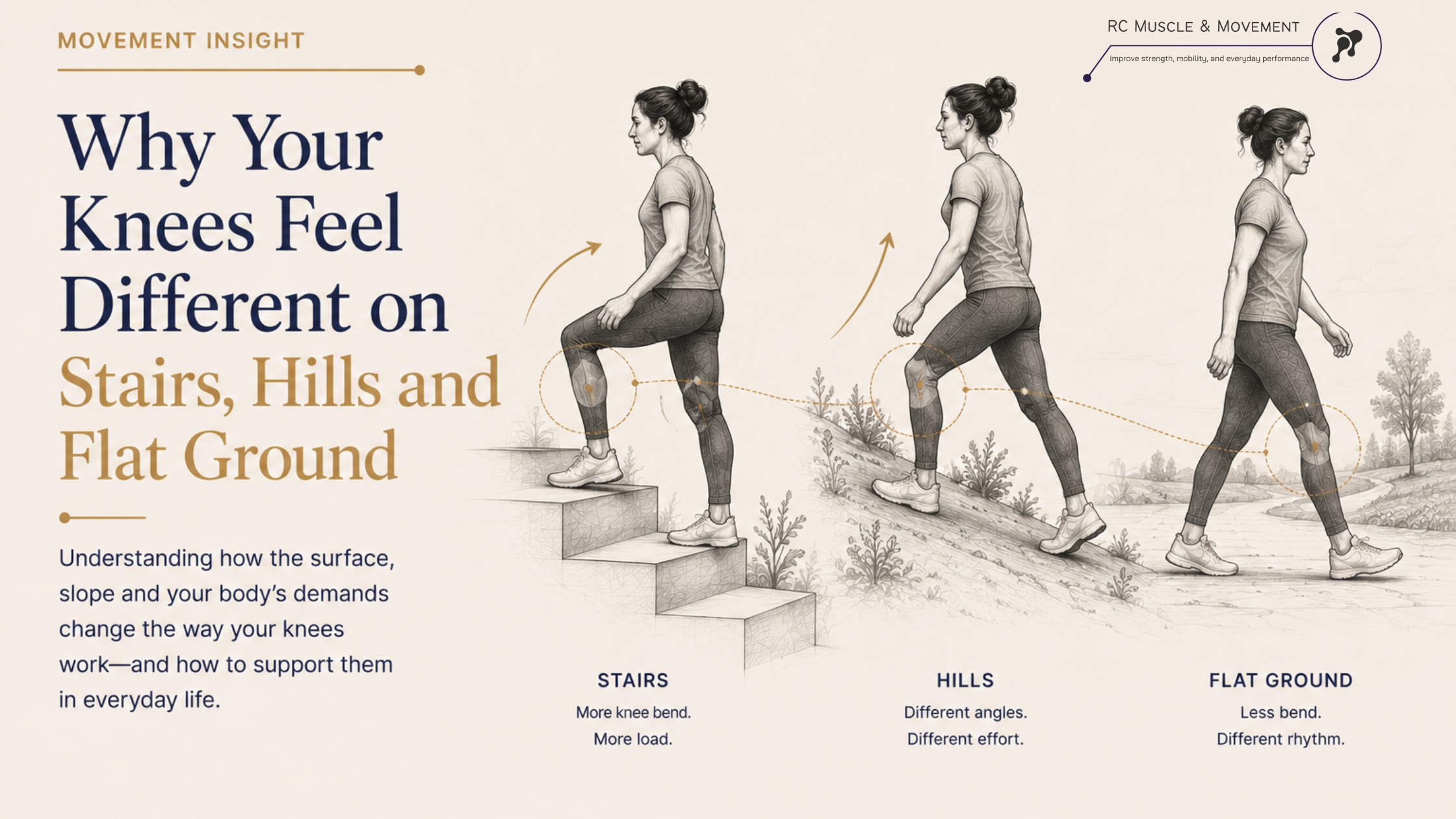
Summary
Your knees can feel different on stairs, hills and flat ground because each surface changes how much the knee bends, how hard the thigh and hip muscles work, how the foot and ankle respond, and how effort is shared across the body. Stairs, slopes and flat ground are not the same movement task. Feeling different on one surface does not automatically mean something is damaged, but it can be useful to notice which situations consistently make the knee feel more noticeable.
Educational Note
This article is for general education only.
It is not medical advice and it is not a diagnosis.
RC Muscle & Movement does not diagnose knee injuries, joint conditions or medical problems. We provide movement-focused assessment, hands-on soft-tissue and musculoskeletal support and practical guidance within sports therapy and strength-coaching scope.
If knee pain is severe, new, worsening, linked with significant swelling, heat, redness, locking, repeated giving way, inability to bear weight, recent trauma, fever, or other concerning changes, it is sensible to seek appropriate medical advice.
A Common Pattern People Notice
A lot of people describe the same thing.
Walking on flat ground feels fine.
Then stairs feel uncomfortable.
Or hills feel heavy.
Or going downstairs feels worse than going up.
Or one slope bothers the knee more than another.
That can feel confusing because it seems like the knee is sending mixed messages.
If walking is fine, why do stairs feel different?
If flat ground is okay, why does a hill make the knee more noticeable?
If one set of stairs feels manageable, why does another set feel harder?
The answer is usually not as simple as:
“My knee is fine.”
or
“My knee is damaged.”
A more useful starting point is:
Different surfaces ask different things from the body.
The knee may simply be responding to the demand of the task.
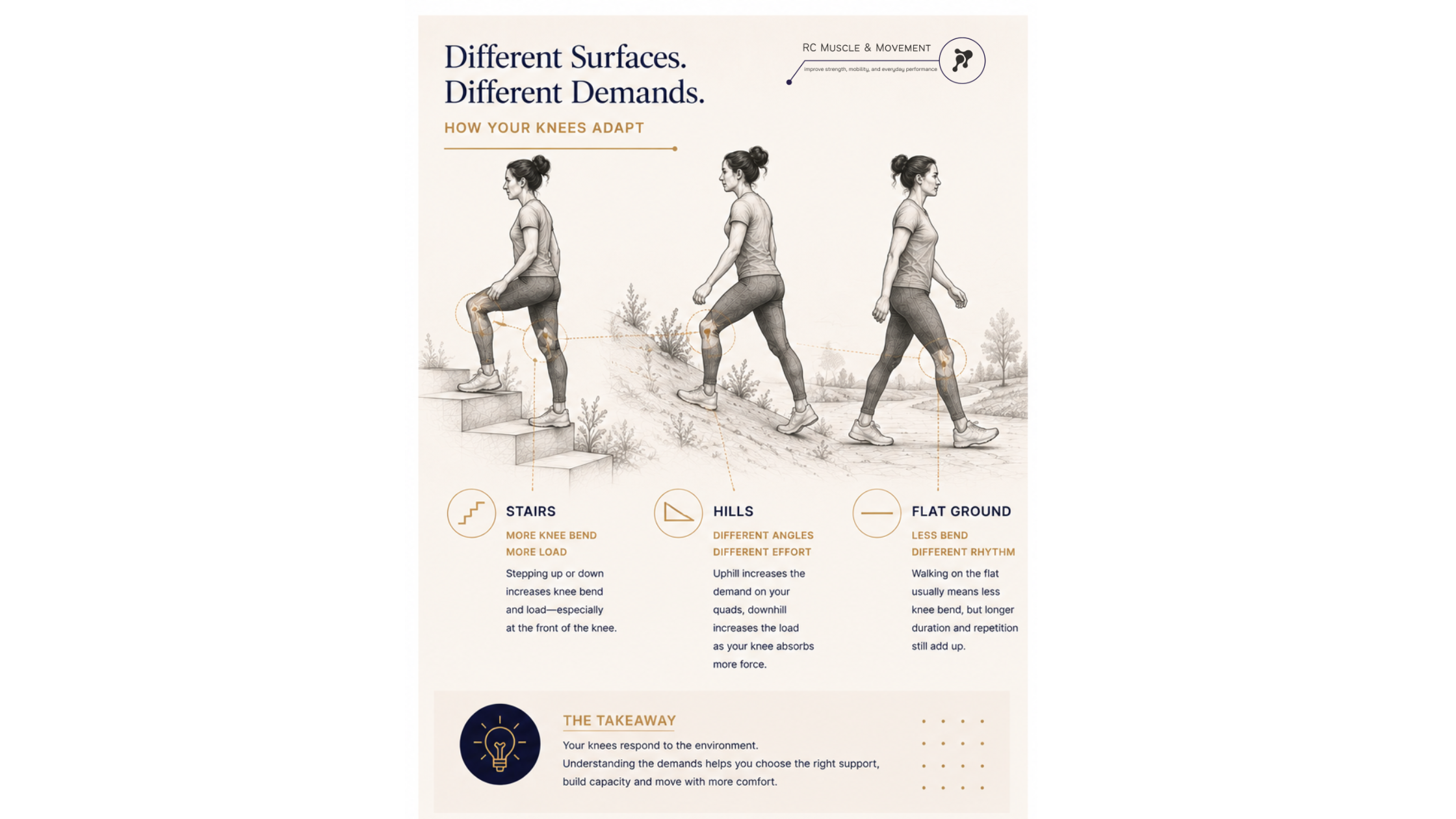
Stairs, Hills And Flat Ground Are Different Movement Jobs
The knee does not experience the same movement demand everywhere.
Flat walking, stair climbing and hill walking all involve the hips, knees, ankles, feet and trunk working together.
But they do not ask those areas to work in the same way.
Flat ground usually allows a more regular walking rhythm.
Stairs ask for more stepping up, lowering down and controlling bodyweight.
Hills change the angle of the ground, which changes how the legs, hips and trunk organise the movement.
Even small changes can matter.
A steeper stair, a longer descent, a heavier bag, tired legs, different shoes or uneven ground can all change how the knee feels.
This is why knee discomfort can be situation-specific.
It may not show up during every movement.
It may appear only when the task asks more from the knee, the hip, the ankle, or the whole leg.
If knee discomfort is the main issue you are noticing, our Knee Pain page explains how RCMM supports people with knee discomfort during everyday movement.
Why Stairs Can Feel Different From Walking
Stairs are one of the most common places people notice knee discomfort.
That makes sense.
Compared with level walking, stair movement usually asks for:
more knee bend
more thigh muscle effort
more control when lowering down
more work from the hip and glute muscles
more balance
more confidence
more coordination between the hip, knee, ankle and foot
Going upstairs is not just walking with a step added.
You are lifting your body upward.
Going downstairs is not just walking downward.
You are controlling your body as it lowers.
That control can feel demanding, especially if the knee already feels sensitive, the legs are tired, or confidence has changed.
This is why people often say:
“I’m fine walking, but stairs get me.”
That is a useful observation.
It tells you the knee may cope with one level of demand but respond differently when the task becomes more challenging.
Why Going Downstairs Often Feels More Noticeable
Many people find going downstairs more noticeable than going up.
This can happen because the leg has to control the lowering movement.
The knee bends while the body’s weight moves downward.
The thigh muscles help control the speed.
The hip and ankle also have to contribute.
If that control feels less confident, the knee may feel more exposed.
People often describe this as:
pressure
sharpness
hesitation
lack of trust
feeling like they need the handrail
not wanting to lead with one leg
stepping more carefully than usual
Using a handrail, slowing slightly, or taking one step at a time can make sense if it helps you feel safer.
But if stairs keep becoming a regular issue, it may be useful to look at the wider movement picture rather than only focusing on the knee itself.
Why Hills Can Feel Heavy
Hills change how the body works.
Walking uphill usually asks the legs and hips to create more effort to move the body upward.
Walking downhill asks the legs to control the body as it moves downward.
Both can feel different from flat ground.
Uphill may feel:
heavy
tiring
slow
harder through the thighs
more effortful around the hips
more demanding if you are carrying bags
Downhill may feel:
more pressured
more cautious
less controlled
more noticeable around the front of the knee
harder if the surface is uneven or slippery
This does not mean hills are bad.
It means hills are a different physical task.
A hill changes the angle, the effort and the way the lower body shares work.
That is why a knee can feel fine on the flat and more noticeable on a slope.
Why Flat Ground Can Feel Easier
Flat ground often feels easier because it is usually more predictable.
The body can settle into a rhythm.
The hip, knee, ankle and foot can share effort in a more familiar way.
Stride length and pace can change naturally.
The knee does not usually need to bend as deeply as it does on stairs.
The body is not working against a slope.
For many people, flat walking gives enough movement to feel better without asking too much from the knee at once.
That is why walking can sometimes feel helpful, while stairs or hills still feel difficult.
This can be reassuring.
It suggests the knee may not dislike all movement.
It may simply be more sensitive to certain demands.
The useful question becomes:
Which movement demands feel manageable, and which ones keep causing problems?
Why One Set Of Stairs Can Feel Different From Another
Not all stairs are the same.
A staircase at home may feel fine, but stairs at work may feel awkward.
Outdoor steps may feel worse than indoor ones.
A steep staircase may feel different from shallow steps.
That can happen because stairs vary in:
step height
depth
steepness
surface
lighting
handrail position
how tired you are
whether you are carrying anything
how often you use them
This is why the same knee can feel different in different places.
The body is not responding to “stairs” as one single thing.
It is responding to the specific task in front of it.
That detail matters.
If you can identify which stairs or surfaces are most difficult, you may understand the pattern better.
Why The Knee Can Feel Different Day To Day
Knee comfort can change from one day to the next.
This can be influenced by:
sleep
stress
recent activity
training
work demands
sitting time
walking volume
footwear
carrying bags
surface changes
fatigue
confidence
how quickly activity increased
None of these automatically mean there is a serious problem.
They simply change how much capacity the body has available and how much demand the knee is being asked to manage.
A knee that felt fine yesterday may feel more noticeable today if you have had a busy week, slept poorly, walked more than usual, used more stairs, or spent longer sitting.
This is why one difficult day should not automatically be treated as a crisis.
But a recurring pattern is worth paying attention to.
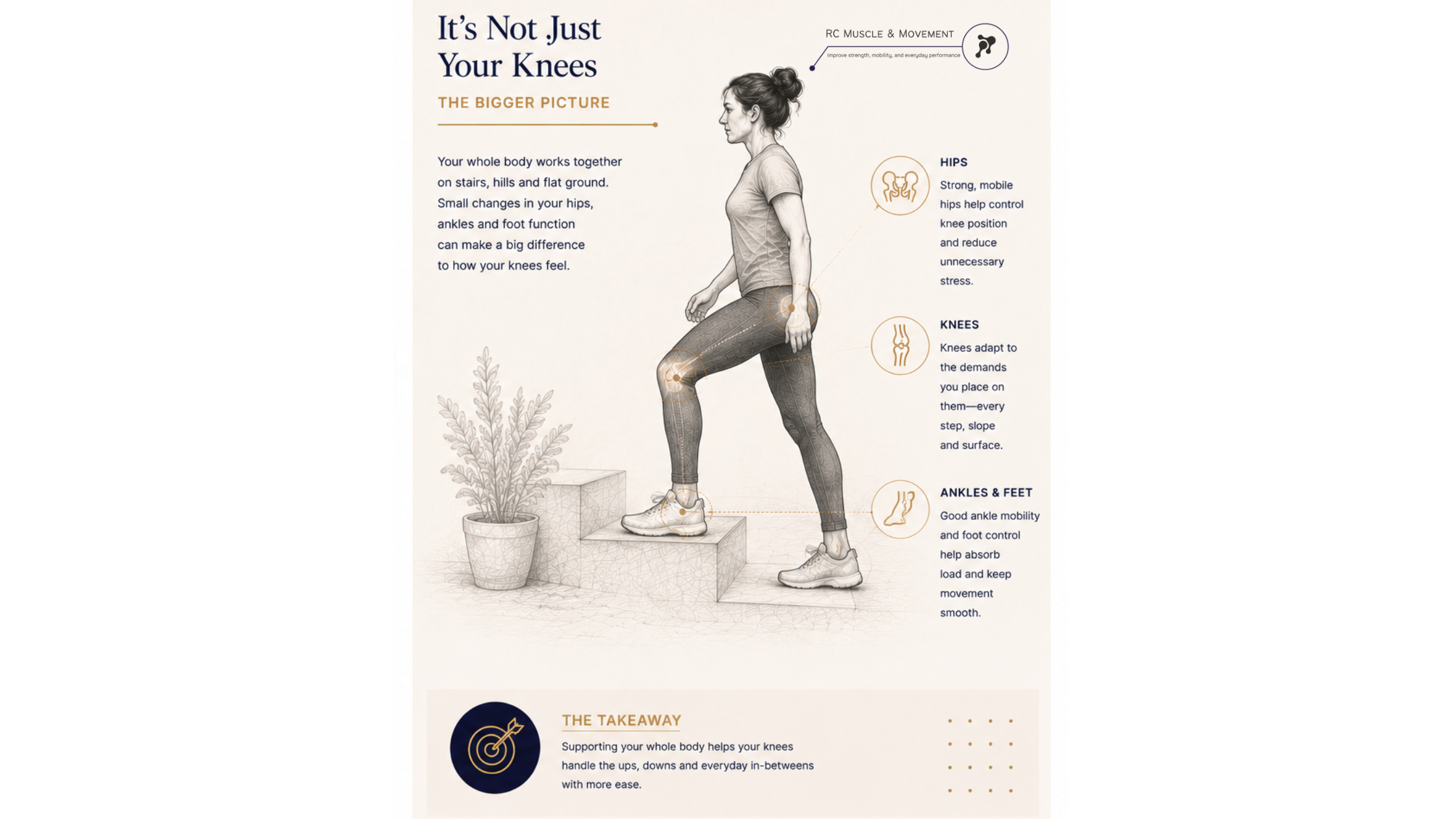
Why The Hip, Ankle And Foot Matter Too
The knee sits between the hip above and the ankle and foot below.
That means knee comfort can be influenced by how the whole lower body is contributing.
For example:
the hip helps create power and control the leg
the thigh helps manage knee bend and lowering
the ankle helps adapt to the ground
the foot helps with balance and contact
the trunk influences where bodyweight is going
If one area is tired, stiff, guarded or less confident, the knee may feel like it is doing more of the work.
That does not mean the hip, ankle or foot is “the problem”.
It means the knee is part of a system.
This is why RCMM often looks beyond the area that feels sore.
Not to make things complicated.
To understand how the movement is being shared.
What To Notice Before You Assume The Worst
If your knees feel different on stairs, hills and flat ground, you do not need to diagnose yourself.
But it can help to notice the pattern.
Useful questions include:
Is it worse going upstairs, downstairs, uphill or downhill?
Is flat walking comfortable?
Does the knee ease once you are moving?
Does it build the more you do?
Is one side more noticeable?
Does carrying bags change it?
Does sitting beforehand make stairs feel worse?
Does tiredness make it more obvious?
Does the surface matter?
Has your walking, training or daily workload recently increased?
These details can be useful because they show how the knee responds to different demands.
A single moment of discomfort does not tell the whole story.
The pattern is usually more useful.
If the same knee discomfort keeps returning on stairs, hills or uneven ground, a Movement & Function Assessment can help build a clearer picture of what may be contributing.
What May Help In Everyday Life
This is general guidance, not a treatment plan.
If stairs, hills or slopes make your knee more noticeable, useful options may include:
using a handrail when needed
taking a shorter step on stairs
slowing down enough to feel controlled
avoiding rushing downstairs when tired
shortening your stride on hills
keeping your pace steady
splitting long hilly walks into smaller sections
carrying weight more evenly
building lower-body strength gradually
giving the body time to adjust after sitting
noticing whether footwear changes the pattern
avoiding sudden jumps in stair or hill volume
The aim is not to avoid stairs and hills forever.
The aim is to make them more manageable.
Confidence often improves when the body has enough strength, control and familiarity for the task.
That takes time.
Why Avoiding Stairs Completely Is Not Always The Answer
It is understandable to avoid something that feels uncomfortable.
But if you avoid stairs completely for a long time, they may feel even harder when you need to use them again.
The body adapts to what it does regularly.
If stairs are removed entirely, the strength, confidence and coordination needed for stairs may reduce over time.
That does not mean you should force through pain.
It means the answer is often somewhere between:
“Do nothing.”
and
“Push through everything.”
A more useful approach is usually:
reduce the demand if needed
keep movement manageable
build gradually
notice the pattern
get support if it keeps returning or affects confidence
The goal is capability, not punishment.
Where Sports Massage May Fit
Sports Massage may be useful when one specific area around the knee, thigh, hip or calf feels tight, overworked or protective.
For example:
thighs feeling heavy after stairs
calves feeling tight after hill walking
hips feeling restricted during slopes
one side feeling more overloaded
muscles around the knee feeling tense after activity
Hands-on soft-tissue support can help an area feel more comfortable and easier to move.
But Sports Massage is not there to “fix” knee mechanics.
It is one support option.
If the same knee issue keeps returning, or if stairs and hills are affecting confidence, assessment may be the clearer starting point.
When Assessment May Be The Better Starting Point
A Movement & Function Assessment may be more useful when:
knee discomfort keeps returning
stairs or hills affect your confidence
you are unsure what is contributing
several areas feel involved
one side feels less trustworthy
Sports Massage helps temporarily but the pattern returns
you are avoiding normal activities
you want to understand what support fits best
The assessment is not about diagnosing a knee condition.
It is about looking at how your body moves, how effort is being shared, what your daily life asks from your knees, and what may help you feel more capable.
That may involve:
movement observation
discussion about your daily demands
simple strength or control checks
hands-on support where appropriate
practical next steps
signposting elsewhere if something appears outside the most appropriate scope
The goal is clarity.
Not overcomplication.
When To Get Medical Advice
Most knee discomfort linked to stairs, hills or walking is not an emergency.
But some symptoms should be checked medically.
Seek appropriate advice if you notice:
severe knee pain
significant swelling
heat or redness
the knee locking
the knee repeatedly giving way
inability to bear weight
the knee changing shape
fever or feeling unwell
symptoms after a fall, twist or direct injury
symptoms that are worsening or not settling as expected
This is not to create fear.
It is about making sure the right support is used at the right time.
If something appears outside the most appropriate scope for an RCMM appointment, we will explain clearly and help guide you toward the most suitable next step.
Key Takeaways
Your knees can feel different on stairs, hills and flat ground because each task changes the demand.
Stairs usually ask for more bend, control and confidence.
Hills change the angle and effort.
Flat ground often allows a more familiar rhythm.
This does not automatically mean something is damaged.
It may simply mean your knee is responding to a task that asks more from the whole lower body.
The useful thing is to notice the pattern:
What surface makes it worse?
Does it ease or build?
Is it linked to tiredness?
Does carrying weight change it?
Is confidence affected?
Does the same issue keep returning?
Those details can help you understand what your body is trying to manage.
The aim is not to avoid movement.
The aim is to build enough comfort, confidence and capability for the movements your life asks from you.
How RCMM Can Help
RC Muscle & Movement is a movement-first sports massage and assessment clinic in East Kilbride.
We support people dealing with tightness, stiffness, restricted movement and areas that feel overworked during everyday life, work, training and routine.
If your knees feel different on stairs, hills or uneven ground, we can help you understand what may be contributing and decide what support fits best.
That may involve:
Movement & Function Assessment
Sports Massage
hands-on soft-tissue support
practical movement guidance
strength-informed support where helpful
clear explanation in everyday language
The aim is to help everyday movement feel clearer, more comfortable and easier to trust.
If knee discomfort keeps returning on stairs, hills or uneven ground, the Movement & Function Assessment is usually the clearest starting point. If one specific area feels tight or overworked, Sports Massage may also be useful.
Optional related condition links:
Knee Pain
Hip Pain
Everyday Movement Support
Foot & Ankle Pain
FAQs
Why do my knees hurt on stairs but not when walking?
Stairs usually ask for more knee bend, more thigh muscle effort and more control than level walking. Your knee may feel fine on flat ground but more noticeable when the task becomes more demanding.
Why does going downstairs feel worse than going upstairs?
Going downstairs often requires more control as the body lowers. The thigh, hip, knee, ankle and foot all have to manage the movement, which can make the knee feel more noticeable.
Why do hills make my knees feel heavy?
Hills change the angle of the ground and how the legs work. Uphill walking can feel effortful through the thighs and hips, while downhill walking can feel more demanding because the body has to control the descent.
Why does my knee feel fine on flat ground?
Flat ground is usually more predictable. It allows a more regular walking rhythm and often asks less from the knee than stairs or slopes.
Does knee discomfort on stairs mean damage?
Not necessarily. Knee discomfort on stairs can reflect the demand of the task, sensitivity, fatigue, confidence, strength, recent workload or how effort is being shared. If symptoms are severe, worsening or concerning, seek appropriate medical advice.
Why does one set of stairs feel worse than another?
Different stairs have different step heights, depths, surfaces and handrail positions. Your tiredness, footwear, speed and whether you are carrying anything can also change how stairs feel.
What can help knees feel more comfortable on stairs or hills?
General options include using a handrail, taking shorter steps, slowing down enough to feel controlled, shortening stride on hills, carrying weight more evenly and building lower-body strength gradually.
What should I book if my knees keep reacting to stairs or hills?
If one specific area feels tight or overworked, Sports Massage may be suitable. If the pattern keeps returning, affects confidence or feels unclear, Movement & Function Assessment is usually the clearer starting point.
Source Base Used
NHS. Knee pain.
NHS Inform. Knee problems.
NHS Inform. Osteoarthritis of the knee.
NICE. Osteoarthritis in over 16s: diagnosis and management. NG226.
Goudakos IG et al. Stair climbing results in more challenging patellofemoral contact mechanics and kinematics than walking at early knee flexion under physiological-like quadriceps loading. Journal of Biomechanics. 2009.
Brechter JH, Powers CM. Patellofemoral joint stress during stair ascent and descent in persons with and without patellofemoral pain. Gait & Posture. 2002.
Hunt NL et al. Effects of Aging on Patellofemoral Joint Stress during Stair Ascent and Descent. 2024.
Kuster M. Stress on the femoropatellar joint in downhill walking. 1993.
Nuckols RW et al. Mechanics of walking and running up and downhill: A joint-level perspective. 2020.
Crossley KM et al. 2016 Patellofemoral pain consensus statement from the 4th International Patellofemoral Pain Research Retreat. British Journal of Sports Medicine. 2016.
Willy RW et al. Patellofemoral Pain: Clinical Practice Guidelines. Journal of Orthopaedic & Sports Physical Therapy. 2019.