Muscle Tightness or Muscle Tension: What’s the Difference?
Written by Paula, RCMM Operations & Content Lead
Originally published: 6 May 2026
Last updated: 7 August 2026
Summary
Muscle tightness and muscle tension are often used to describe a similar feeling, but neither term is a precise diagnosis.
Tightness usually describes your experience: an area may feel restricted, tense, heavy or less comfortable to move. Muscle tension can be an everyday description of the same sensation, although in a technical setting it may refer more specifically to force or activity within a muscle. Stiffness, muscle tone and range of movement are different again.
These ideas can overlap, but one does not prove another. Feeling tight does not, by itself, show that a muscle is shortened, damaged, overactive or in need of one particular treatment.
The feeling is real. The label simply cannot explain everything on its own.
Educational Note
This article provides general education. It is not medical advice, a diagnosis or personalised exercise guidance.
RC Muscle & Movement provides movement-focused assessment, hands-on soft-tissue support and strength-informed guidance within Sports Therapy scope.
Seek appropriate medical advice when symptoms are severe, rapidly worsening, follow significant trauma or involve a substantial loss of normal function, new weakness, numbness, marked swelling or another concerning change.
Why These Words Become Confusing
Most people describe physical sensations in ordinary language, not laboratory measurements.
You might say:
“My shoulders are holding a lot of tension.”
“My hamstrings always feel tight.”
“My hips feel stiff after sitting.”
“My ankle does not move as far as the other one.”
Every one of those descriptions is useful because it tells us something about your experience. The confusion starts when the word is treated as a complete explanation.
For example, tight might mean that an area feels stretched, crowded, tired, heavy, resistant or simply less comfortable than usual. Another person may use the same word because a particular movement has become harder. The word is the starting point, not the conclusion.
Tightness tells us how an area feels. It does not tell us the full reason it feels that way.
For the wider role of muscles, joints and related tissues in physical function, read What Is Musculoskeletal Health—and How Does Everyday Life Affect It?. This article has a narrower job: separating the words people commonly use when a muscle or body area feels different.
Tightness, Tension, Stiffness and Range of Movement Are Not the Same
The terms are connected, but they answer different questions.
| Term | What it usually describes | What it does not prove |
|---|---|---|
| Tightness | A personal feeling that an area is tense, restricted, heavy or difficult to move. | That a muscle is physically short or damaged. |
| Muscle tension | In everyday language, a feeling similar to tightness; technically, it may refer to force or activity in a muscle. | Why the tension is present or whether it is a problem. |
| Muscle tone | A clinical or physiological idea involving the state of a muscle and its response to passive movement. | The ordinary sensation someone means when they say “I feel tense”. |
| Stiffness | Either an everyday feeling or, in biomechanics, resistance to a change in length or movement. | That every stiff feeling comes from one tissue or mechanism. |
| Range of movement | How far a joint or body region moves in a particular direction. | Why that range is available, comfortable or limited. |
A feeling and a measurement can be related without being identical.
Someone can feel tight while still moving through a useful range. Another person can have less range at one joint without describing the area as tight. Research on stretching and movement also shows that range can be influenced by mechanical properties and by how stretch is perceived or tolerated. It is not a simple measurement of muscle length. (Weppler and Magnusson; Behm and colleagues)
Two People Can Both Say “Tight” and Mean Different Things
Imagine two people who both describe an area as tight.
The first notices tension across their shoulders after several hours at a desk. They can still turn their head and move their shoulders comfortably, and the feeling often changes after they get up, walk around or finish work for the day.
The second notices tightness around one calf after about 20 minutes of walking. At the same time, the ankle begins to feel harder to move and the person shortens their walk because it is becoming uncomfortable.
The same word is being used, but the useful follow-up questions are different.
For the first person, it may help to ask when the feeling builds, whether it changes with position or movement, and what else has been different during the day. For the second, the change in walking and ankle movement matters. It would also be useful to know when the problem started, exactly where it is felt and whether there is pain, swelling, weakness, numbness or another change.
Neither example provides a diagnosis. That is the point.
Two people can use the same word and need a completely different conversation.
The word tight is useful. The context determines what it means and whether anything more needs to happen.
What Does Muscle Tension Mean?
In normal conversation, muscle tension often means that an area feels tense. Someone may notice it around the shoulders during a demanding week or through the legs after an unfamiliar physical task.
In physiology, the language becomes more specific. Muscles produce active force when they contract, while their resting properties can contribute to resistance when they are moved passively. Muscle tone is usually discussed within a clinical or neurological setting, where it has a more particular meaning than the everyday feeling of tension. (Ganguly and colleagues)
You do not need technical language to explain what you are noticing. A practitioner does, however, need more than the word tension before drawing a conclusion.
Can a Muscle Feel Tight Without Being Physically Short?
Yes. Feeling tight is not a direct measurement of muscle length. A single bout of stretching can produce a small short-term increase in range of movement, while changes in sensation or stretch tolerance may also influence what is available. Feeling better after a stretch therefore does not prove that a shortened muscle caused the original sensation. (Weppler and Magnusson; Behm and colleagues)
The separate RCMM guide Why Feeling Tight Doesn’t Always Mean Something Is Short explores that specific question in more detail.
What Can a Tight Feeling Actually Tell You?
A tight feeling is useful information. It can help you notice:
where something feels different
when the change appears
which movement, position or task brings it on
whether it changes after sitting, activity, movement or rest
whether it affects what you can comfortably do
whether the experience is local, one-sided or spread across several areas
That information can build a clearer picture. What it cannot do on its own is identify one diagnosis or certain cause.
The sensation does not automatically prove that a muscle is short, a joint is “out”, scar tissue or a “knot” is blocking movement, your posture is wrong, another muscle is weak or the area is damaged. It also cannot tell you, by itself, that you need stretching, massage, rest or any other single response.
Those conclusions require more information. Sometimes a physical assessment is useful. At other times, a mild and familiar sensation may change with ordinary movement, a different position or time.
This is the bridge between the label and something more practical: rather than trying to guess one hidden cause, look at what is happening around the feeling.
Why Might an Area Feel Tight?
There is no universal list that can reveal the cause from a blog article. Context can still provide useful clues.
A tight feeling might become noticeable after more activity than usual, a new physical task, a long period in one position, repeated use of the same area, less movement than normal or working near the end of a comfortable range. An area that is sore, tired or sensitive may also be described as tight.
Stress is one possible influence, not an explanation for every case. Laboratory research has found that acute psychosocial stress can alter neck and shoulder muscle activity in some circumstances. That does not mean all shoulder tension is caused by stress, or that the experience is “all in your head”. (Shahidi, Haight and Maluf)
If the feeling follows a new or unfamiliar activity, Why Am I Sore After Trying a New Sport or Fitness Class? explains the separate question of expected post-activity soreness and the signs that deserve closer attention.
Possible influences give you questions to consider. They do not turn a general description into a diagnosis.
A More Useful Way to Describe Tightness
“My calf is always tight” is a genuine description, but it leaves several useful questions unanswered.
You can make the information clearer by adding a few details:
Where is it? Point to the area rather than relying only on a body-part name.
When did you first notice it? Was the change gradual, sudden or linked with a particular event?
What does it feel like? Tight, heavy, sore, cramped, pulling, stiff or resistant can describe different experiences.
What brings it on? Consider a particular movement, time of day, duration, task or activity.
What changes it? Note whether walking, warming up, stretching, rest or changing position makes any difference.
What can you not do as comfortably as usual? This connects the sensation with function rather than focusing only on the label.
Is anything else happening? Pain, swelling, bruising, numbness, tingling, weakness or feeling unwell may change the appropriate next step.
For example:
“The outside of my right calf starts to feel tight after about 20 minutes of walking. My ankle then feels harder to move, but it eases after I stop. I have not noticed swelling, numbness or weakness.”
That description does not diagnose the issue. It does give far more useful information than tight calf alone.
You do not need the correct technical term. You need enough detail to make the description useful.
Share With Ross What You Feel
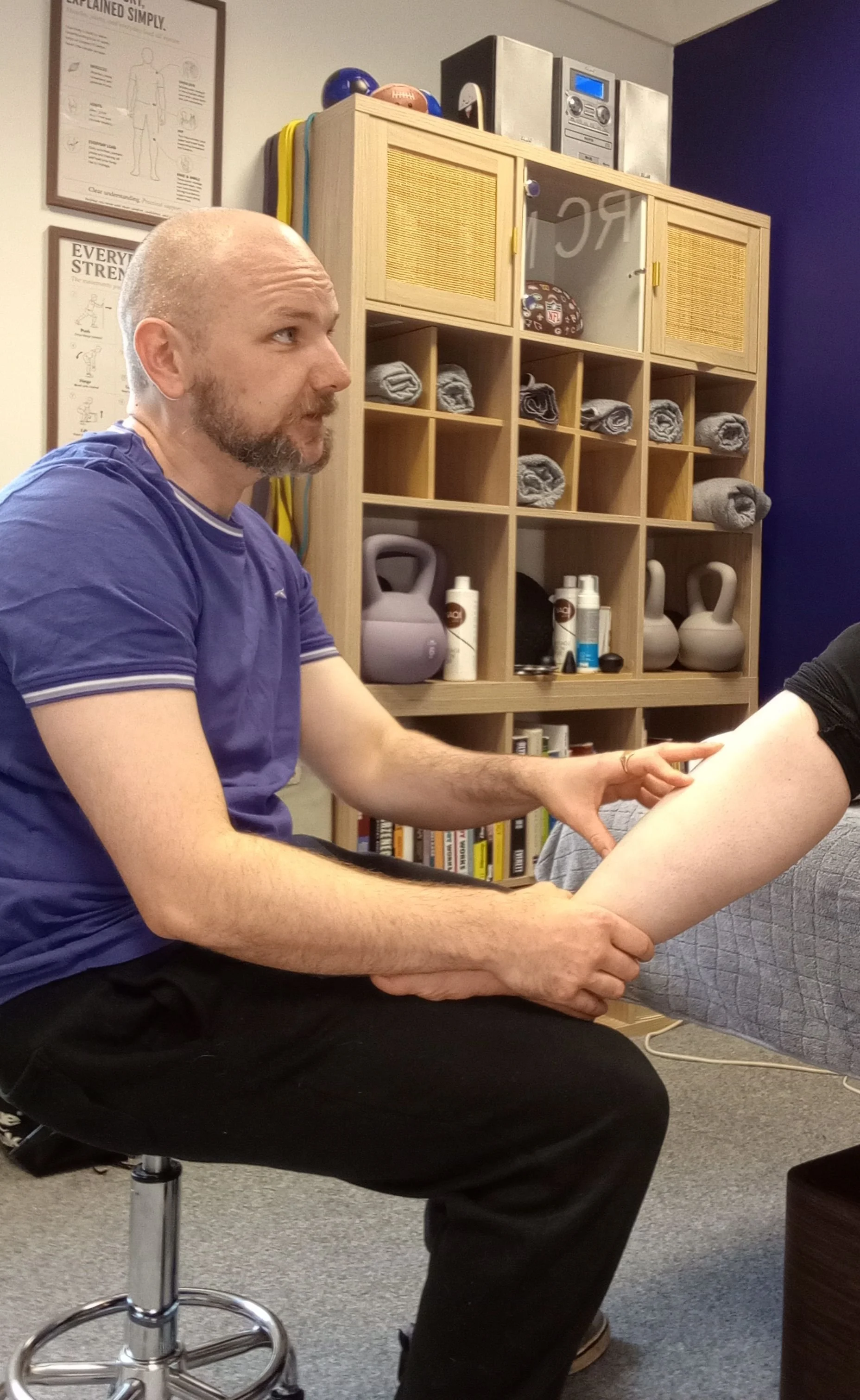
Ross can support you better when you describe what you feel and where whether thats tightness or tension
What Can You Try When an Area Feels Tight?
The sensible first step depends on what else is happening.
If the feeling is mild, familiar and not linked with concerning symptoms, you might try:
changing position and moving the area gently
taking a short walk if you have been still for a long time
using a comfortable stretch if stretching feels helpful
avoiding the idea that a stretch must be intense to be worthwhile
adjusting an unfamiliar activity rather than repeatedly pushing through a worsening response
noticing whether the feeling changes after warming up or returns during one particular task
allowing time to recover after a sudden increase in physical demand
These are ways to support comfort and gather information. They are not tests that reveal a diagnosis.
Stretching is also an option, not an obligation. A systematic review found a small short-term increase in range after a single stretching session, with no significant subgroup difference by stretching intensity. That supports a comfortable approach rather than assuming that harder stretching must work better. (Behm and colleagues)
If hands-on treatment helps an area feel more comfortable, that response can be useful too. It does not prove that a knot was removed or that the original cause has been corrected. Why Does Tightness Come Back After Massage? explains why a helpful short-term response and a recurring experience can both be true.
When Is Assessment More Useful Than Guessing?
Individual assessment may be useful when:
the same feeling repeatedly returns
several areas seem connected
your usual range or function appears to be changing
the sensation affects walking, lifting, work, training or everyday tasks
you cannot tell whether the concern is local or part of a wider movement issue
the description tight no longer gives you enough information to decide what to do
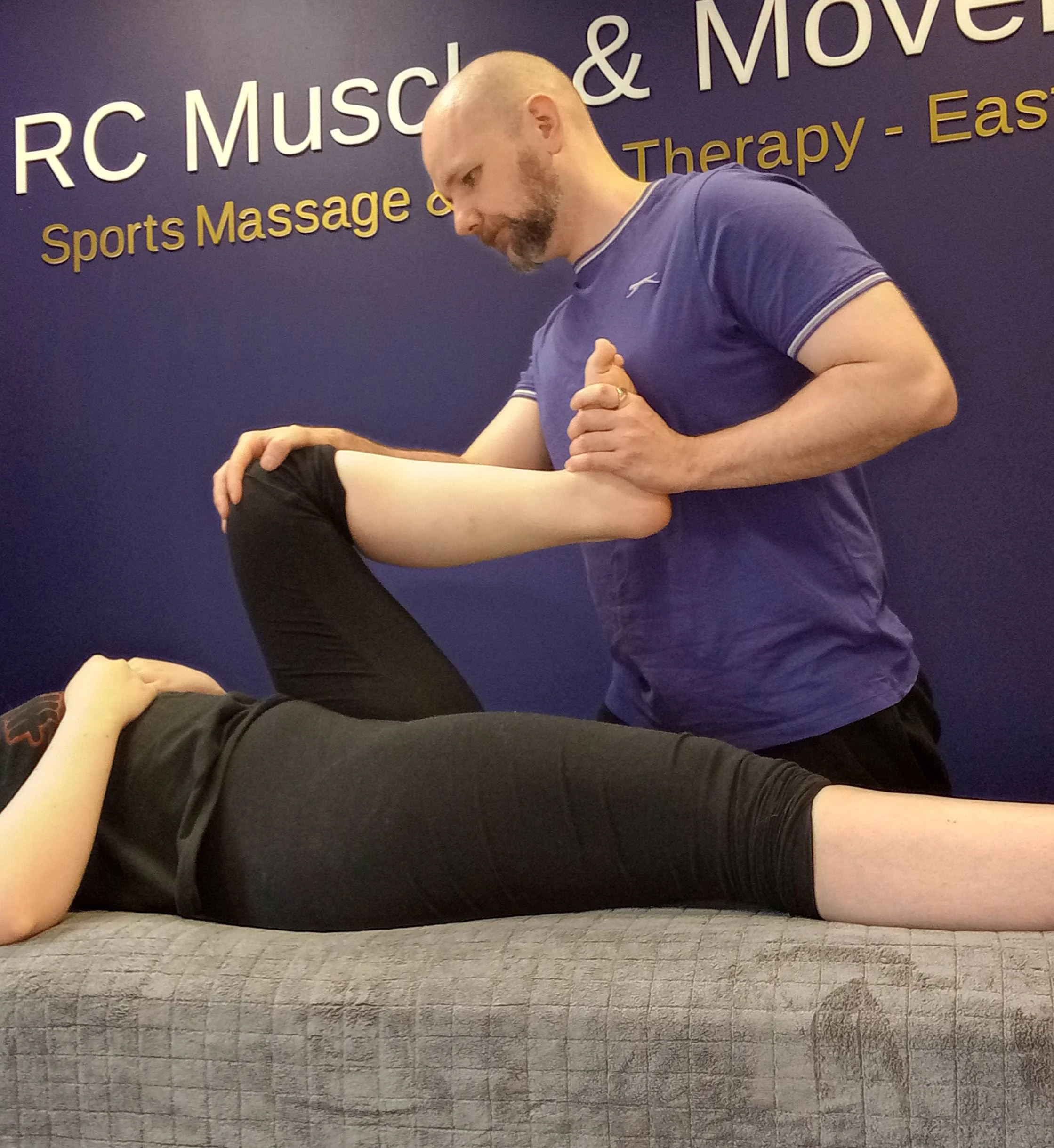
RCMM’s Movement & Function Assessment is designed to build a clearer picture of recurring, unclear or multi-area concerns within Sports Therapy scope. It is not a medical diagnosis and does not replace NHS or medical assessment where that is more appropriate.
An appointment may include talking through what you have noticed, looking at relevant movement and considering how the issue affects ordinary tasks or activities. The aim is not to attach a dramatic label to an everyday sensation. It is to make the next step clearer.
If the main question is why one side feels different from the other, Why One Side Can Feel Tighter Than the Other covers that topic without assuming the body should feel perfectly symmetrical.
Key Takeaways
Tightness is usually a felt experience, not a diagnosis.
Muscle tension can be an everyday description or a more technical reference to force or activity in a muscle.
Muscle tone, stiffness and range of movement are related ideas, but they are not interchangeable.
Feeling tight does not prove that a muscle is shortened, damaged, weak or overactive.
Two people can use the same word while describing different experiences.
A useful description includes timing, location, triggers, changes and the effect on everyday function.
Mild, familiar tightness may respond to comfortable movement, a change of position, stretching or time.
Recurring, unclear or function-changing symptoms may deserve individual assessment.
Severe, rapidly worsening, traumatic or neurologically concerning symptoms need an appropriate medical route.
The most useful question is often not:
“What single thing is wrong with this muscle?”
It is:
“What exactly am I feeling, when does it happen and what changes it?”
That gives you a clearer starting point without turning an ordinary body sensation into a diagnosis.
How RCMM Can Help
RC Muscle & Movement provides practical, movement-focused musculoskeletal support in East Kilbride. Our role is to listen to what you have noticed, consider how it affects movement and everyday function, and help identify a sensible next step within scope.
The right appointment depends on what you want from the session:
Deep Tissue Massage suits people looking for broader, whole-body comfort when several areas feel as though they could use attention.
Sports Massage is more focused when one or two areas feel particularly noticeable and hands-on support is your priority.
Movement & Function Assessment is usually the clearest starting point when the feeling keeps returning, involves several areas or remains difficult to explain.
You do not need to arrive knowing the correct service name. Start with what you have noticed and what you would like help with.
FAQs
Are muscle tightness and muscle tension the same thing?
They are often used to describe a similar feeling in everyday conversation, but they are not exact synonyms in a technical sense. Tightness usually describes a personal sensation, while muscle tension may also refer to force or activity within a muscle.
Does feeling tight mean a muscle is short?
Not necessarily. A tight feeling and measured muscle length or joint range are different. Sensation, stretch tolerance, stiffness and other factors can influence how movement feels.
Can a muscle feel tight even when I am resting?
Yes. People can notice tightness while sitting or resting. The sensation alone does not show whether the muscle has unusually high activity or tone. Timing, position, recent activity and other symptoms provide more useful context.
Is muscle stiffness the same as muscle tension?
No. In everyday speech, the words can overlap. In biomechanics, stiffness describes resistance to a change in length or movement, while tension refers more broadly to force within a muscle. Neither term, used alone, explains why an area feels different.
Can stress cause muscle tension?
Stress can influence muscle activity in some people and situations, particularly around the neck and shoulders. It should be treated as one possible influence rather than the automatic explanation for every tight area.
Should I stretch a muscle that feels tight?
A comfortable stretch may help some people feel easier or move further in the short term. It does not need to be painful, and a helpful response does not prove that the muscle was shortened. Stop and seek appropriate advice if stretching causes sharp, severe or worsening symptoms.
Does muscle tightness mean damage?
No. Tightness on its own does not prove tissue damage. Equally, a general article cannot rule out an injury or medical condition. Sudden severe symptoms, significant swelling or bruising, new weakness or numbness, trauma or substantial loss of function need appropriate assessment.
What should I book if tightness keeps returning?
If your priority is broader, whole-body comfort, Deep Tissue Massage may suit. If one or two areas feel muscular and you mainly want focused hands-on support, Sports Massage may fit. If the concern is recurring, unclear, affects several areas or changes how you move, RCMM’s Movement & Function Assessment is usually the better starting point.
Professionally Reviewed by Ross Canning, Sports Therapist
Ross reviewed this article for accuracy, professional scope and practical relevance. RCMM’s educational content does not replace medical diagnosis or individual healthcare advice.
Weppler CH, Magnusson SP. Increasing Muscle Extensibility: A Matter of Increasing Length or Modifying Sensation? Physical Therapy. 2010;90(3):438–449. Used for the distinction between temporary mechanical change and altered sensation or stretch tolerance.
Behm DG et al. Acute Effects of Various Stretching Techniques on Range of Motion: A Systematic Review with Meta-Analysis. Sports Medicine - Open. 2023;9:107. Used for the small acute increase in range after stretching and the finding that subgroup results did not differ significantly by stretching intensity.
Ganguly J, Kulshreshtha D, Almotiri M, Jog M. Muscle Tone Physiology and Abnormalities. Toxins. 2021;13(4):282. Used to distinguish the physiological and clinical idea of muscle tone from an ordinary report of feeling tense.
Shahidi B, Haight A, Maluf K. Differential Effects of Mental Concentration and Acute Psychosocial Stress on Cervical Muscle Activity and Posture. Journal of Electromyography and Kinesiology. 2013;23(5):1082–1089. Used for the cautious statement that acute psychosocial stress can alter neck and shoulder muscle activity in some circumstances.
NHS. Sprains and strains. Used for general safety-netting after injury, including severe or worsening pain, marked swelling or bruising, loss of normal use and sensory changes.