Why Your Hips Feel Tight When Your Day Involves a Lot of Sitting
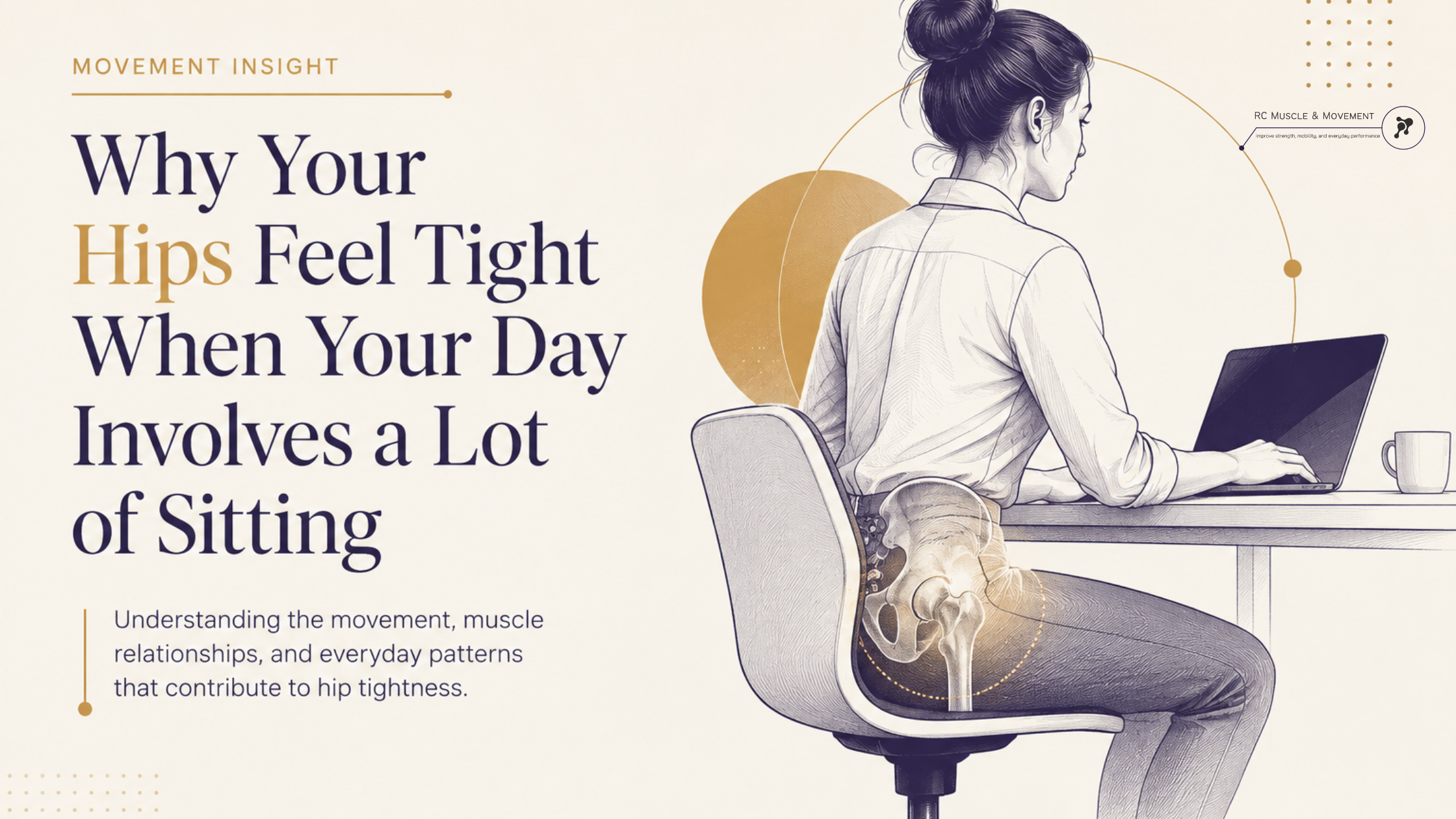
Hips often feel stiff after long periods sitting.
You might notice it when you stand up from your desk, get out of the car, walk upstairs, start training, or move after being still for a while.
For some people, it feels like the front of the hips is tight. For others, it shows up around the glutes, lower back, pelvis, or the outside of the hip.
That does not automatically mean something is wrong.
Often, it means your body has spent a lot of time in one position and is now being asked to move differently.
Why sitting can make hips feel tight
Sitting keeps your hips bent for long periods.
That position is not a problem on its own. The issue is usually the amount of time spent there, especially when the rest of the day does not include much movement variety.
Your hips are built to move in different directions. They help with walking, standing, stairs, squatting, lifting, rotating, and getting up and down from chairs.
When most of the day is spent sitting, the hips do not get much chance to work through that full range.
Over time, certain areas may start to feel stiff, heavy, or overworked.
Research has found an association between prolonged sitting, physical inactivity, and reduced passive hip extension, although more research is needed to fully understand how this links to discomfort.
In plain English:
if your hips spend most of the day bent, they may not feel as comfortable when you ask them to open, extend, rotate, or produce force later. Our hip pain page looks at common complaints we see within the clinic
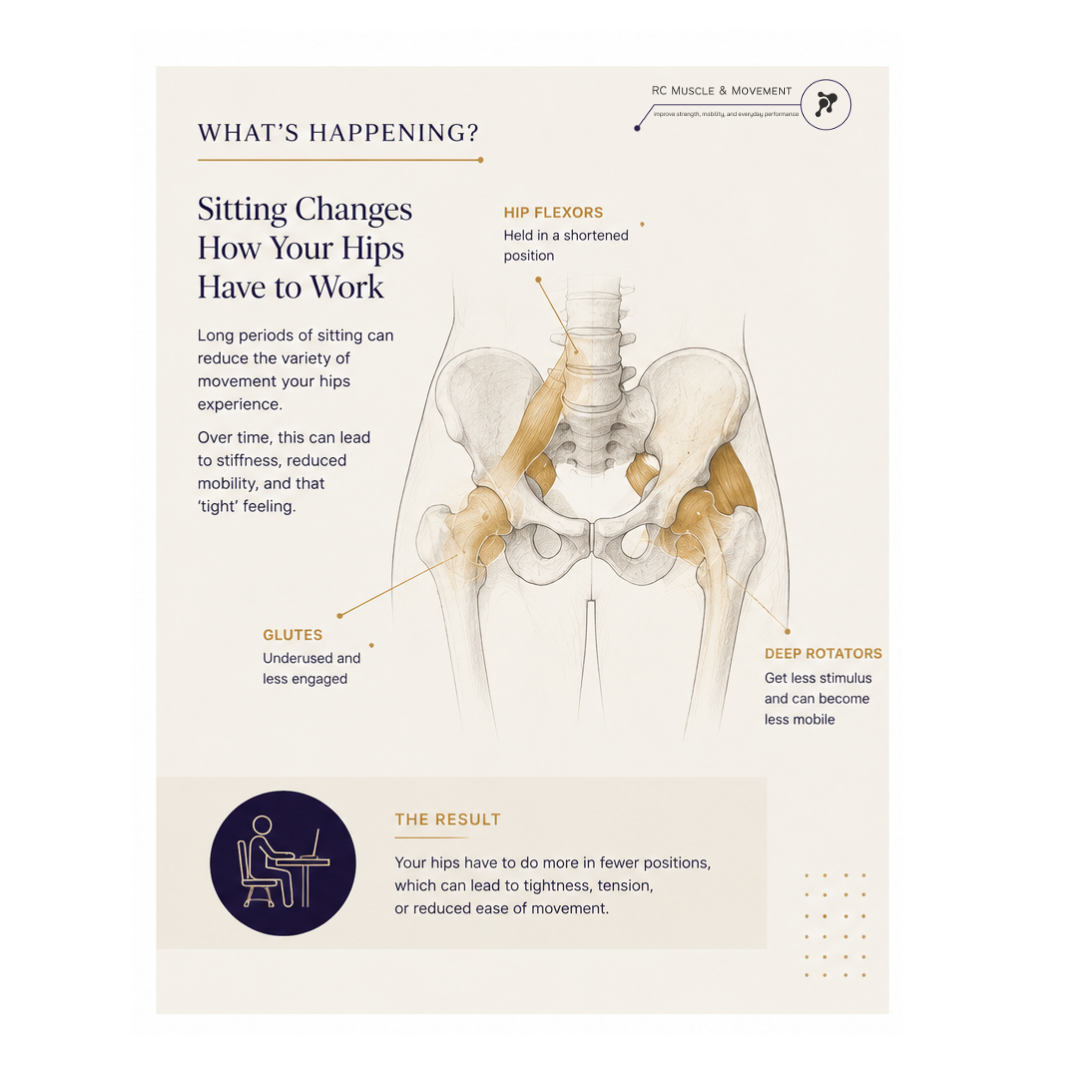
Sitting changes how your hips have to work
diagram shows how long periods of sitting affect hip flexors and glutes
It is not just about posture
A lot of people blame posture when their hips feel tight.
Posture can play a part, but it is rarely the whole story.
Hip tightness after sitting is usually more about:
how long you stay in one position
how often you change position
how much walking or movement you get through the day
how much your glutes and hips are asked to work
what you do straight after sitting
whether your body has enough strength and support for daily demands
Someone can sit with “good posture” and still feel stiff if they barely move for several hours.
Someone else may sit in a less perfect position but feel fine because they move regularly, walk often, and have good strength around the hips and trunk.
The body generally responds better to movement variety than perfect positioning.
Why the glutes matter
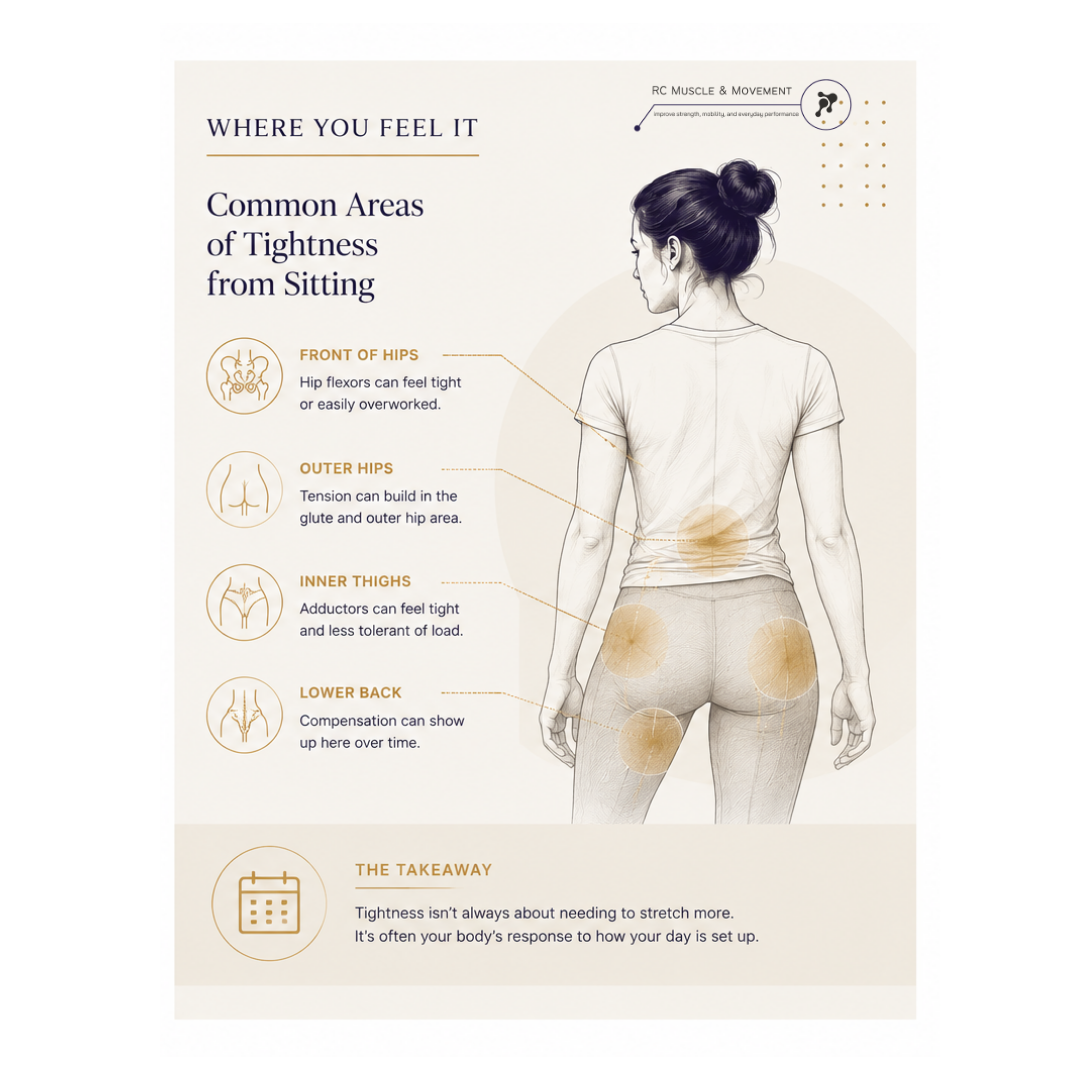
Common areas of stiffness from sitting
Image shows areas where tension can build up
The glutes help support the hips and pelvis during walking, standing, stairs, lifting, and getting up from a chair.
When you sit for long periods, the glutes are not doing much active work.
That does not mean they are “switched off” or broken.
It simply means they may not be getting much regular demand through the day.
Then, when you stand up, walk quickly, climb stairs, train, or carry something, the body suddenly asks those areas to contribute again.
If the hips and glutes are not well prepared for that demand, other areas may start doing more work than they should.
That can leave you feeling tight around the front of the hips, side of the hips, glutes, or lower back.
Why tightness can show up after work
For many people, hip tightness is not about one big event.
It is the build-up of ordinary daily positions and tasks.
Common examples include:
sitting at a desk
driving
working from a laptop
sitting through long meetings
crossing one leg over the other
standing up after being still
going straight from work into training
walking quickly after a long car journey
climbing stairs after sitting most of the day
The body is not separate from your day.
Work, stress, sitting, training, sleep, recovery, and general activity levels all influence how movement feels.
That is why hips may feel fine some days and tighter on others. Our sports massage offers targeted soft tissue work on the hips and glutes.
What may help tight hips from sitting
The aim is not to panic about sitting.
Most people need to sit. Work, driving, admin, appointments, family life and downtime often involve it.
The better question is:
how can you stop sitting from being the only position your hips spend time in?
Small changes often help.
1. Break up long periods of sitting
You do not need a complicated routine.
Standing up, walking briefly, changing position, or moving your hips for a short period can help reduce how static the day becomes.
NHS physical activity guidance encourages adults to reduce time spent sitting or lying down and break up long periods without movement.
That fits well with what we see in clinic.
Often, people do not need perfect posture. They need more regular movement.
2. Add simple hip movement into the day
Gentle movement can help the hips feel less stiff, especially if you have been sitting for a while.
That could include:
standing up regularly
short walks
gentle hip circles
stepping backwards and forwards
slow sit-to-stands
easy walking after long drives
NHS Inform advises adding hip exercises gradually and notes that small amounts throughout the day can be useful when building movement back in.
The key word is gradually.
Doing too much too quickly can make things feel more irritated, especially if your hips already feel sensitive.
3. Build strength around the hips
Mobility matters, but strength matters too.
If the hips and glutes do not have enough capacity for daily life, tightness can keep returning.
That does not mean everyone needs heavy gym training.
Strength can be built through everyday movement, resistance exercises, carrying tasks, stairs, controlled squats, bridges, step-ups, or other suitable work.
NHS guidance for adults includes strengthening activities for major muscle groups, including the legs and hips, on at least two days a week.
At RC Muscle & Movement, we think about strength in a practical way:
not gym performance for the sake of it, but enough capability to help your body tolerate normal life better.
4. Look at what happens after sitting
Sometimes the issue is not just the sitting.
It is what comes next.
For example:
sitting all day, then training hard
driving for an hour, then walking quickly uphill
desk work all morning, then lifting or carrying
long meetings, then rushing around
sitting most of the week, then doing a big weekend activity
The body often prefers a gradual transition.
If your hips feel tight after sitting, it may help to give them a few minutes of movement before asking them to do something more demanding.
When hands-on work can help
Hands-on work can help when hips, glutes, or surrounding muscles feel tight, heavy, or guarded.
Sports massage or deep tissue work may help reduce the feeling of tension and make movement feel easier for some people.
But if the tightness keeps coming back, it is usually worth looking beyond the tight area.
That is where movement-focused thinking matters.
The question becomes:
how are your hips moving?
are your glutes contributing well?
are certain areas doing more work than they should?
does your day involve enough movement variety?
are your hips strong enough for what you ask of them?
This is where a Movement & Function Assessment can be useful, especially if the same tightness keeps returning or movement feels harder than it should.
When to get medical advice
Most everyday hip stiffness is not urgent.
But there are times where you should seek medical advice rather than waiting to see if it settles.
NHS guidance advises getting help if hip pain is severe, worsening, follows a fall, or you are unable to walk or put weight through the leg.
That is outside the purpose of a general massage or movement appointment.
If something does not feel right, it is better to get it checked.
How RC Muscle & Movement can help
At RC Muscle & Movement in East Kilbride, we work with people who feel tight, stiff, restricted, or uncomfortable in everyday movement.
If your hips feel tight after sitting, we will not just look at the tight area in isolation.
We look at how your hips, glutes, pelvis and everyday movement may be contributing, then match the session to what you actually need.
That might mean hands-on work.
It might mean looking more closely at how you move.
It might mean simple guidance to help your hips feel less restricted through the day.
The goal is straightforward:
to help you understand what may be contributing and improve how you move and feel in everyday life.
Our deep tissue or sports massage can offer relief or recurring hip tightness or restrictions.
FAQs
Why do my hips feel tight after sitting?
Your hips stay bent while sitting. If you stay in that position for long periods, the hips may feel stiff when you stand, walk, climb stairs, or train later.
Are tight hips always caused by poor posture?
No. Posture can play a part, but hip tightness is often more about time in one position, reduced movement variety, daily workload, and how well the hips and glutes are supporting movement.
Can massage help tight hips from sitting?
Massage may help reduce the feeling of tension around the hips, glutes and surrounding muscles. If the tightness keeps returning, it may also be worth looking at movement, strength and daily habits.
Should I stretch my hips every day?
Some gentle stretching or movement may help, but it should be suitable for you. If stretching makes symptoms worse or the same tightness keeps returning, it may be better to look at the bigger movement picture.
What should I book if my hips keep feeling tight?
If you mainly want tension relief, deep tissue or sports massage may fit. If the tightness keeps returning or you are unsure what is causing it, a Movement & Function Assessment is usually the better starting point.
Source Base Used
This blog is grounded in NHS guidance on keeping moving with hip pain, NHS Inform guidance on gradual hip movement and strengthening, NHS adult physical activity guidance on reducing long periods of sitting and doing strengthening work, and research linking prolonged sitting/physical inactivity with reduced hip extension.