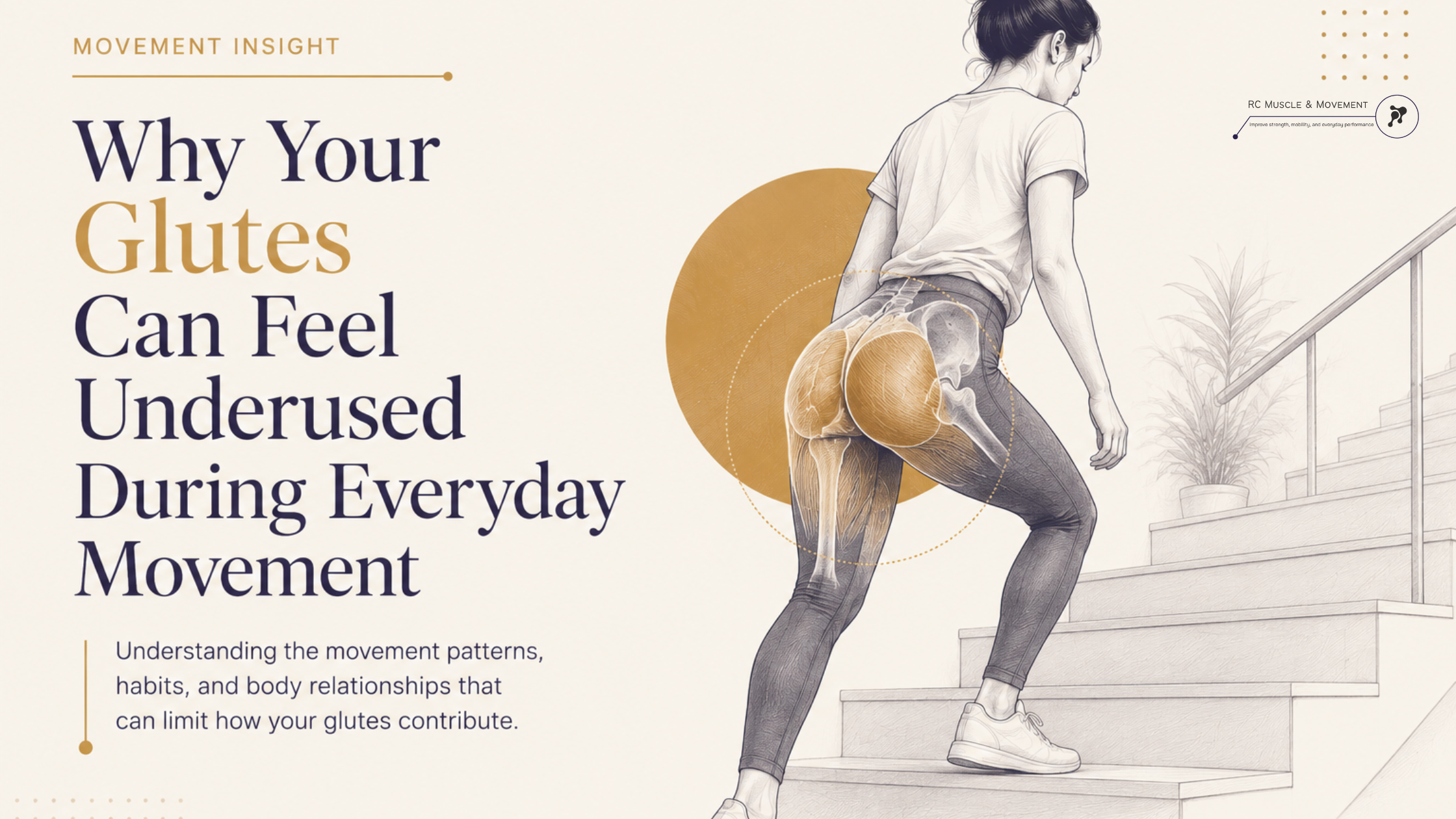
Why Your Glutes Can Feel Underused During Everyday Movement
People often describe their glutes as feeling “switched off”.
That phrase is common, but it can make the body sound broken.
Most of the time, your glutes have not stopped working. They may just not be contributing as well as they could during everyday movement.
You might notice this as:
hips feeling stiff after sitting
glutes feeling tight, heavy, or hard to engage
lower back or hips doing more work than expected
walking or stairs feeling less smooth
one side feeling less steady
movement feeling harder than it should
That does not automatically mean there is one major problem.
Often, it means your body has adapted to what it does most.
What your glutes actually do
Your glutes are a group of muscles around the back and side of the hip.
They help with:
standing up
walking
climbing stairs
lifting
squatting
controlling the pelvis
supporting the hips during single-leg movement
creating power when you push through the legs
The gluteus maximus plays an important role in hip extension and pelvic stability, especially when movement asks more of the hips, such as stairs, lifting, running or changes in body position. (Mayo Clinic)
The side glute muscles also matter. Hip abductor strength is linked with pelvic stability, lower-limb control and balance, although how that applies to each person depends on their movement, strength and daily demands. (PMC)
In plain English:
your glutes help your hips and pelvis share work properly.
When they are not contributing well, other areas may start picking up more of the load.
If hip stiffness or discomfort keeps showing up during walking, stairs, sitting or training, it may help to understand how hip-related discomfort can build through everyday movement. You can read more over on our hip pain page
Why glutes can feel underused
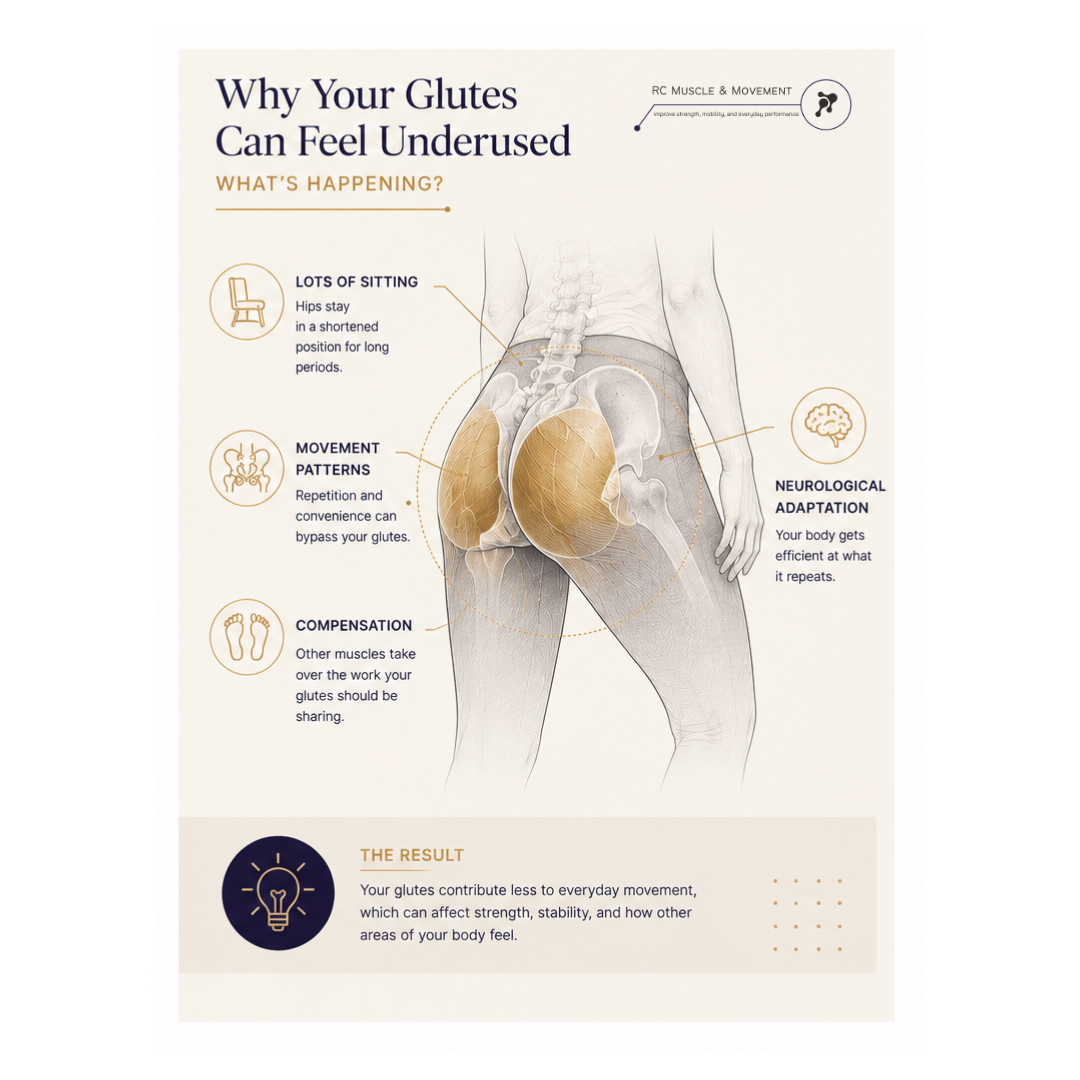
Reasons glutes may feel underused
Image showing how different movement patterns contribute
Glutes can feel underused for several reasons.
It is rarely about one muscle being “off”.
It is usually about a mix of:
sitting for long periods
reduced walking or varied movement
repeated daily positions
lack of hip strength
rushing from stillness into harder activity
certain areas doing more work than they should
The body adapts to repeated demand.
If your day involves a lot of sitting, short walks, desk work, driving, and not much movement variety, your hips and glutes may not get many chances to work through different ranges.
Research has found an association between prolonged sitting, physical inactivity and reduced passive hip extension, although more research is needed to understand how this relates to discomfort. (PubMed)
That does not mean sitting is “bad”.
It means sitting becomes more of a problem when it takes up most of the day and movement becomes too limited.
Sitting reduces demand on the glutes
When you sit, your glutes are mostly resting.
That is normal.
But if you sit for long periods, then stand up and immediately ask your body to walk quickly, climb stairs, lift, train or carry things, your glutes may not be well prepared for that jump in demand.
That can leave movement feeling less smooth.
Some people feel this around the hips.
Some feel it around the glutes.
Some feel it through the lower back or pelvis.
Some just feel like their body is working harder than it should.
This is where RCMM’s movement-first view matters.
We are not just asking:
“Where does it feel tight?”
We are also asking:
“What is doing the work?”
It is not always weakness
Glutes feeling underused does not always mean they are weak.
They may be:
underloaded through the day
not being challenged regularly
not well coordinated with the hips and trunk
tight from doing repeated work
slow to contribute after long periods sitting
being asked to do too much too suddenly
This is why generic “glute activation” advice can be too simplistic.
A few band exercises may help some people.
But if the wider issue is sitting all day, limited walking, low strength, rushed training, or poor load tolerance, then the answer is usually broader than one exercise.
Your body does not work in isolated parts.
The hips, glutes, pelvis, trunk and legs all share work.
Why walking and stairs can show the issue
Walking and stairs are useful because they show how the hips and glutes deal with repeated everyday demand.
Walking asks your hips to move, support, stabilise and transfer weight from one side to the other.
Stairs usually ask more from the hips and glutes because you need to push yourself upward.
That is why some people notice glute or hip fatigue more on:
stairs
hills
longer walks
getting up from low chairs
carrying shopping
training after work
moving after a long drive
This is not about being “unfit”.
It is about whether your hips and glutes have enough capacity for what your day is asking.
Everyday life can change how the glutes feel
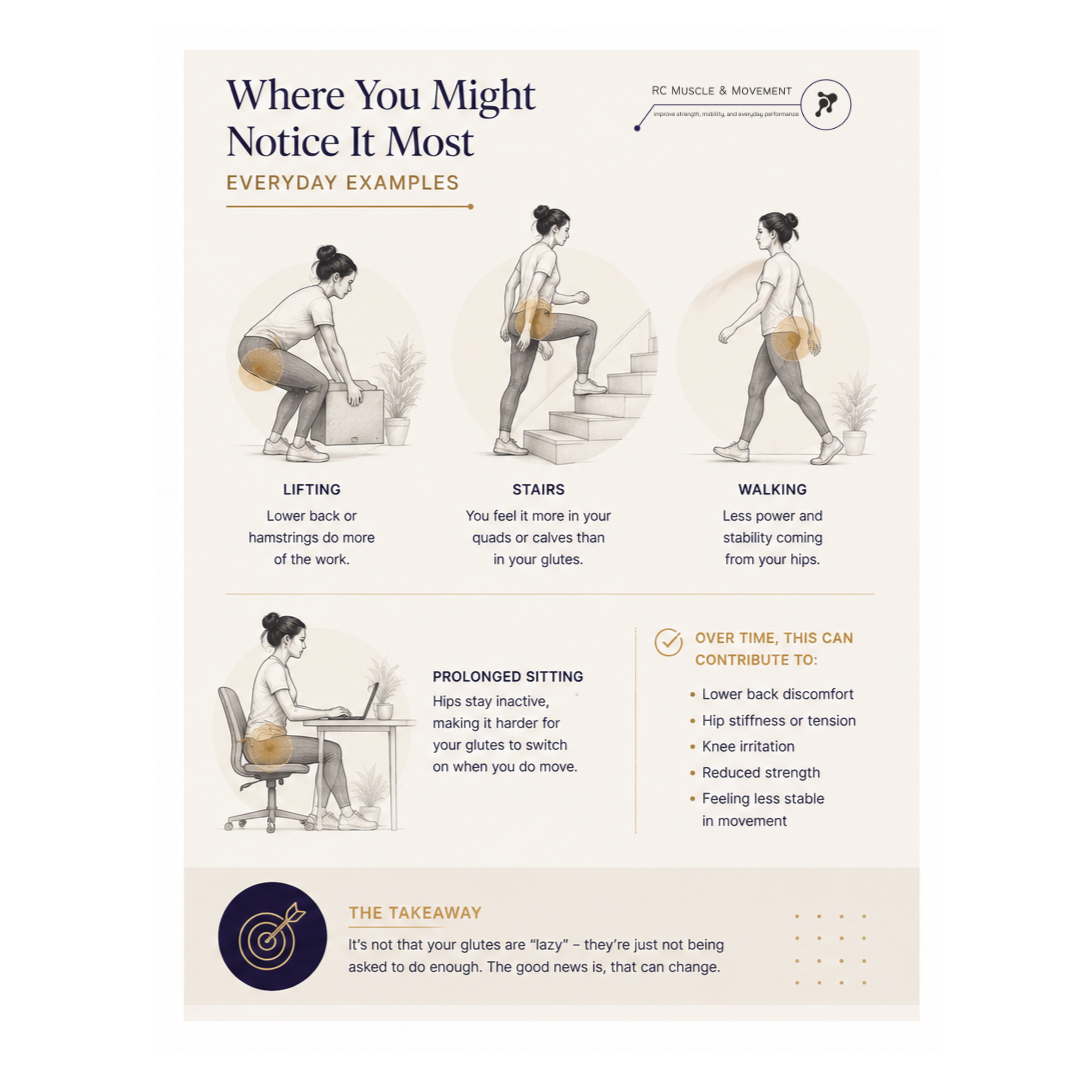
Why glutes may feel underused in everyday life
Glute and hip tension often builds through ordinary routines.
Examples include:
sitting at a desk for hours
driving regularly
standing with more weight on one side
always carrying bags on the same side
rushing upstairs after being still
walking less during busy weeks
training hard after low-movement days
not getting much recovery between busy periods
None of these are dramatic.
That is the point.
The body often responds to repeated small demands, not just big events.
Over time, those repeated demands can make certain areas feel tight, tired, restricted or underused.
What may help glutes work better in everyday movement
The goal is not to obsess over your glutes.
The goal is to help your hips, glutes and surrounding areas share work better during normal life.
1. Break up long sitting periods
If your glutes spend most of the day resting, it makes sense to give them more chances to work.
That does not need to be complicated.
It could mean:
standing up more often
walking for a few minutes
using stairs when suitable
changing position regularly
doing a few controlled sit-to-stands
moving before training or longer walks
NHS guidance encourages adults to reduce time spent sitting or lying down and break up long periods without movement. It also recommends strengthening activities for major muscle groups, including the legs and hips, at least twice a week. (nhs.uk)
That fits the RCMM view well:
small, regular movement usually matters more than perfect posture.
2. Build strength gradually
If the glutes are not used to doing much work, they often need gradual exposure.
That might include:
sit-to-stands
step-ups
bridges
controlled squats
walking hills gradually
carrying tasks
simple resistance work
slower, more controlled movement
NHS Inform advises adding hip exercises gradually, starting with small amounts and building up as comfort allows. (NHS inform)
Cambridge University Hospitals also describes hip strengthening exercises as a way to improve control and strength of the gluteal muscles. (Cambridge University Hospitals)
This does not mean everyone needs a gym plan.
Strength can be built in a way that fits real life.
For RCMM, strength is not about performance culture.
It is about helping your body feel more capable for everyday movement.
If the same tightness keeps returning, or you are not sure whether the issue is strength, movement, workload or habit, a Movement & Function Assessment can help you understand what may be contributing. Book an assessment , you find more about our movement assessment here
3. Notice what other areas are doing
If your glutes feel underused, look at what is doing more work instead.
You might notice:
front of the hips gripping
lower back working harder
hamstrings feeling tight
one side feeling less steady
hips feeling heavy after walking
stiffness after stairs or training
That does not mean those areas are wrong.
It may simply mean your body is sharing work in a way that is not as efficient as it could be.
Movement assessment can help make this clearer.
4. Avoid jumping from stillness to high demand
A common pattern is:
sit most of the day
then go straight into training, stairs, lifting, or a long walk
That jump can feel rough on the hips and glutes.
A short transition can help.
For example:
walk for a few minutes before training
stand and move before climbing lots of stairs
warm up before lower-body exercise
change position before getting into a demanding task
build up gradually after a quieter week
The aim is not to make movement complicated.
It is to give your body a better chance to respond.
Can hands-on work help?
Hands-on work can help when the hips, glutes or surrounding areas feel tight, heavy or overworked.
Sports massage may help when a specific area feels restricted or loaded.
Deep tissue massage may suit people who feel more general tension and want their body to feel more comfortable.
But if your glutes keep feeling underused, it is usually worth looking beyond the tight area.
The useful questions are:
how are your hips moving?
are your glutes contributing well?
are other areas doing more work than they should?
does your day give your body enough movement variety?
do your hips and glutes have enough strength for daily life?
That is where hands-on work and movement-focused thinking work well together.
When to get medical advice
Most everyday tightness or stiffness is not urgent.
But if symptoms are severe, worsening, linked to a fall, or you are struggling to walk or put weight through the leg, it is better to seek medical advice. NHS guidance gives similar advice around hip symptoms that are severe, worsening or affecting walking and weight-bearing. (NHS inform)
If something does not feel right, get it checked.
How RC Muscle & Movement can help
At RC Muscle & Movement in East Kilbride, we work with people who feel tight, stiff, restricted or like certain areas are doing more work than they should.
If your glutes feel underused, we will not just hand you a list of exercises and send you away.
We look at how your hips, glutes, pelvis and everyday movement are working together.
That might include hands-on work.
It might include movement assessment.
It might include simple guidance to help you build more confidence in how your body moves.
The goal is straightforward:
to help you understand what may be contributing and improve how you move and feel in everyday life.
Sports massage may help when a specific area feels restricted or loaded.
FAQs
Why do my glutes feel underused?
Glutes can feel underused when they are not being asked to work regularly through everyday movement. Long sitting, reduced walking, repeated habits and low strength around the hips can all contribute.
Are my glutes actually switched off?
Usually, no. “Switched off” is a common phrase, but your glutes have not stopped working. They may simply not be contributing as well as they could during certain movements.
Can sitting make glutes feel inactive?
Sitting means the glutes are mostly resting. If you sit for long periods and do not move much through the day, they may feel less ready when you stand, walk, climb stairs or train.
Do weak glutes cause hip tightness?
Weak or underused glutes may contribute to hip tightness for some people, but it is rarely one simple cause. Hip tightness can also relate to sitting, workload, movement habits, recovery and how the body shares effort.
What should I book if my glutes keep feeling underused?
If you mainly want tension relief, sports massage or deep tissue massage may help. If the same issue keeps returning or you want to understand what may be contributing, a Movement & Function Assessment is usually the better starting point.
Source Base Used
This blog is grounded in NHS guidance on reducing long periods of sitting and strengthening major muscle groups, NHS Inform guidance on gradual hip movement and strengthening, Cambridge University Hospitals guidance on improving gluteal control and strength, and research discussing hip strength, pelvic stability and prolonged sitting. (nhs.uk)