Why Hip Tightness Comes and Goes During Everyday Life
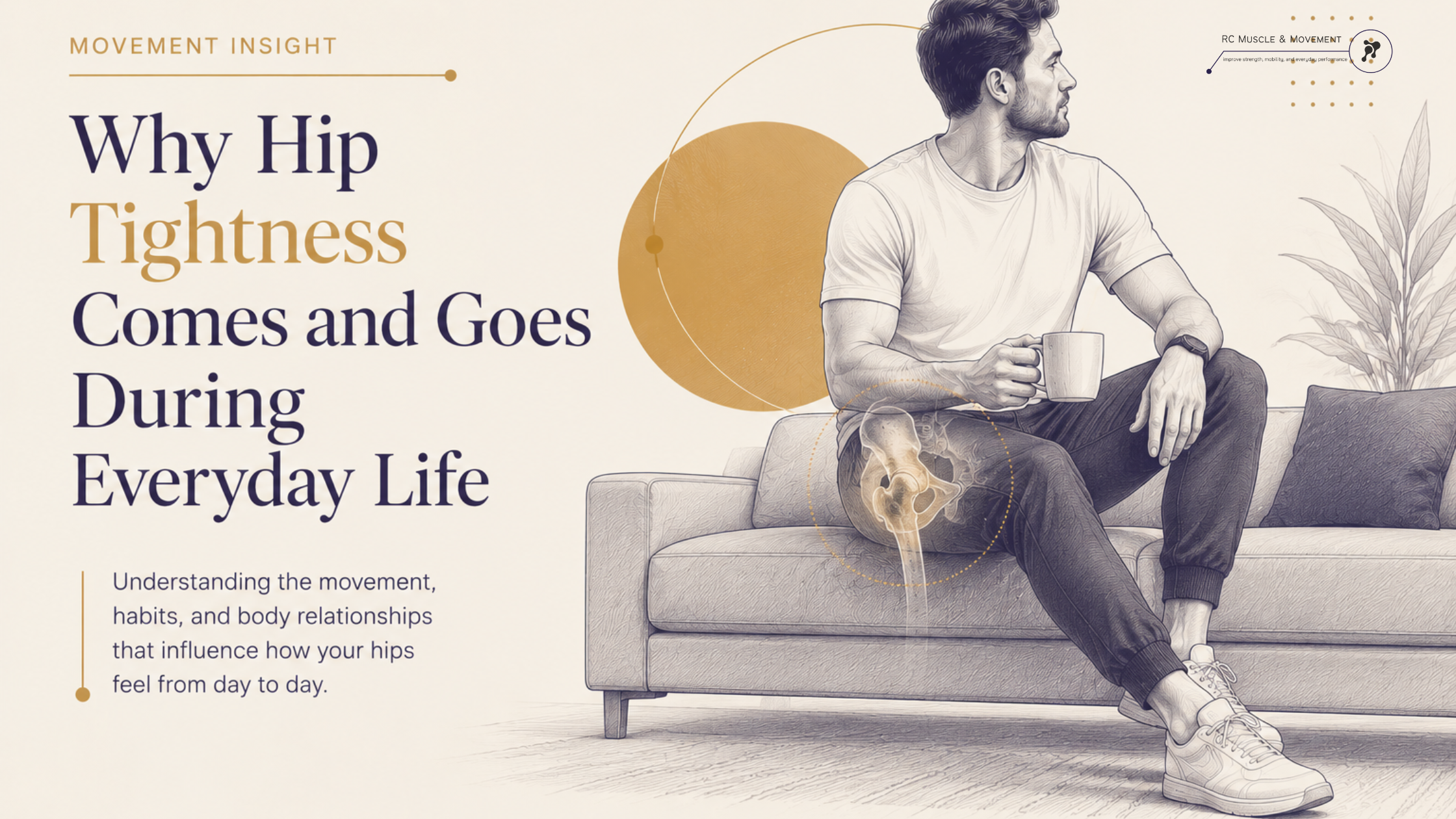
Hip tightness is not always the same every day.
Some days your hips feel fine.
Other days they feel stiff, heavy, restricted, or harder to move than usual.
You might notice it after sitting, driving, walking, stairs, training, standing for a long time, or moving after a quieter day.
That can be frustrating because it feels inconsistent.
But changing symptoms do not always mean something serious is happening.
Often, hip tightness comes and goes because your body is responding to what your day has asked from it.
Why hip tightness can change from day to day
Your hips are involved in a lot of everyday movement.
They help with:
standing up
walking
stairs
bending
lifting
sitting down
getting out of the car
turning and changing direction
carrying things
training or exercise
Because your hips are used so often, how they feel can change depending on daily load.
A day spent sitting at a desk may affect them differently from a day spent walking, lifting, travelling, training, or standing for hours.
The hip area also does not work on its own.
The hips, glutes, pelvis, trunk and legs all share effort.
If one area is doing more work than usual, or another area is not contributing as well as it could, the hips may start to feel tighter or more restricted.
It is not always one clear cause
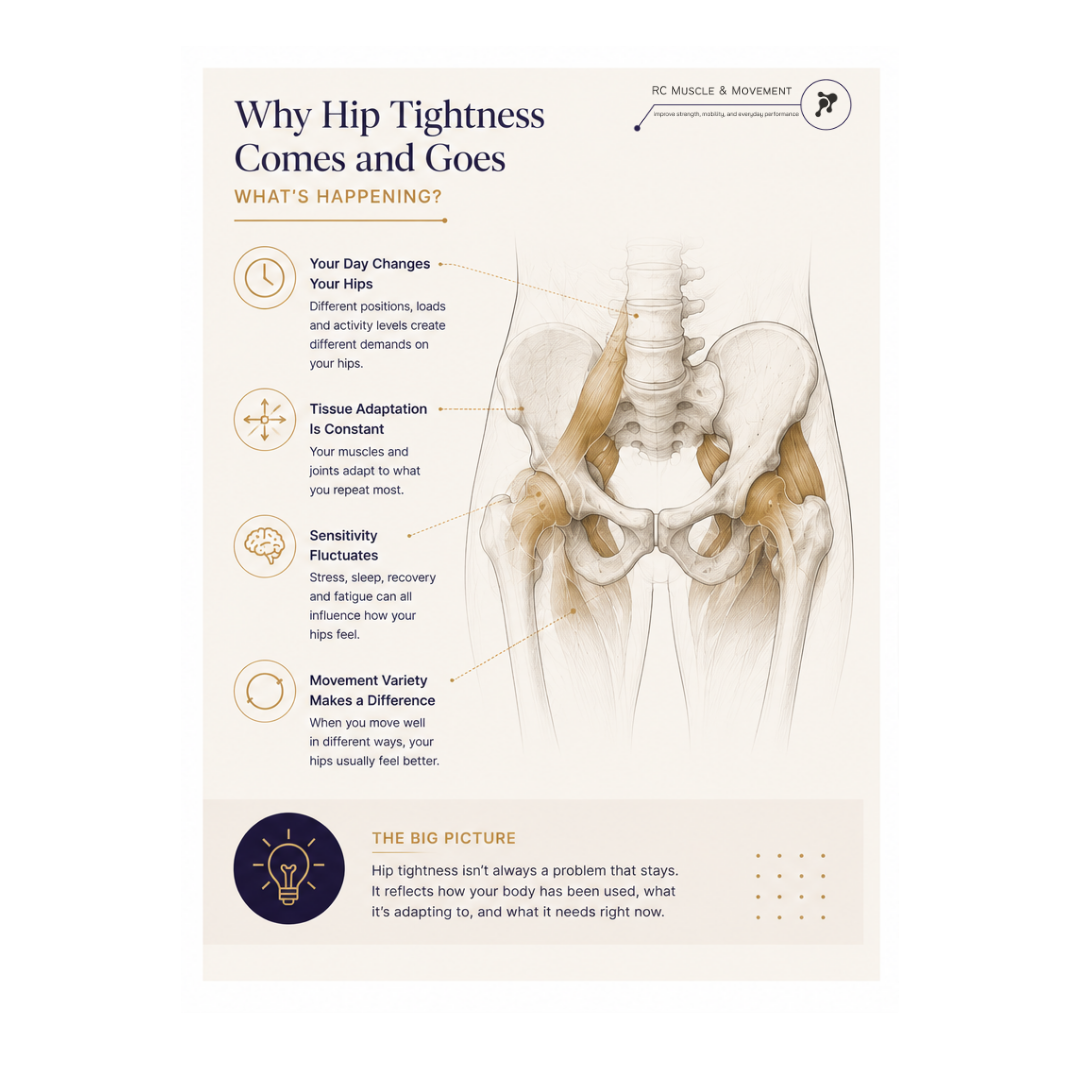
Potential reasons that influence hip tghtness
People often look for one reason:
“Is it my chair?”
“Is it my posture?”
“Is it my glutes?”
“Is it because I trained?”
“Is it because I sat too long?”
Sometimes one thing clearly stands out.
But often, hip tightness builds from a mix of smaller factors.
For example:
sitting longer than usual
less walking during the week
more stairs than normal
driving for longer
training after a quiet day
standing with weight shifted to one side
carrying bags or equipment
not recovering well between busy days
None of these have to be dramatic.
The body often responds to repeated ordinary demands.
That is why tightness may build gradually, ease off, then return again when the same pattern repeats.
Sitting can play a part
Sitting is not automatically bad.
Most people need to sit for work, driving, meals, admin, appointments, and rest.
The issue is usually not sitting itself. It is how long the hips stay in one position and how little movement variety happens around it.
When you sit, the hips stay bent. If they stay there for a long period, they may feel stiff when you stand, walk, climb stairs, or train later.
Research has found an association between prolonged sitting, physical inactivity and reduced passive hip extension, although more research is needed to understand exactly how this relates to discomfort.
In plain English:
if your hips spend most of the day in one position, they may not feel as free when you ask them to move differently.
That is not a reason to panic about sitting.
It is a reason to add more movement variety where possible.
If hip tightness is becoming more frequent or starting to affect walking, stairs, sitting or training, it may help to understand how hip-related discomfort can build through everyday movement.
Walking, stairs and training can also change how hips feel
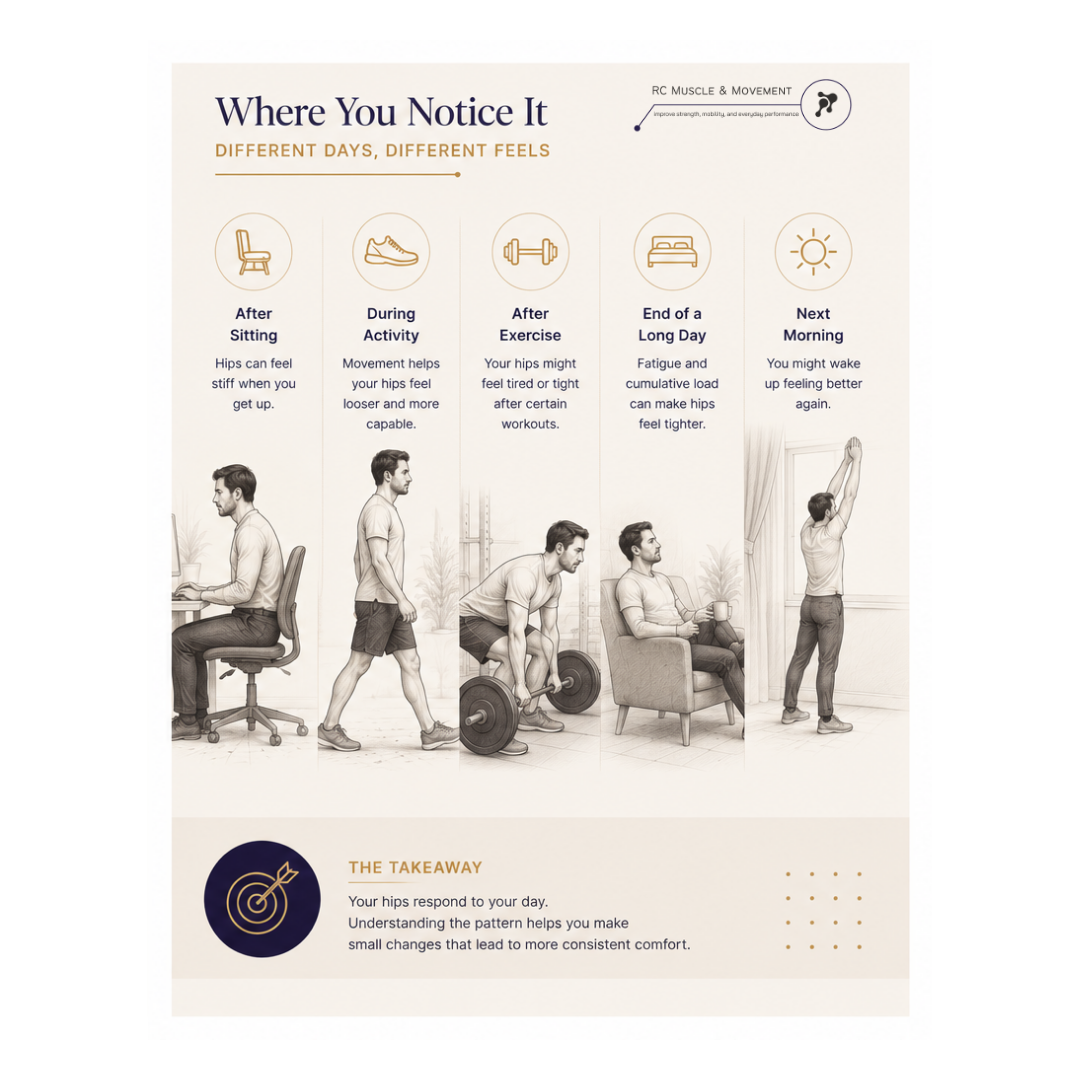
Image showing hip comfort throughout the day and activities
Hip tightness does not only come from sitting.
Sometimes the hips feel tighter after more movement, not less.
That can happen after:
longer walks
hill walking
more stairs than usual
lower-body training
carrying heavier loads
returning to exercise after time off
doing more on the weekend than during the week
This does not mean movement is the problem.
It usually means the demand has changed.
Your body has a certain amount of capacity for what you ask it to do. If the jump in demand is bigger than usual, the hips and surrounding areas may feel tighter afterwards.
This is why someone can feel stiff after both:
sitting all day
doing more activity than usual
They sound opposite, but both can create a change in demand.
Why the glutes matter without making it all about glutes
The glutes help support the hips and pelvis during walking, stairs, lifting and standing.
If the glutes are not getting much regular use, or if they are being asked to do more than they are ready for, the hips may feel less comfortable.
That does not mean the glutes are “switched off”.
It means the hips and glutes may not be sharing work as well as they could.
Some people notice this as:
tightness at the front of the hip
tightness around the side of the hip
glute tightness
a heavy feeling after walking
stiffness after stairs
one side feeling less steady
The important question is not just:
“Where is it tight?”
It is also:
“What is doing the work?”
That question is often more useful when tightness keeps coming and going.
Why tightness can ease, then return
Hip tightness can ease for several reasons.
You may move more.
You may rest.
You may warm up.
You may change position.
You may have hands-on work.
You may have a quieter few days.
But if the same daily pattern returns, the tightness can return too.
That does not mean nothing helped.
It may mean the short-term relief did not change the reason the area keeps being overloaded.
For example:
massage may ease tension
walking may loosen stiffness
stretching may give temporary relief
rest may reduce sensitivity
warming up may make movement feel easier
But if the hip area keeps being asked to manage the same workload without enough strength, movement variety, or recovery, the tightness may keep coming back.
This is why RCMM does not look at tightness in isolation.
The tight area matters.
But the wider movement picture matters too.
What may help when hip tightness comes and goes
The aim is not to micromanage every movement.
The aim is to notice what your hips are responding to.
1. Look at the week, not just the moment
If your hip feels tight today, look at the previous few days.
Ask:
Have I sat more than usual?
Have I walked less than usual?
Have I done more stairs?
Have I trained harder?
Have I driven more?
Have I had less recovery?
Have I gone from stillness into high demand?
This helps you spot patterns without overthinking every symptom.
You are not trying to find a perfect answer.
You are looking for useful clues.
2. Break up long periods of stillness
If your day involves sitting, driving, or desk work, breaking up long periods of stillness can help.
This does not need to be complicated.
You might:
stand up regularly
walk for a few minutes
change position
do a few sit-to-stands
move before training
walk briefly after driving
NHS physical activity guidance encourages adults to reduce time spent sitting or lying down and break up long periods without movement. It also recommends strengthening activities for major muscle groups, including the legs and hips, at least two days a week.
For most people, regular movement variety is more useful than trying to sit perfectly.
3. Add movement gradually
When hips feel tight, the answer is not always to stretch harder.
Sometimes the body needs gradual, repeated movement so the hips feel more comfortable doing normal tasks again.
That could include:
short walks
gentle hip movement
controlled sit-to-stands
easy step-ups
light squats
steady stairs
slower warm-ups before training
NHS Inform advises adding hip exercises gradually and starting with small amounts before building up as comfort allows.
That gradual approach matters.
Doing too much too quickly can make things feel more irritated, especially if the area already feels sensitive.
4. Build enough strength for everyday life
If hip tightness keeps coming and going, mobility is only part of the picture.
Strength matters too.
The hips and glutes need enough capacity for:
walking
stairs
carrying
standing
lifting
getting up and down
training
long workdays
This does not mean everyone needs a gym programme.
Strength can be built through simple, progressive movement that fits your life.
At RCMM, strength-informed support is not about performance culture.
It is about helping your body feel more capable for everyday movement.
If the same hip tightness keeps returning, or you are not sure whether the issue is sitting, strength, workload, recovery or movement habits, a Movement & Function Assessment can help you understand what may be contributing.
When hands-on work can help
Hands-on work can help when the hips, glutes or surrounding muscles feel tight, heavy or overworked.
Sports massage may be useful when the tightness feels more specific to one area or linked to movement.
Deep tissue massage may suit people who feel more general tension and want their body to feel more comfortable.
But when hip tightness keeps coming and going, hands-on work is usually most useful when it sits alongside movement-focused thinking.
That means asking:
what has changed this week?
what does the area feel like during movement?
are the hips and glutes sharing work well?
are certain areas doing more work than they should?
does the body have enough strength for the demand?
This gives you a clearer picture than only chasing the tight spot.
When to get medical advice
Most everyday hip tightness is not urgent.
But there are times where you should seek medical advice.
NHS guidance advises urgent help if hip pain is severe after a fall, you cannot walk or put weight through the leg, or there is tingling or loss of feeling after an injury.
It is also sensible to get advice if symptoms are worsening, unusual for you, or not settling as expected.
If something does not feel right, get it checked.
How RC Muscle & Movement can help
At RC Muscle & Movement in East Kilbride, we work with people who feel tight, stiff, restricted, or like certain areas are doing more work than they should.
If your hip tightness comes and goes, we look at more than the tight area.
We consider how your hips, glutes and everyday movement are working together.
That might involve hands-on work.
It might involve looking more closely at how you move.
It might involve simple guidance to help you build more confidence in everyday movement.
The goal is straightforward:
to help you understand what may be contributing and improve how you move and feel in everyday life.
FAQs
Why does hip tightness come and go?
Hip tightness can come and go because the hips respond to daily demand. Sitting, walking, stairs, training, driving, recovery and general activity levels can all affect how the hips feel.
Why are my hips tight some days but fine on others?
Your hips may feel different depending on what your body has done recently. A longer sitting day, harder training session, longer walk, poor recovery or more stairs than usual can all change how tight or restricted the hips feel.
Is hip tightness always caused by sitting?
No. Sitting can contribute, but hip tightness can also relate to walking, stairs, training, standing, lifting, reduced movement variety, strength, recovery and how the hips and glutes are sharing work.
Can massage help hip tightness that comes and goes?
Massage may help reduce the feeling of tension around the hips, glutes and surrounding muscles. If the tightness keeps returning, it may also help to look at movement, strength and daily workload.
What should I book if my hip tightness keeps returning?
If you mainly want tension relief, sports massage or deep tissue massage may help. If the tightness keeps returning or you are unsure what is contributing, a Movement & Function Assessment is usually the better starting point.
Source Base Used
This blog is grounded in NHS guidance on hip pain red flags, NHS physical activity guidance on reducing long periods of sitting and strengthening major muscle groups, NHS Inform guidance on gradual hip movement and strengthening, and research linking prolonged sitting and physical inactivity with reduced hip extension.